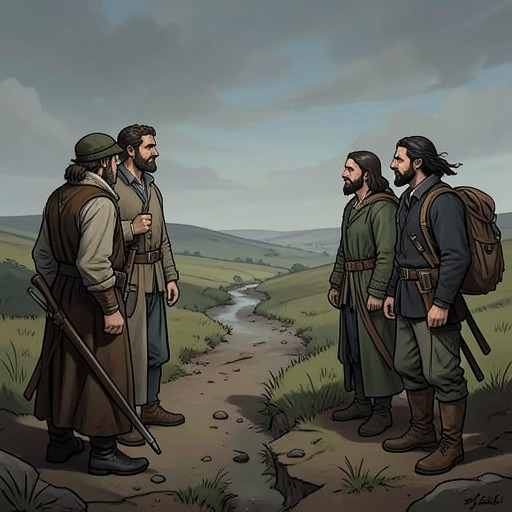
Northern Song
Demi-Gods and Semi-DevilsThe Northern Song is the southern state at the center of the book’s border conflict with Liao and a lasting point of reference in Xiao Feng’s divided identity. Its people share his language and customs, yet its soldiers also raid Khitan communities; as a result, the conflict between the two states becomes inseparable from his questions about kinship, loyalty, and the human cost of political boundaries.
Historical and Political Setting
In the account of the earlier attack at Yanmen Pass, Dali’s interest in the Northern Song is presented as a matter of survival as well as alliance. Madam Ma recounts that Elder Xu regarded the Song as Dali’s northern barrier: if the Khitan destroyed the Song, Dali might be the next target. This strategic dependence explains why Duan Zhengchun, though a prince of Dali, joined the Central Plains fighters who went to intercept the Khitan force. The defense of the Song frontier thus also served Dali’s security.
The account of Liao’s succession crisis places the conflict within a longer political history. After YeLu LongXu designated his elder son YeLu ZongZhen as successor, their mother favored the younger YeLu ZhongYuan, but ZhongYuan disclosed her plan to his brother and supported him instead. ZongZhen later made ZhongYuan next in line, yet after ZongZhen’s death the throne passed to his son YeLu HongJi. HongJi compensated his uncle with rank and authority, while giving ZhongYuan’s son YeLu NieLuGu command of the Southern Chancellery. These inherited claims and appointments help explain how the rebellion could draw on both dynastic legitimacy and control of the military.
Territory also shaped the balance between the Song and Liao. The book traces Liao’s strategic advantage to the sixteen prefectures ceded by Shi JingTang in return for Liao’s support. Their position enabled Liao forces to penetrate southward while leaving the Song without comparable defensive strongholds. The narrative therefore connects present military vulnerability not only to commanders and armies but to earlier political concessions whose effects persisted across generations.
Border Warfare and Civilian Costs
The conflict is sustained through reciprocal raids rather than confined to formal battles. Liao troops, according to the account Xiao Feng hears, receive neither provisions nor wages from the state and are expected to obtain what they need by raiding neighboring lands. These expeditions, called Beating the Grass Valley, target people and goods across the borders. Song troops retaliate with raids of their own, called Beating the Standing Valley. The names differ, but the civilians caught in the cycle endure the same insecurity.
That pattern becomes immediate when Xiao Feng encounters a Liao unit returning with captives from near ZhuoZhou. The force includes hundreds of Song civilians, mostly young women, alongside plundered goods. When a commander offers captives and valuables to Xiao Feng in his capacity as Lord of the Southern Chancellery, the scene makes the customary violence of raiding a test of his new office. A woman from Zhang Village pleads to return to her parents, while the other captives kneel; one young man remains standing and asks to speak privately.
Xiao Feng releases the captives rather than accepting them as spoils. He tells them to move away from the frontier, warning that he may not be able to save them another time. Their fear reflects the vulnerability of poor border residents, who lack the wealth to secure their release if captured. The episode sets his personal judgment against a military economy that treats civilian lives and property as resources to be taken.
Xiao Feng and the Northern Song
The Song is not simply an enemy state in Xiao Feng’s thinking. He grew up in the south and, before his Khitan parentage was revealed, considered himself a citizen of the Song. At the same time, he recognizes the Khitan as his own people. When Jurchen and Khitan forces clash, he hesitates to harm his Khitan kin, even as he intervenes to protect the Jurchen with whom he has formed a friendship. His choices reveal the strain of belonging to communities divided by war rather than a settled allegiance to one side.
The captives sharpen that conflict. Xiao Feng reflects that he and the Song people speak the same language and eat the same food, and questions why people insist on separating Khitan, Song, Jurchen, and Korean communities into hostile groups. He recognizes the retaliatory logic by which one side raids while the other answers with killing and arson, and by which each condemns the other in dehumanizing terms. His decision to free the captives is a concrete refusal to treat their identity as a reason for their suffering.
The Northern Song’s significance therefore reaches beyond the history of a rival dynasty. It is the home Xiao Feng once believed was his, a strategic neighbor whose safety matters to Dali, and one participant in a border system that repeatedly harms civilians. These roles converge in his uneasy position between inherited identity and human obligation: he cannot erase the divisions among states, but he can refuse to reproduce their violence when the captives’ lives are placed in his hands.