Qiao Feng
Demi-Gods and Semi-DevilsQiao Feng, later known by his birth name Xiao Feng, is a martial hero whose discovery of his Khitan lineage does not resolve his divided belonging; it makes that conflict the measure of his choices. Raised in the Central Plains and once the leader of the Beggar Society, he is forced to see himself from the outside as well as from within: as a man of Khitan ancestry, as a figure condemned by people who once trusted him, and as someone who cannot ignore suffering simply because its victims belong to another people. His actions on the frontier repeatedly challenge the border logic that separates Han, Khitan, and Jurchen, even as family history, sworn loyalty, and political obligation pull him in different directions.
Identity and the Search for Origins
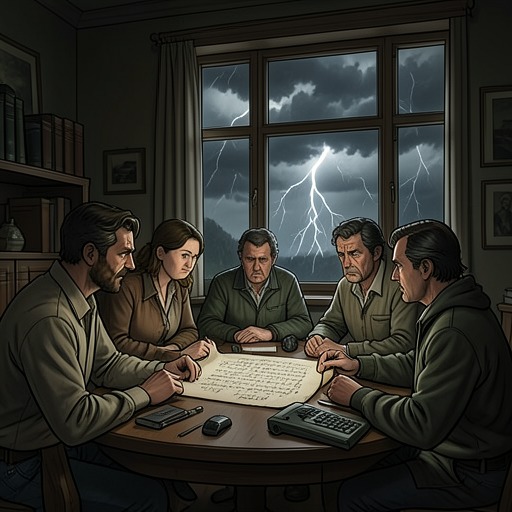
When Xiao Feng and A'Zhu reach Zhiguan Temple, they have disguised themselves to seek out Zhiguang. Before meeting the monk, Xiao Feng fears that the prime villain may have reached him first; seeing Zhiguang safe brings relief. The pair remove their disguises, and Xiao Feng bows to the monk, asking pardon for disturbing his secluded life. In that meeting, the search for the source of his misfortunes becomes a search for his own name.
Zhiguang tells him that he was originally surnamed Xiao. On the stone wall outside Yanmen Pass, Xiao Feng’s father had left a written account identifying himself as Xiao Yuanshan and addressing his son as Feng’er. The name Feng had been retained, but the child had been entrusted to Qiao Sanhuai for upbringing and therefore took his foster father’s surname. Xiao Feng had known he was Khitan, but had not known his father’s surname. The news leaves him shaken; when Zhiguang explains the link to Xiao Yuanshan, tears come to his face, and he rises to bow in gratitude.
The revelation gives his ancestry a political dimension as well as a family one. Zhiguang explains that Xiao was the surname of the Liao empresses, whose clan had long held influence through its place in the imperial court and its succession of generals and officials. Xiao Feng is thus connected not merely to Khitan identity in general, but to a powerful clan in Liao. After a long spell of disorientation, he turns to A'Zhu and declares that from then on he is Xiao Feng, not Qiao Feng. She accepts the change, addressing him as Great master Xiao. The naming is decisive, but it does not erase the years and relationships bound up with the name Qiao Feng.
A Life Imagined Beyond Jianghu
Zhiguang’s account of the past leaves Xiao Feng and A'Zhu with the sense that old wrongs cannot be undone by erasing the words on a cliff. After they leave, they discuss the writing Zhiguang left on the floor: Han and Khitan identity, they conclude, cannot by itself determine a person’s worth; kindness, enmity, honor, and disgrace are ultimately dust. A'Zhu proposes that Xiao Feng leave the Central Plains behind and live beyond Yanmen Pass, hunting and tending cattle and sheep rather than remaining entangled in Jianghu disputes.
Xiao Feng admits that he is tired of struggling for survival at the points of sabers. He imagines a quieter northern life of riding, hunting, and release from worry, then asks whether A'Zhu will come to see him after his return beyond the Great Wall. Her answer makes the proposal a shared future: he may ride and hunt, while she tends the cattle and sheep. Having crossed thousands of li with him, from pursuing him beyond Yanmen Pass to accompanying him through Weihui, Tai'an, and Tiantai, she now makes clear that she wants to live with him there and not return to the Central Plains.
Xiao Feng understands what her words mean and takes her hand. He asks whether she would reject him because of his Khitan origin. A'Zhu answers that Han and Khitan are both human and neither is higher or lower; choosing to be with him is her own desire. His response is joyful, but the exchange also sets a standard against which later decisions can be measured: the life he longs for depends on treating identity as no bar to affection, and on being able to leave the violence and obligations that keep drawing him back.
That hope does not extinguish his pursuit of the man he believes responsible for his suffering. When he and A'Zhu consider how to uncover the truth from Madam Ma, he accepts A'Zhu’s proposal to trick her rather than extort an answer himself. He explains that he has long wanted to kill his father’s prime murderer. Learning his true origin should have made him grateful to the person who exposed it, because the revelation told him who his ancestors were. Instead, he believes that the same enemy killed his foster parents and his master, forced him to harm friends, and left him infamous and hated by the heroes of the world. Only after capturing the culprit, he says, could he feel at ease enough to ride, hunt, and herd cattle and sheep with A'Zhu. Revenge therefore remains bound to the pastoral future: it is both an obstacle to that life and, in his mind, a necessary reckoning before it can begin.
Crossing Divided Communities
In the Jurchen chief Helibu’s encampment, Xiao Feng is received as an honored guest despite the war between Jurchen and Khitan. Helibu has eleven sons, all described as capable, and Aguda is his second son. A Han trader, Xu Zhuocheng, acts as interpreter, while Aguda’s admiration for Xiao Feng helps secure the tribespeople’s welcome. Aguda gives up his own tent for Xiao Feng and A'Zi, and the Jurchen hold a feast in their honor. Their reception shows that hostility between peoples is not absolute: respect for an individual hero can create welcome where a political border would predict enmity.
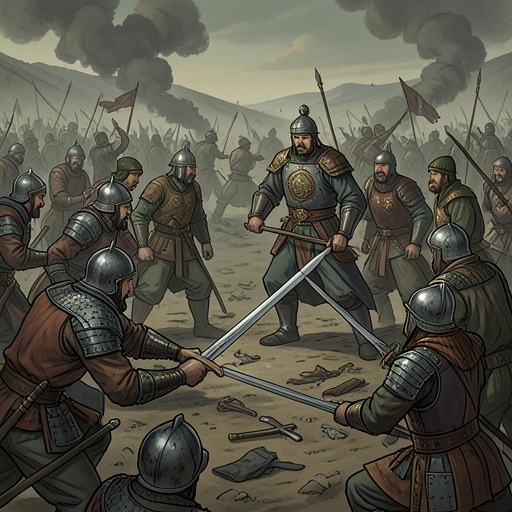
The reversal is immediate when a hunting party encounters Khitan riders. As arrows are loosed at the Jurchen, Xiao Feng recognizes the Khitans as his own people and feels an intimate attachment to them; when Aguda retreats, he initially stays to observe. After an old Jurchen hunter is killed, he intervenes without turning on either side wholesale. He disarms two Khitan riders by taking their spears and knocking them from their horses, then helps Aguda’s men escape when the Khitan force presses its advantage. In the retreat, he uses a bow to shoot four Khitans in the shoulder or foot, bringing them down without killing them. His choices do not dissolve the conflict, but they distinguish stopping an attack from seeking slaughter, even when those attacking are his own tribesmen.
The episode makes the difficulty of his position concrete. Loyalty of birth draws him toward the Khitans; gratitude and fellowship draw him toward Aguda and the Jurchen. He cannot simply claim one side without confronting the other, and he does not treat ethnic affiliation as permission to kill. The scene’s restraint anticipates his later response to raids: his compassion is expressed not only in what he refuses to do, but in the lives he chooses to spare.
Political Allegiance and the Liao Rebellion
The history of the Liao succession provides the background to a later conflict of loyalty. Xiao Feng’s account of the dynasty’s past traces the struggle through the sons of YeLu LongXu: ZongZhen, the elder son chosen to succeed, and ZhongYuan, his younger brother, who was favored by their mother, the empress. ZhongYuan could have accepted the throne with the empress’s support, but the scheme was thwarted after ZongZhen informed his brother; ZongZhen later made ZhongYuan the royal emperor brother and next in line. Yet after ZongZhen’s death, the throne passed to his son YeLu HongJi rather than ZhongYuan.
HongJi attempted to compensate his uncle for that succession by conferring the title of royal emperor uncle, placing him next in line, and appointing him commander of the entire army. He also gave military authority in the Southern Chancellery to ZhongYuan’s son YeLu NieLuGu, Prince of Chu. The arrangement left the emperor’s uncle and cousin with exceptional power, while HongJi’s trust in his uncle shaped the crisis that followed. When a scout reports that NieLuGu has proclaimed ZhongYuan emperor, the edict denounces HongJi as a usurper and presents ZhongYuan as the legitimate ruler. HongJi burns it, but recognizes the danger: an appeal to legitimacy could weaken loyalty in the army, and his uncle could command far more forces than the roughly one hundred thousand troops with HongJi.
Xiao Feng’s own obligations sharpen when HongJi, his sworn brother, appoints him to high office. Xiao Feng would prefer to leave with A'Zi rather than take up an official post, but he cannot walk away while his sworn brother is in danger. He considers serving for a time and resigning later, because refusing immediately would seem to repay HongJi’s trust with disloyalty. His hesitation is not a simple contest between private desire and public duty: it is a collision between reluctance to serve a state whose wars trouble him, attachment to a sworn brother, and the autonomy he hopes to recover.
Captives, Raids, and the Meaning of Belonging
The frontier’s violence becomes personal when Xiao Feng encounters a Liao detachment returning with hundreds of captives from Song territory. The party includes about eight hundred soldiers and roughly seven or eight hundred captives, mostly young women and some boys, alongside goods taken in the raid. Its captain treats the captured people and possessions as offerings for the newly appointed Prince of Chu. Xiao Feng sees their distress and asks where the raid took place. A girl from Zhang Village kneels and begs to be released to her parents; the other captives follow her example, while one youth remains standing and asks to speak privately about a secret.
The sight recalls the other side of the border: at Yanmen Gate, Xiao Feng had seen Song soldiers capture Khitan civilians. The Liao practice of taking supplies from neighboring peoples is called Beating the Grass Valley, while retaliatory Song raids are called Beating the Standing Valley. The names do not change what the practice is: civilians near the borders live under recurring threat, and people without wealth may have no means of buying their freedom. Xiao Feng has already regarded the system as cruel and immoral. Now the captives stand before him not as an abstraction about military supply, but as people whose fate he can affect directly.
When he learns that earlier Prince of Chu raids had included using Song captives as live targets, he is appalled. He looks south and thinks through the terms used to divide the peoples: each side raids the other, each curses the other with an animal insult, and each claims a distinction that cannot make the victims less human. If his parentage had never been revealed, he reflects, he would still have thought of himself as a citizen of Great Song. The question is not whether he has a Khitan ancestry or a life among Han people; it is why either identity should excuse one people’s violence against another.
After the raiding soldiers leave, Xiao Feng tells the captives he will release them and urges them to run. At first they hesitate, suspecting that they are being made to flee before being shot. He warns them that they should move farther from the border, since he may not be able to save them next time. Only then do they believe him. Their gratitude makes the consequence of his choice plain: he has used his authority not to accept the captives as spoils, but to return poor civilians to their families, even though they belong to the people his empire is fighting.
Significance and Unresolved Allegiance
Across these episodes, Xiao Feng’s changing name and changing political position never produce a settled identity. The revelation of Xiao Yuanshan links him to a powerful Khitan clan; his upbringing ties him to the Central Plains; and his relationships create loyalties that cross those inherited boundaries. His wish to leave Jianghu with A'Zhu expresses the possibility of a life outside the cycle of vengeance, but his search for the prime murderer and his later duty to HongJi repeatedly draw him back into conflict.
His conduct on the frontier offers no easy reconciliation between communities. He does not cease to recognize the Khitans as his own people, nor does he abandon the Jurchen who have treated him as a guest. In the fighting, he restrains rather than kills; in the raid aftermath, he releases Song captives rather than accepting them as the spoils of Liao warfare. The through-line is not the denial of his different affiliations, but his refusal to let them cancel the humanity of people on the other side. That refusal gives his divided belonging its ethical force, even as revenge, brotherhood, and political office leave the peaceful future he imagines unresolved.