The Dali succession struggle
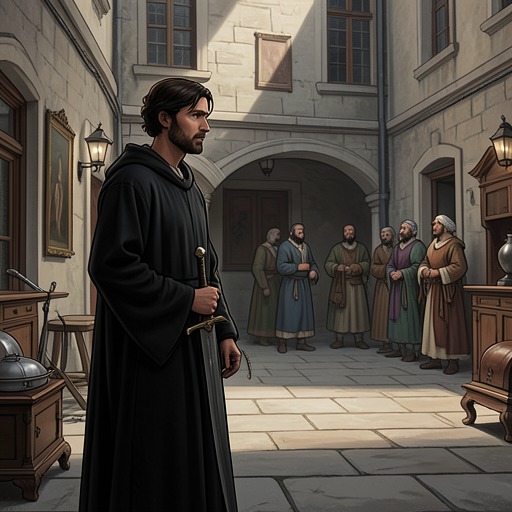
Demi-Gods and Semi-DevilsThe Dali succession struggle is a contest between Duan Yanqing and Duan Zhengchun for the throne, fought in the name of the Duan family’s own martial tradition. It is not presented as a private feud: the rivals’ choice of combat is shaped by the need to make a political victory appear legitimate to Dali’s officials, while the family history behind Liao’s later succession crisis offers a pointed parallel in how dynastic decisions continue to shape the present.
The Dali Claim and Its Stakes
Duan Zhengchun frames the confrontation as a contest between the two of them, asking that Duan Yanqing’s quarrel not be visited upon Ruan Xingzhu, A'Zi, Fan Hua, or the other people with him. He recognizes that Duan Yanqing’s skill makes his own death a real possibility, but seeks to spare those around him. Duan Yanqing rejects the separation between family and political consequences: he argues that the earlier ruler’s failure to kill Duan Zhengchun and his brother created the conditions for the current usurpation and rebellion.
The struggle is therefore bound to competing judgments of past rule. Duan Yanqing invokes an earlier act of mercy as a political mistake that enabled his present claim; Duan Zhengchun answers by standing to face him and defending the conduct of the Duan house. His appeal to benevolence and righteousness is accompanied by a practical act of protection: he wants the dispute to remain between the rival claimants rather than engulf his companions.
The Duel as a Test of Legitimacy
Duan Zhengchun challenges Duan Yanqing to fight him without outside interference, and Duan Yanqing accepts the terms. Before the duel, Duan Zhengchun salutes the body of Chu Wanli and declares that he will face the enemy alongside his dead companion. He also asks Fan Hua to arrange for his grave and Chu Wanli’s to lie side by side, without a distinction between master and vassal. These gestures express a conception of loyalty that sits uneasily beside the formal hierarchy of the state.
The combat is conducted with the Duan family’s inherited swordsmanship. Duan Zhengchun opens with a sword stance, while Duan Yanqing uses his iron canes as though they were swords. Both know the family art; Duan Yanqing’s use of it is deliberate. Because the officials of Dali are present, he reasons that defeating Duan Zhengchun through unorthodox methods would invite their disapproval. A victory with the family’s orthodox swordsmanship, by contrast, would be defensible before the court and leave less room for dissent if he later took the throne.
The fighting style reinforces that political calculation. Duan Zhengchun executes the forms carefully, with steady footwork and balanced attack and defense. Duan Yanqing’s cane movements reproduce the family sword art on a broader, more expansive scale, retaining its speed and elegance while projecting royal dignity. The duel is thus both a martial contest and an argument over who can claim the family’s traditions as a legitimate basis for rule.
A Parallel in Liao’s Succession History
The novel later sets out an earlier Liao succession crisis that clarifies how dynastic claims can persist across generations. The Holy Emperor designated his eldest son, YeLu ZongZhen, to succeed him, although the empress favored his second son, YeLu ZhongYuan, and schemed to place him on the throne. YeLu ZongZhen learned of the plan and informed his brother; the scheme failed, and he later rewarded ZhongYuan by making him the royal emperor brother and next in line to succeed.
When YeLu ZongZhen died, however, the throne passed to his son YeLu HongJi rather than to ZhongYuan. Once enthroned, YeLu HongJi tried to compensate his uncle with the title of royal emperor uncle, succession priority, supreme command of the army, and exceptional court privileges. He also granted ZhongYuan’s son, YeLu NieLuGu, the title of Prince of Chu and control of the Southern Chancellery’s military affairs. The settlement preserved ZhongYuan’s prestige and power, but left the succession claim and the command of armed force closely intertwined.
The consequence emerges when YeLu HongJi receives an edict declaring him a false emperor and naming ZhongYuan the legitimate ruler. YeLu NieLuGu’s rebellion turns the inherited dispute into a military crisis: HongJi is outnumbered, while his uncle’s command and his cousin’s office give their side formidable authority. The account therefore presents succession not as a question settled by genealogy alone, but as a continuing struggle over recognition, office, and the capacity to command.
From Family Conflict to State Power
The Liao crisis also shows how a personal bond can intervene in a contest for rule. When YeLu HongJi’s position is restored, he embraces Xiao Feng and offers to share his realm with him. Xiao Feng urges him to pardon ZhongYuan, judging that mercy will help settle the rebels’ morale. HongJi follows this advice and appoints Xiao Feng Prince of Chu and Lord of the Southern Chancellery, the very title and office associated with the defeated rebellion’s leadership.
Xiao Feng does not welcome the appointment as a prize. He tells HongJi that he did not seek rank and asks him to withdraw the order, but HongJi insists on honoring their sworn brotherhood. The appointment changes the scale of Xiao Feng’s obligations: HongJi later instructs him to base himself in Nanjing and prepare for a possible campaign against the Song. Xiao Feng accepts the command while inwardly reluctant to wage war against the land where he grew up.
The Dali duel and the Liao rebellion are distinct conflicts, but both make the succession question larger than a single claimant’s ambition. In Dali, family martial arts are used to make a prospective victory acceptable to officials; in Liao, a settlement of titles and succession rights leaves military authority concentrated among relatives and becomes part of the next crisis. Across both accounts, rule depends not only on who can claim the throne, but on whether that claim can be made credible to the people whose allegiance sustains it.