Tiger
Demi-Gods and Semi-DevilsTigers are more than background wildlife in Xiao Feng’s northern journey: they become quarry, a measure of human courage, and a means of keeping A'Zi alive. The contrast between a young girl’s casual cruelty toward fish and Xiao Feng’s practical use of a tiger’s blood and meat gives these encounters a varied ethical texture; the animals are formidable in their own right, but the story also shows how human need and display determine their fate.
Animals in the story
A tiger first enters the story through a strikingly different encounter with A'Zhu and a young girl. The girl dismisses angling as dull, takes a fisherman’s rod, and repeatedly thrusts it into the water, spearing six fish before flinging them back into the lake. Xiao Feng notices the neat, attractive movement of her hand, yet judges it too slow for combat. The fisherman, meanwhile, objects that the fish were killed without being used for food. This scene establishes a distinction between skill and purpose: an action can be deft, but its purpose still matters.
Later, the tigers are not caught as a sport. Lost in a snowy forest and carrying an unconscious A'Zi, Xiao Feng has gone three days without food. He makes a fire, eats more than twenty fungi, and hears two tigers approaching while someone pursues them. Hoping the encounter will provide food, he leaves A'Zi beside the fire and runs toward the commotion. The immediate circumstances turn the tiger hunt into a matter of survival, although its danger is clear from the outset.
The two-tiger hunt
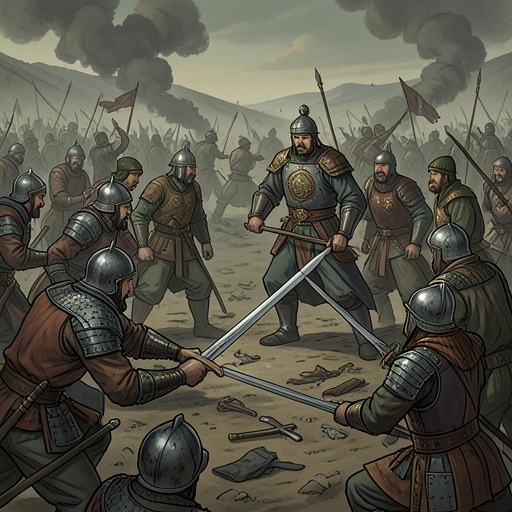
After running more than ten li, Xiao Feng finds a hunter in animal-hide clothing facing two tigers with a large iron fork. One tiger evades the fork aimed at its throat, and the second closes in as well. The hunter responds quickly, striking one tiger with the fork’s handle and driving it off, but Xiao Feng judges that the man’s knowledge of animal behavior may not be enough to kill both. The encounter presents the hunter as capable and experienced without making him a martial artist.
Xiao Feng calls out that he will help, then meets the first tiger bare-handed. His initial palm strike knocks it over, but does not stop it from charging again. He strikes its flank, catches its tail with both hands, and pulls against its forward rush, hurling it into the air. As the tiger comes down, he uses his Twin Palm Parting Cloud technique against its belly, killing it. The sequence makes the tiger’s strength legible through the force Xiao Feng must use: even a palm strike powerful enough to overwhelm an exceptional martial artist only stuns the animal at first.
The hunter meanwhile continues fighting the second tiger. After repeated thrusts fail to settle the struggle, he dodges its attack and drives the iron fork into its forehead, pinning it to the snow. His clothing splits across the upper back as he exerts himself. Once both animals are dead, the hunter and Xiao Feng exchange approving gestures and praise despite being unable to understand one another’s speech. The shared danger, rather than a common language, provides the basis for their first rapport.
Food, medicine, and hospitality
The hunter identifies himself by name as Wanyan Aguda and says that he is Jurchen; Xiao Feng gives his own name and identifies himself as Khitan. Although the Jurchen and Khitan are at war, Aguda’s people admire accomplished heroes. With Aguda’s support, Xiao Feng is welcomed rather than treated with hostility. The two men bring the dead tigers back to A'Zi, who is too injured to travel independently.
Xiao Feng opens one tiger’s throat and gives its still-fresh blood to A'Zi, who is able to swallow about ten mouthfuls. He then tears off two tiger legs and roasts them over the fire. The meat feeds Xiao Feng and Aguda, while the blood serves the immediate purpose of sustaining A'Zi. Aguda watches Xiao Feng tear the animal apart with his bare hands and is astonished by his strength. The tiger thus links practical care for an injured companion with the display of physical power that earns Xiao Feng admiration.
Aguda offers Xiao Feng his own tent, and the Jurchen hold a feast at which the two tigers’ meat is served. Xiao Feng drinks more than ten bags of their strong wine without showing its effects, further impressing a people who associate drinking capacity with heroism. During the following months, he hunts with Aguda, learns Jurchen and Khitan, and gathers valuable ginseng for A'Zi. His care for her continues alongside the friendship that began over the tigers.
Later uses and meanings
The tiger remains part of the Jurchen account of hunting and healing. Early in summer, Aguda invites Xiao Feng and a dozen tribesmen north to hunt bears, explaining that bear fat and paws are valued and that bear gall can treat injuries. This later expedition shows the broader setting in which animals are pursued for food and medicinal use. The tigers’ role in the earlier episode is similar in practical terms, but more immediate: their blood and meat answer the needs of the moment when Xiao Feng is lost in a blizzard with A'Zi.
The novel also returns to the tiger as an object of spectacle and threat. In a palace scene, A'Zi proposes that You TanZhi test whether the iron mask on his head can withstand a lion’s bite, presenting the captive animal as an instrument in her cruel test of his obedience. This is not a tiger episode, but it echoes the earlier use of powerful animals to measure or display human endurance. Taken together, the encounters resist a single symbolic meaning: the fish speared for amusement are rebuked as needless killing, the tigers are hunted for food and care, and the caged lion is made part of a coercive spectacle.
Later uses and meanings
The tiger remains part of the Jurchen account of hunting and healing. In early summer, Aguda invites Xiao Feng and a dozen tribesmen north to hunt bears, explaining that bear fat and paws are valued and that bear gall can treat injuries. This later expedition places the earlier tiger hunt within a broader practical relationship with wildlife: animals are pursued for food and medicinal use, while the tiger’s blood and meat had answered an immediate need when Xiao Feng was lost in a blizzard with A'Zi.
The novel also returns to the tiger as an object of spectacle and threat. In a palace scene, A'Zi proposes that You TanZhi test whether the iron mask on his head can withstand a lion’s bite, using the caged animal to test his obedience. Though this is not a tiger episode, it recalls how powerful animals become measures of human endurance. Across these scenes, the animals’ roles differ: the young girl’s fish are killed without purpose and the fisherman objects, the tigers are hunted to sustain and shelter people, and the caged lion is made part of a coercive display.
Food, medicine, and hospitality
Xiao Feng brings the dead tigers back to A'Zi, who is too weak to travel independently. He opens one tiger’s throat and gives her its blood; she manages about ten mouthfuls. He then tears off two legs and roasts them over the fire. The blood helps sustain A'Zi, while the meat feeds Xiao Feng and Wanyan Aguda. Seeing Xiao Feng tear apart a tiger with his bare hands, Aguda stares at his strength in amazement. The animal becomes both practical sustenance for the injured girl and the occasion for Xiao Feng’s prowess to be recognized.
Aguda gives Xiao Feng his own tent, and the Jurchen welcome him with a feast featuring the two tigers’ meat. Xiao Feng, who has gone more than half a month without wine, drinks over ten bags of the tribe’s potent wine without any visible change in his complexion. The Jurchen regard drinking capacity as a mark of a true hero, so the feast extends the admiration first earned through the hunt. In the months that follow, Xiao Feng hunts with Aguda, learns Jurchen and Khitan, and gathers prized ginseng for A'Zi. His ongoing care for her develops alongside the hospitality and friendship that began when he joined the hunt.
Hunting, care, and the Jurchen welcome
The two dead tigers connect Xiao Feng’s urgent care for A'Zi with the friendship he forms with Wanyan Aguda. Xiao Feng opens one tiger’s throat and gives its blood to A'Zi, who can swallow about ten mouthfuls; he then tears off two legs and roasts them over the fire. The blood and meat answer immediate needs, while Aguda’s astonishment at Xiao Feng’s strength turns the practical work of dressing the animal into another sign of his prowess.
Aguda leads Xiao Feng, carrying A'Zi and a tiger, through the blizzard toward the Jurchen encampment. The Jurchen welcome him as an honoured guest despite the war between their people and the Khitans, in part because Aguda praises him and they admire heroes. Aguda gives up his tent for Xiao Feng and A'Zi, and the tribe holds a feast at which the two tigers’ meat is served. Xiao Feng drinks more than ten bags of strong Jurchen wine without any visible change in his complexion, impressing a community that regards drinking capacity as a measure of heroism. The hunt therefore yields more than food: it begins a bond of hospitality and mutual admiration.
During the following months, Xiao Feng hunts with Aguda while learning Jurchen and Khitan, and he gathers valuable ginseng for A'Zi. Her condition improves, though she remains weak and dependent on his care. The tigers’ place in this episode is consequently practical rather than merely emblematic: their meat sustains the men, their blood helps A'Zi, and the encounter that brings them down opens a path through the snow to a welcoming community.