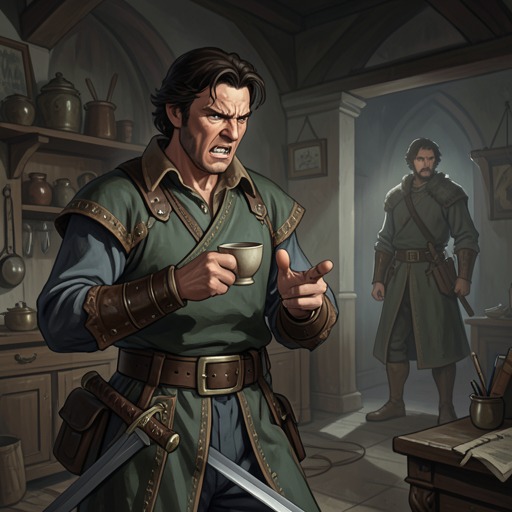
Vengeance
Demi-Gods and Semi-DevilsVengeance is both a motive and a destabilizing force in the novel: Xiao Feng pursues the person behind the deaths of his parents, yet his search implicates other people, deepens his isolation, and forces him to weigh private justice against loyalty and public duty. The pursuit is not simply a march toward a named enemy. It is a struggle to distinguish the actual culprit from those caught in the history of the crime, while deciding what kind of life can follow once the grievance is answered.
The Search for the Prime Culprit
Xiao Feng’s investigation turns on a letter connected to the former Beggar Society chief Wang Jiantong. He asks Grandpa Tan who wrote it, treating the answer as a route toward the person who killed his father. Grandpa Tan refuses to identify the writer, arguing that disclosure would expose his friend to Xiao Feng’s revenge. Xiao Feng presses him by invoking the danger to Granny Tan’s reputation, showing how the search can make other people’s attachments and vulnerabilities part of its leverage.
The deaths of Grandpa Tan, Granny Tan, and Zhao Qiansun leave the investigation more urgent but do not resolve it. A'Zhu assumes at first that Xiao Feng killed them; he denies it and says he does not know who did. He believes only three people who know the prime culprit remain alive, and fears that the enemy will keep getting ahead of them. Rather than force a widow to speak, he and A'Zhu decide to seek information from the Shan family in Tai'an. Their hurried departure makes vengeance a continuing pursuit: each failed lead creates pressure to move before the next clue disappears.
When Xiao Feng later asks Zhiguang who the “leading big brother” was, the question reaches back to the incident that set his life on this course. Zhiguang explains that the man involved had disappeared after the truth came out, and that three decades had passed. Xiao Feng thanks him for explaining the cause and aftermath, saying that the knowledge has made him a new man, but immediately asks for the leading big brother’s identity. Understanding the old crime has changed his view of himself without extinguishing the demand to know who was responsible.
A'Zhu’s Assistance and the Costs of Revenge
A'Zhu helps Xiao Feng pursue the answer while recognizing limits he places on his own conduct. He says that, as a hero, he cannot extort the truth from Madam Ma; A'Zhu proposes that she use her disguise skills to draw it out instead. The distinction does not end the pursuit, but redirects it from direct pressure by Xiao Feng to a stratagem devised by his companion.
His stated purpose is intensely personal. Xiao Feng says he has long hoped to kill his father’s prime murderer, even though that person’s exposure of his Khitan ancestry had revealed his origins. He cannot reconcile that disclosure with the alleged killing of his foster parents and master, and with the disgrace and hostility he has endured. He imagines that killing the culprit would let him find peace and leave with A'Zhu to live beyond the Great Wall, herding cattle and sheep. A'Zhu, by contrast, hopes that capturing the culprit could also permit a public banquet at which Xiao Feng’s wrongs are explained and his reputation restored.
Xiao Feng rejects that public vindication as his goal. After the bloodshed at Juxian Manor, he says he does not expect forgiveness from the heroes of the world; he wants the matter ended so that he and A'Zhu can leave the Central Plains behind. The contrast reveals two possible consequences of solving the case: A'Zhu imagines a return to public standing, while Xiao Feng seeks release from the society that has condemned him. Vengeance promises an end to the pursuit, but not a return to his former place within the Jianghu.
The plan to find the culprit also expands into several linked grievances. Xiao Feng insists that he must avenge not only his birth parents but also his foster parents, Old Master Qiao and Old Madam Qiao, and Venerable Xuan Ku. He strikes the table as he acknowledges that there is more than one score to settle. The multiplication of losses makes revenge difficult to contain: resolving one accusation cannot by itself answer the harm he associates with the others.
Strategy, Risk, and the Unfinished Feud
A'Zhu warns that an attempt to confront the Duan Clan in Dali alone would be dangerous. Xiao Feng replies that he can wait three to five years, or even eight to ten, if necessary, because he believes time may eventually give him an opportunity against Duan Zhengchun. His confidence in patience does not soften his resolve; he says his own death matters less than failing to avenge his parents. At the same time, he takes A'Zhu’s hand and recalls their promise to herd cattle and sheep beyond Yanmen Pass. The desired future is therefore present within the revenge plot as a fragile alternative to it, dependent on his survival and on the feud’s eventual conclusion.
A'Zhu urges planning rather than immediate action, arguing that a smaller party need not accept defeat if it can use its wits instead of force. Xiao Feng agrees that strategy may be necessary when direct strength cannot prevail, and declares that he will not live under the same sky as his parents’ killer. His readiness to disregard Jianghu custom in settling that account marks how vengeance strains the ideals by which he is otherwise judged. The search is at once an attempt to establish responsibility and a declared willingness to use whatever means he thinks necessary.
History, Succession, and the Political Parallel
The account of Liao’s royal succession supplies a political parallel to the personal grievance. The Holy Emperor designated his eldest son, ZongZhen, as successor, but the empress favored her second son, ZhongYuan, and sought to place him on the throne. ZongZhen warned his brother of the scheme; ZhongYuan supported him instead, and ZongZhen later made him the next heir. Yet after ZongZhen’s death, the throne passed to his son HongJi rather than to ZhongYuan.
HongJi subsequently gave ZhongYuan the title of royal emperor uncle and placed him next in line, while also giving him command over the army and exceptional court privileges. ZhongYuan’s son NieLuGu became Prince of Chu and controlled the Southern Chancellery’s military affairs. The arrangement concentrated power in the family of a potential successor even as HongJi relied on his uncle’s loyalty. When NieLuGu’s rebellion begins, the emperor fears that ZhongYuan may support his son; a scout then reports that NieLuGu has proclaimed his father emperor and denounced HongJi as a false ruler. The old succession dispute thus returns in altered form, with a contested claim becoming the justification for renewed conflict.
This political history does not establish a simple equivalence between Xiao Feng’s private pursuit and the rebellion. It does, however, show how unresolved claims and inherited arrangements can carry past conflict into the present. In Liao, HongJi’s concessions have made ZhongYuan powerful enough that family loyalty and imperial security collide. In Xiao Feng’s life, the effort to identify the person responsible for an old crime likewise keeps the past active, shaping present choices and relationships.
The Limits of Personal Vengeance
After helping HongJi suppress the rebellion, Xiao Feng is appointed Lord of the Southern Chancellery and ordered toward a campaign against the Song. His response exposes a conflict that revenge alone cannot resolve: he is a citizen of Liao, but he grew up in the south and is reluctant to take part in an attack on the Song. He considers delaying his resignation because leaving at once could injure the bond with his sworn brother, the emperor. The question before him is no longer only how to answer a family grievance, but how to act when political obedience, personal loyalty, and attachment to the land where he was raised pull in different directions.
The novel also makes the wider military consequences legible through geography and history. Liao’s possession of the sixteen prefectures, ceded after Shi JingTang sought Liao’s support, gives its forces strategic positions for attacks into Song territory. The Song has tried for generations to recover the region without success, and the account attributes Liao’s advantage to those positions rather than simply to superior soldiers or equipment. Vengeance belongs to this larger landscape of remembered injury and contested claims, but the political history warns against treating force as a clean settlement: an inherited grievance can harden into institutions, territorial control, and another generation’s conflict.
Across these strands, vengeance supplies momentum while refusing to promise uncomplicated repair. Xiao Feng’s search begins with a demand for the truth about his parents, gathers the losses of his foster parents and master, and coexists with the hope of a life with A'Zhu beyond the pass. The rebellion narrative broadens the pattern from private retaliation to succession and state power. In both, the past presses upon the present; yet the evidence of that pressure does not guarantee that vengeance can restore what was lost or settle every claim it awakens.