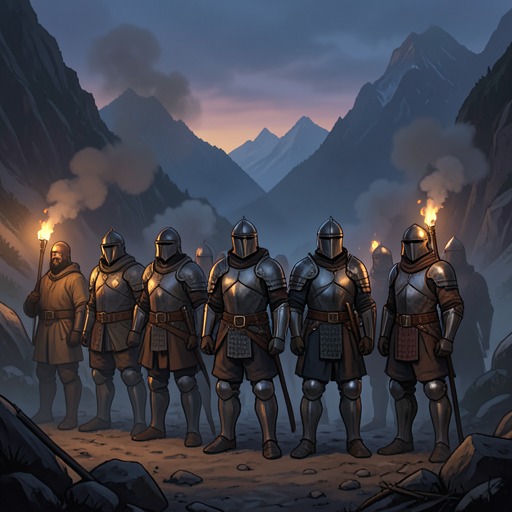
Xiao Feng and Xiao Yuanshan
Demi-Gods and Semi-DevilsXiao Feng and Xiao Yuanshan are father and son, separated when Xiao Feng was an infant and reunited in knowledge only through the testimony and surviving words of others. Their relationship is decisive to Xiao Feng’s understanding of his birth: his father’s inscription identifies him as Feng’er, gives the reason he was raised under another surname, and reveals that the violence at Yanmen Pass arose from a grave mistake rather than the raid the attackers believed they were confronting.
Identity and separation
At the time of the attack at Yanmen Pass, Xiao Yuanshan and his wife were travelling with their son, who was one year old. Because Xiao Feng had been entrusted to Qiao Sanhuai for upbringing, he was given the Qiao surname. The truth of his biological descent remained unknown to him until Zhiguang explained that his father had left an inscription on the cliff under the name Xiao Yuanshan, addressing the child as Feng’er.
The revelation changes Xiao Feng’s identity in a single conversation. With tears on his face, he rises to thank Zhiguang for telling him his father’s surname and bows to him. He then declares to A'Zhu that from that point on he is Xiao Feng, not Qiao Feng. The change does not erase his upbringing under Qiao Sanhuai, but it makes his paternal name and Khitan ancestry part of his conscious identity.
The inscription and its recovery
Xiao Feng had gone to the site outside Yanmen Pass, but the words carved into the rock had already been completely scraped away. Zhiguang therefore gives him a rubbing made from pieces of cloth stitched together. The writing is in Khitan, its strokes forceful and unfamiliar to Xiao Feng, who asks Zhiguang to interpret it. The material object preserves the father’s account after the original inscription has vanished, turning a lost mark on a cliff into the means by which the son can learn what happened.
The inscription says that Xiao Yuanshan and his wife were on their way to visit his mother-in-law when they encountered men from the Southern Dynasty. Xiao Yuanshan records that his wife was killed and that, in the ensuing violence, he killed more than ten Han people. He had previously vowed before his martial arts master, a Han man from the Southern Dynasty, never to kill Han people. His words present grief over his wife and shame at breaking that vow as intertwined causes of his despair.
A fatal misunderstanding
Zhiguang explains that the attackers had originally believed Xiao Yuanshan was leading Khitan warriors to Shaolin Monastery to seize Buddhist scriptures. The inscription persuaded them that this was a misunderstanding: Xiao Yuanshan had been travelling with a woman who knew no martial arts and a baby barely over a year old, circumstances inconsistent with the supposed raid. Their inquiry traced the claim about a Shaolin attack to an ignorant person who had deliberately deceived the man called the Leading Big Brother, sending him on a long journey to make a fool of him.
The correction comes too late to undo the deaths. Zhiguang laments that the writing could be erased but the several dozen people killed could not be brought back. In receiving the rubbing, Xiao Feng learns not only who his father was but also that the violence at Yanmen Pass began with false information and ended in irreversible loss. The relationship is therefore marked by a truth recovered after the chance for direct reunion has passed.
Inherited loyalties and the living son
The inscription also explains why Xiao Yuanshan’s death was not caused by bereavement alone. Xiao Feng understands that his father had jumped from the cliff in grief over his wife and from shame at having violated his vow against killing Han people. The father’s account preserves a conflict between ethnic affiliation and a personal moral commitment: Xiao Yuanshan was Khitan, yet had sworn loyalty to a Han teacher, and the retaliatory killing left him unable to reconcile his action with that promise.
For Xiao Feng, receiving this account is an act of recognition without any exchange between father and son. His father’s own words supply the missing history, while the new name makes that history present in the son’s life. Their bond thus reaches him through both kinship and an inherited ethical burden: Xiao Feng learns his ancestry at the same moment he learns how grief, mistaken judgment, and a broken vow shaped his father’s final choices.
Political echoes of family and succession
The book places this intimate revelation beside accounts of political inheritance in the Liao court. Xiao Yuanshan’s Khitan identity belongs to a wider world in which clan affiliation and imperial authority affect allegiance, while the story of the succession from YeLu ZongZhen to YeLu HongJi and the position of YeLu ZhongYuan shows how obligations within a ruling family shape later political choices. These histories do not establish a further personal encounter between Xiao Feng and his father; rather, they give the recovered paternal identity a broader setting in which descent and loyalty are consequential.
The consequences of dynastic decisions become concrete in the rebellion against YeLu HongJi. YeLu NieLuGu’s claim that his father, YeLu ZhongYuan, should rule draws upon an earlier succession crisis and the emperor’s subsequent treatment of his uncle as heir apparent and commander of the army. The contrast with Xiao Feng and Xiao Yuanshan is one of scale, not a direct equivalence: in both accounts, family ties meet public loyalties, but the surviving evidence of the father-son relationship is concentrated in an erased inscription, its cloth rubbing, and the son’s belated recognition of the name he inherits.