Xiao Yuanshan's letter on the stone wall of Yenmen Pass
Demi-Gods and Semi-DevilsXiao Yuanshan’s cliff inscription is the written testimony that reveals Xiao Feng’s Khitan birth and revises the story of the violence at Yanmen Pass. Preserved not on the cliff but in a cloth rubbing that Zhiguang gives to Xiao Feng, it records a mistaken attack, a father’s grief, and remorse over a vow broken in the confusion. The inscription changes the meaning of Xiao Feng’s origins and undermines the belief that Xiao Yuanshan had led a raid on Shaolin Monastery.
Origin and preservation
On the stone wall outside Yanmen Pass, Xiao Yuanshan left writing in which he named himself and addressed his infant son as Feng’er. Zhiguang explains that the inscription established the child’s paternal name, but the people who took the child entrusted him to Qiao Sanhuai to raise; accordingly, he grew up with Qiao’s surname. The writing thus connects the adult known as Qiao Feng to his Khitan father while preserving the circumstances behind his Han surname.
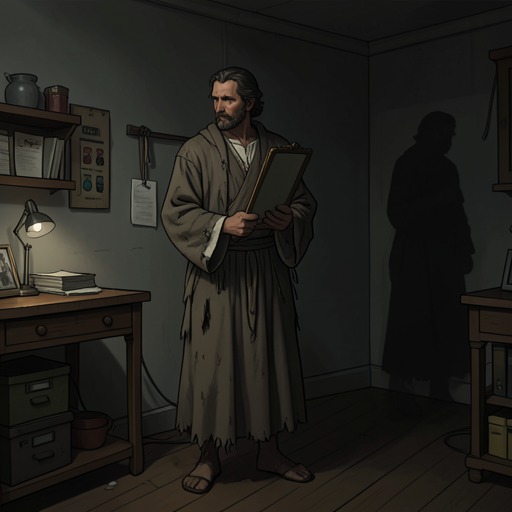
The original inscription was later scraped away, leaving no trace for Xiao Feng to read when he visited Yanmen Pass. Zhiguang has kept a rubbing instead, assembled from many scraps of cloth sewn together. Its words appear as white, hollow strokes, resembling Han characters but unintelligible to Xiao Feng until he recognizes that they are written in Khitan. He sees the strokes as forceful, like cuts from sabers and axes, and weeps over them before asking Zhiguang to interpret them. The physical survival of the account is therefore precarious: the cliff text has vanished, and its remaining witness is a handmade copy that depends on other people’s reading and translation.
What the inscription records
The translated account begins by establishing that Feng’er was one year old. Xiao Yuanshan says that he and his wife were travelling to his mother-in-law’s home for a banquet when they encountered men from the Southern Dynasty. In the attack, his wife was killed. The family journey and the child in his parents’ care contradict the later claim that Xiao Yuanshan’s party had set out to rob Shaolin Monastery.
The inscription also records the conflict between Xiao Yuanshan’s grief and his moral obligation. He writes that his martial-arts master was a Han from the Southern Dynasty and that he had vowed never to kill Han people. Yet during the attack he killed more than ten. He describes himself as ashamed and sorrowful, and says that after death he would have no face to meet his master. Zhiguang’s interpretation lets Xiao Feng understand that his father’s suicide followed not only the loss of his wife but also the violation of that vow and the shame attached to it.
The correction of an accusation
Zhiguang explains that the people involved initially believed Xiao Yuanshan was leading Khitan warriors to Shaolin Monastery to steal sutras. The inscription forced them to reconsider: a man supposedly conducting such a raid would have had little reason to bring a noncombatant wife and a baby just over a year old. They investigated the origin of the report and concluded that it had come from an ignorant person who deliberately misled the Leading Big Brother into travelling a great distance. The rubbing therefore serves as evidence against the explanation that had shaped the initial response to the attack.
The document does not restore those killed or undo the consequences of the mistake. Zhiguang acknowledges that the writing could be scraped from the rock, but the people who died could not be brought back. His words place the inscription’s power and its limit side by side: it can correct the record and expose the error, but it cannot reverse the violence that the error set in motion.
Transmission, interpretation, and limits
The rubbing reaches Xiao Feng through several stages of transmission. Zhiguang and others made the copy; Khitan speakers inside Yanmen Pass interpreted the text; and Zhiguang then reads that interpretation aloud to the man named in it. The copy preserves Xiao Yuanshan’s account, but Xiao Feng cannot read it unaided, and the people who interpret it acknowledge that their agreement makes their reading only probable rather than certain. The inscription is powerful evidence within the story, but it is not a direct, effortless disclosure: its script, preservation, and translation all mediate what its reader can know.
The novel also sets this apparently decisive record against later uncertainty about authorship. When Xiao Feng recalls the letter from the Apricot Forest addressed to Chief Wang, he distinguishes its angular, martial style from the elegant handwriting of Duan Zhengchun’s calligraphic scroll. He concludes that the writer of the letter and the writer of the scroll cannot be the same person, reopening the question of who the Leading Big Brother was. That later comparison concerns different documents, not the cliff inscription itself, but it extends the same narrative concern with what writing can establish: a text can preserve a crucial account, while its script, attribution, and interpretation remain matters that must be examined.
Significance
The inscription turns a lost family history into a material object Xiao Feng can receive. Learning the name of his father and the circumstances of the attack, he declares that he is Xiao Feng rather than Qiao Feng. His response joins personal recognition to political identity: the rubbing names a father and a people, while its account challenges the inherited story that had made the violence appear justified.
Its deepest reversal is ethical as well as factual. Xiao Yuanshan is not presented in the translated writing as a man carrying out the planned raid attributed to him, but as a bereaved father who has violated his own vow amid a disastrous misunderstanding. The inscription cannot erase the deaths or settle every later mystery, yet it gives the tragedy a surviving voice. A message cut from stone, lost from its original surface, and recovered through stitched cloth changes how the past is understood without making its losses reparable.