Yanmen Pass
Demi-Gods and Semi-DevilsYanmen Pass is both a strategic frontier and the place where the past that governs Xiao Feng’s identity is preserved and disclosed. The erased inscription on its cliff and the cloth rubbing kept by Zhiguang connect the pass to the mistaken attack on Xiao Yuanshan’s family; its military importance also frames the larger political and human consequences of conflict between Liao and Song.
A frontier crossed in secrecy
After Xiao Feng and A'Zhu leave the area, they travel south by a mountain ridge, bypassing Yanmen Pass and reaching a small town. Their route reflects the danger of being recognized: A'Zhu worries that pursuers may catch up within two days, while Xiao Feng observes that a growing number of enemies could eventually overwhelm them. They consider traveling quickly at night and resting at inns during the day, making the pass a boundary to evade as well as a landmark on their journey.
The cliff inscription and Xiao Feng’s identity
Outside Yanmen Pass, Xiao Feng’s father, Xiao Yuanshan, had left a written account identifying himself and addressing his son as Feng’er. Zhiguang explains that the name Xiao Feng was retained, but that the child was given the surname of his foster father, Qiao Sanhuai, when entrusted to him for upbringing. Learning his father’s surname prompts Xiao Feng to declare that he is Xiao Feng rather than Qiao Feng; the revelation makes the pass central to the change in how he understands his own descent.
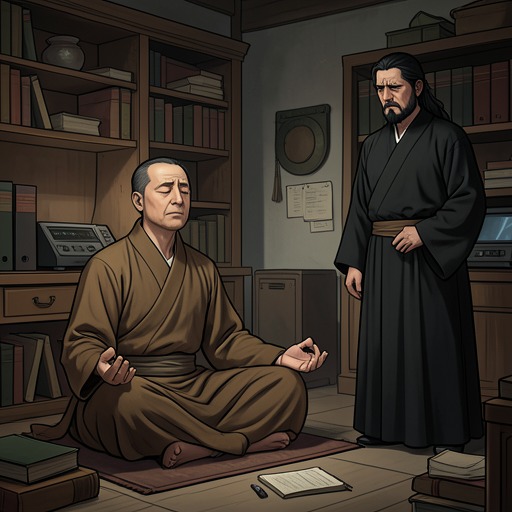
Xiao Feng has not seen the cliff writing: when he went to the site, it had already been completely scraped away. Zhiguang nevertheless possesses a rubbing made from the inscription, assembled from pieces of cloth. Its unfamiliar characters are written in Khitan, and Xiao Feng recognizes the language even though he cannot read the text. He receives the rubbing with tears and asks Zhiguang to interpret it. When Zhiguang gives him the cloth, it becomes a material record of Xiao Yuanshan’s final words and a link between a concealed family history and the son who had been raised under another surname.
A mistaken expedition and its consequences
Zhiguang recounts that the men who went to Shaolin Monastery initially believed Xiao Yuanshan was leading Khitan warriors there to seize Buddhist scriptures. Study of the cliff inscription later showed that this belief was mistaken. Zhiguang argues that Xiao Yuanshan’s account was credible because, before his death, he had no reason to leave a false explanation; he also points out that the group included a woman with no martial-arts ability and a baby just over a year old, circumstances that did not fit the supposed raid.
The report that prompted the expedition had come from an ignorant person who deliberately deceived the man known as the Leading Big Brother into traveling thousands of li. The physical inscription could be erased, Zhiguang observes, but the people killed in the resulting events could not be brought back. The pass thus anchors a chain of error and irreversible loss: the account preserved there corrects the story that prompted violence, but it cannot undo its consequences.
Strategic ground and recurring border conflict
The political history associated with the pass extends beyond Xiao Feng’s family. In explaining Liao’s imperial succession, the narrative describes how the balance between the throne, the royal emperor uncle, and the Southern Chancellery shaped the rebellion against YeLu HongJi. The inherited authority of the imperial family and its military offices helps explain why the crisis could not be resolved by personal loyalty alone. Yanmen Pass belongs to the same larger landscape in which dynastic decisions and military power determine the choices available to individuals.
The account also places the pass within a long contest between Liao and Song. The sixteen prefectures ceded to Liao under Shi JingTang included strategically important territory, and their position gave Liao an advantage when its armies advanced south. In Xiao Feng’s encounters with border communities, that political contest appears as a cycle of raids: Liao soldiers seize Song civilians for provisions, a practice called Beating the Grass Valley, while Song forces retaliate with raids across the frontier. Xiao Feng has seen Song soldiers capture Khitan civilians near Yanmen Pass; later, seeing Song captives in Liao hands, he recognizes the repeated pattern rather than treating either side’s victims as strangers.
A boundary questioned
The people and armies around the frontier do not fit neatly into opposing national identities. When Khitan riders attack a Jurchen group, Xiao Feng recognizes the attackers as his own people but also sees the Jurchen hunter killed. He avoids killing the Khitan riders while intervening to protect the Jurchen, an act that exposes the personal conflict produced by overlapping affiliation and obligation.
Later, confronted with Song captives, Xiao Feng reflects on the shared language and food that connect people across the political divide. He releases the prisoners and urges them to move away from the border, where they risk being seized in future raids. In this way, the pass’s narrative significance broadens: it is not only the site of an old error and a revelation of parentage, but also a frontier where strategic geography sustains violence and where Xiao Feng’s experience challenges the divisions that violence depends on.