YeLu ZhongYuan
Demi-Gods and Semi-DevilsYeLu ZhongYuan is the royal uncle whose earlier loyalty to his brother becomes the foundation—and the vulnerability—of his later political position. Having once stood aside for YeLu ZongZhen rather than take the Liao throne, he is subsequently made heir presumptive and supreme commander of the army. His son’s rebellion turns that carefully balanced inheritance into a civil war; captured by Xiao Feng, he helps end the fighting by ordering his own followers to lay down their weapons, but later dies by suicide.
Identity and Background
YeLu ZhongYuan is the second son of YeLu LongXu, the ruler remembered in Liao history as the Holy Emperor. His elder brother, YeLu ZongZhen, was kind and generous, while ZhongYuan was known for military talent and courage. When the Holy Emperor was near death, he designated ZongZhen as successor. The empress, however, favored her second son and plotted to place ZhongYuan on the throne. Because the empress dowager wielded great influence in Liao, ZongZhen could not securely consolidate his rule, and his life was in danger.
ZongZhen revealed their mother’s scheme to his brother. ZhongYuan did not seize the opportunity to claim power: he supported ZongZhen, and the plot was thwarted. ZongZhen rewarded this loyalty by granting him the rank of royal emperor brother and making him next in line to succeed. That history is presented as more than a private act of brotherly trust. In a succession system where the empress dowager could help determine who ruled, ZhongYuan’s decision to stand aside left him with a powerful claim while preserving his brother’s throne.
Status Under YeLu HongJi
After ZongZhen’s death, the throne passed not to ZhongYuan but to ZongZhen’s son, YeLu HongJi. HongJi felt apologetic toward his uncle and elevated him to royal emperor uncle, again placing him next in line to the throne. He also made ZhongYuan supreme commander of the entire army, exempted him from kneeling in court, and granted him gold, scriptures, a mortar board, a two-colour robe, and other marks of special favor. The narrative describes him as the most powerful figure in the Liao Empire.
HongJi’s decisions gave practical force to his uncle’s position as well as ceremonial honor. While HongJi went hunting, ZhongYuan was entrusted with the military affairs of the empire. His son, YeLu NieLuGu, received the title of Prince of Chu and control of the Southern Chancellery’s military affairs, becoming its Lord. The arrangement placed an immense concentration of authority in one family: ZhongYuan stood next in succession and commanded the army, while his son held a senior military office in the capital. The account’s history of past succession politics thus leads directly into the conditions of the later rebellion.
The Rebellion and Capture
The crisis begins when a rapidly relayed bugle signal reaches YeLu HongJi’s hunting camp. HongJi calmly announces that there is a rebellion in the capital and orders an immediate return. After three days of marching south, a scout reports that the Lord of the Southern Chancellery has occupied the palace and taken the empress dowager, empress, princes, princesses, officials, and their families hostage. The report identifies the rebel leader as YeLu NieLuGu and makes the danger personal: the uprising is not simply a challenge by a distant commander, but a revolt by ZhongYuan’s son.
HongJi is unsettled by what ZhongYuan may do. The emperor had trusted his uncle with military command, and the account stresses that ZhongYuan had once given up a throne rather than betray his brother. But NieLuGu is reputed to be ruthless, and once he proclaims his father emperor, the old family history becomes a weapon. His edict calls HongJi a false emperor who usurped the throne and declares the royal emperor brother the legitimate ruler. HongJi burns the document, yet fears that it will turn the army and populace against him. ZhongYuan’s claim is backed not only by family rank but by command over forces that HongJi cannot match: the emperor estimates that his own returning army numbers about 100,000, while his uncle can command 800,000, in addition to the troops controlled by NieLuGu.
When ZhongYuan and his son march north with 500,000 troops to intercept the emperor, the account of the earlier succession reverses in force. The uncle who once declined the throne now stands at the center of a rebellion conducted in his name. HongJi’s soldiers are frightened, in part because their families are held in the capital; the men’s grief spreads through the camp until their crying leaves the army’s morale shattered. HongJi nevertheless leads his troops to meet the enemy, and Xiao Feng accompanies him as his personal bodyguard.
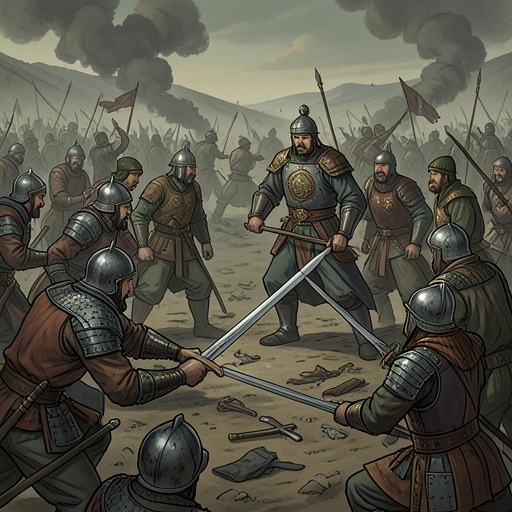
In the decisive confrontation, Xiao Feng penetrates the rebel ranks and reaches ZhongYuan, who is protected by layers of shield-bearing bodyguards. Xiao Feng leaps over their shields and lands at his uncle’s horse, then seizes ZhongYuan and lifts him into the air. With the rebel soldiers aiming their weapons at him, Xiao Feng calls for them to lay them down and promises that the emperor will pardon them. ZhongYuan is initially too frightened to speak; once brought before HongJi, however, he kneels and asks for forgiveness. He then addresses the rebel army himself, declares that the Prince of Chu brought about the disaster and is dead, and tells the soldiers to surrender and seek the emperor’s pardon. His authority ends the armed resistance: the rebels cast down their weapons.
Pardon, Death, and Political Aftermath
HongJi accepts Xiao Feng’s advice to pardon his uncle, reasoning that leniency will settle the army’s morale. The decision reunites the imperial command without continuing the battle through mass punishment. ZhongYuan’s own order has helped make that settlement possible: although his son’s rebellion placed him against the emperor, his rank still carries enough authority for the defeated troops to obey him.
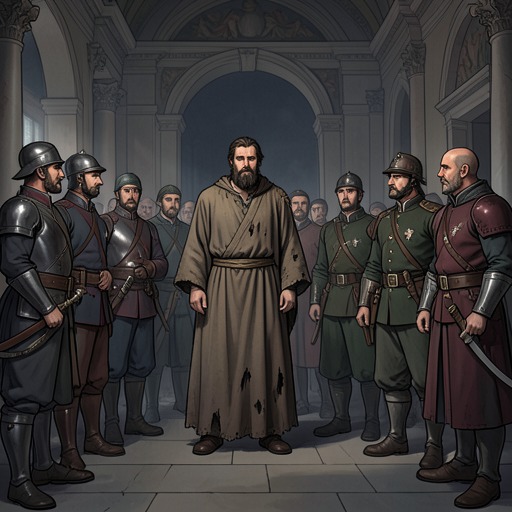
The pardon does not restore ZhongYuan to his former position. On the third day, HongJi, the empress dowager, the empress, and other members of the imperial household return to the capital with the captured families. ZhongYuan, ashamed of what he has done, commits suicide on the way. HongJi keeps his promise not to prosecute the rebels collectively, but executes twenty of the Prince of Chu’s chief instigators. The return and the selective punishment close the immediate crisis while making ZhongYuan’s fate distinct from that of the ordinary soldiers who surrender under his command.
The political settlement also reshapes the offices ZhongYuan had occupied. HongJi appoints Xiao Feng Prince of Chu and Lord of the Southern Chancellery, the very title and administrative position previously held by ZhongYuan’s son. Xiao Feng’s appointment follows the capture of the royal emperor uncle and his intervention to preserve the emperor’s rule; it is not a reward ZhongYuan survives to contest. Instead, his death leaves the capital’s military hierarchy to be reorganized around HongJi’s sworn brother.
Significance
ZhongYuan’s arc turns on the tension between a family memory of restraint and the institutional power that restraint helped accumulate. His earlier choice to support ZongZhen is treated as evidence of loyalty, yet it does not remove him from succession politics: both ZongZhen and HongJi formally place him next in line. Nor does his later authority remain merely symbolic. As supreme commander, he is central to the balance of power that makes HongJi fear defeat and the rebel army capable of marching in overwhelming numbers.
The story connects that succession structure to the practical mechanisms of the coup. The emperor’s authority depends on command, the loyalty of soldiers, and the fate of relatives held as hostages; the rebel claim depends on ZhongYuan’s royal standing and the army behind his son. At the battlefield’s end, personal force intervenes where inherited rank and military organization have produced stalemate: Xiao Feng captures ZhongYuan, but ZhongYuan’s command persuades the rebels to surrender. His final role is therefore both political and personal. The uncle whose refusal to take power once preserved a brother’s throne becomes a rebel ruler in another man’s edict, then helps stop the bloodshed before dying in disgrace.