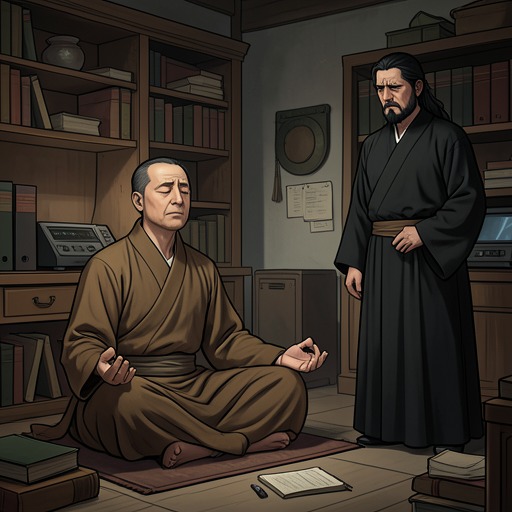
Zhiguan Temple
Demi-Gods and Semi-DevilsZhiguan Temple is a small temple on Mount Tiantai, inconspicuous in appearance but prominent in the martial world. Its significance rests on a brief, consequential meeting: Zhiguang receives Xiao Feng and A'Zhu there, gives Xiao Feng a cloth rubbing of his father's words at Yanmen Pass, and dies before answering Xiao Feng's question about the Leading Big Brother. The temple becomes a place where evidence of the past is revealed, but its most sought-after answer remains withheld.
Setting and reputation
Xiao Feng and A'Zhu reach the Tiantai county seat after crossing the Yangtze and Qiantang rivers. They plan to ask directions to Mount Tiantai, but an innkeeper announces that a monk from Zhiguan Temple has come to see them. The visitors have disguised themselves, and Xiao Feng has registered at the inn under the surname Guan; nevertheless, the temple's messenger recognizes him and knows A'Zhu's surname, Ruan. Their discovery underscores that concealment offers little protection from the network of knowledge surrounding Xiao Feng.
The route to the temple crosses steep, rugged mountain paths. Xiao Feng follows the messenger Pozhe cautiously, aware that his pursuers may know where he is going. The journey proves uneventful, and they arrive at a temple whose ordinary, weatherworn exterior hardly matches its standing in the martial world: much of its outer plaster and paint has peeled away. It is distinct from the better-known Guoqing Temple, associated with the eminent monk Zhizhe and the flourishing of the Tiantai school of Buddhism. The contrast between Zhiguan's humble physical condition and its considerable reputation gives the visit an understated, secluded setting.
Zhiguang's welcome and Xiao Feng's identity
Pozhe announces Xiao Feng's arrival, and Zhiguang comes to greet the guests himself. Xiao Feng and A'Zhu remove their disguises and meet him openly. Xiao Feng has come hoping that Zhiguang will identify the Leading Big Brother and the principal villain behind the past violence. He has, he says, already put aside his grievance over Zhiguang's part in his parents' deaths because he believes the monk to be kind to ordinary people; what he wants now is an account of the people responsible.
Instead, Zhiguang first tells him that his original surname is Xiao. The revelation changes the name by which Xiao Feng understands himself: he turns to A'Zhu and says that he is Xiao Feng from then on, not Qiao Feng. Zhiguang asks whether he has seen the writing once left on the stone wall outside Yanmen Pass. Xiao Feng has not; by the time he reached the site, the writing had been scraped away. Zhiguang therefore produces a rubbing he had preserved, made from the inscription his father carved before his death.
The rubbing and the unanswered question
The rubbing is not a single sheet but many scraps of cloth stitched together. Its characters are written in Khitan, which Xiao Feng recognizes, although the marks initially appear unfamiliar to him. As Zhiguang recounts the inscription, the recovered text explains that Xiao Feng was one year old during the incident at Yanmen Pass. His father described an attack by people from the Southern Dynasty, the death of his wife, and his own grief and shame after breaking a vow not to kill Han people. For Xiao Feng, the cloth makes a remote account personal: he reads his father's words and weeps over them.
After recounting the history, Zhiguang says the Leading Big Brother disappeared once the truth became known and may no longer be alive. But he does not name him. When Xiao Feng presses for the identity, Zhiguang instead mentions the deaths Xiao Feng is believed to have caused while investigating the affair, including those of Elder Xu, Grandpa Tan, Granny Tan, Zhao Qiansun, and the Shan family, whose manor was burned. Xiao Feng is about to correct the accusation that he killed Elder Xu and the others, but Zhiguang has already gone into the rear hall to fetch an object.
Zhiguang then leads the conversation to Buddhist teaching. Xiao Feng considers the view that human beings, animals, emperors, and generals are all alike, and wonders whether the distinction between Han and Khitan identity should matter. Yet he cannot detach himself from his need to know who the Leading Big Brother is. He asks several times; Zhiguang smiles and does not answer. The temple's spiritual setting thus frames, but does not resolve, the conflict between detachment and Xiao Feng's urgent search for the truth.
Zhiguang's death and the temple's aftermath
Xiao Feng notices that Zhiguang's smiling expression is motionless. When he checks the monk's breathing, he finds that Zhiguang has died. Grief-stricken, Xiao Feng kneels and bows before leaving quietly with A'Zhu. Zhiguang's death ends the conversation at the moment Xiao Feng's central question remains unanswered; the temple gives him his father's history, but not the identity he came to learn.
As they travel back toward the county seat, Xiao Feng tells A'Zhu he never intended to harm Zhiguang and wonders why the monk brought suffering upon himself. A'Zhu suggests that Zhiguang had understood the world deeply and regarded life and death as alike. They also suspect that the principal villain had informed Zhiguang in advance that Xiao Feng was coming to exact revenge, leading the monk to believe he would be killed and to take poison after their conversation. This remains their explanation, not a certainty established by the scene. Zhiguan Temple consequently marks both a disclosure and a loss: a material record restores Xiao Feng's family history, while Zhiguang's death leaves the investigation's crucial name in silence.