
The Golden Glove as a Convergence Point
Der goldene HandschuhThis thread traces how the Golden Glove gathers the novel’s otherwise separate lives into a shared setting where class, loneliness, violence, and imagined escape meet.
increasing Bearing strength in each event
 decreasing
Bearing strength in each eventdecreasingA Tavern Without a Closing Hour
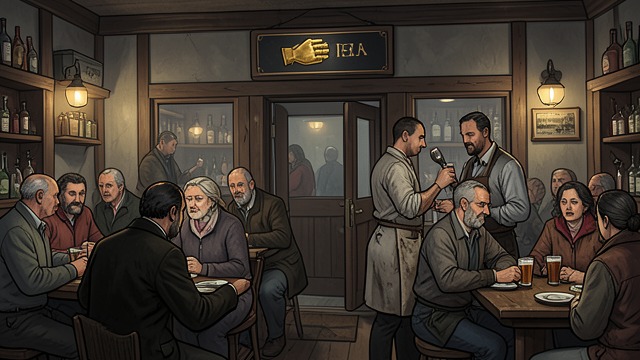
A Tavern Without a Closing Hour
A place open to the stranded
The Golden Glove operates around the clock on Hamburg’s St. Pauli, receiving people who have nowhere else to go or who cannot yet face going home. Its regulars include the drunk, the unhoused, the sick, and the lonely.
Order at the edge of disorder
Herbert Nürnberg runs the place with an understanding of its customers and their dangers. The tavern is not safe in any ordinary sense, but its routines, familiar faces, and small acts of assistance offer a kind of provisional order.
The setting as social world
The tavern brings together people from different histories without erasing the inequalities between them. Its crowded room makes private suffering visible, while its constant turnover allows individual catastrophes to pass almost unnoticed.
Gerda’s Brief Shelter
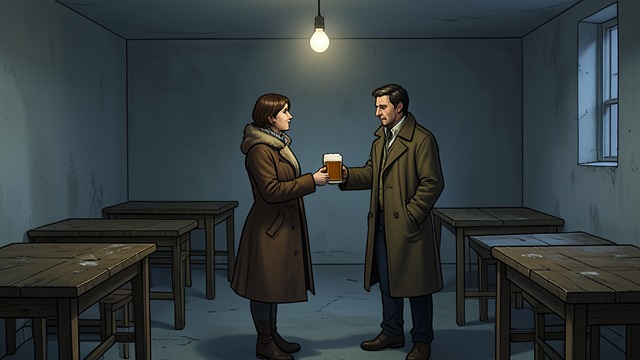
Gerda’s Brief Shelter
A drink as an opening
When Gerda Voss enters the tavern cold and without money, Fiete offers her a drink and uses the gesture to begin an encounter. The act appears generous, but it is also the beginning of a relationship in which he expects submission in return.
Between tavern and apartment
The journey from the bar to Fiete’s apartment takes Gerda from a public place where people can see her into a private space controlled by him. Her hunger, exhaustion, and lack of shelter narrow her ability to refuse his terms.
The limits of rescue
Her stay brings moments of food, music, and companionship, but none amounts to freedom. When Gerda later disappears, the tavern’s brief hospitality remains only a point along a larger route of poverty, exploitation, and abandonment.
Gisela’s Unfinished Mission
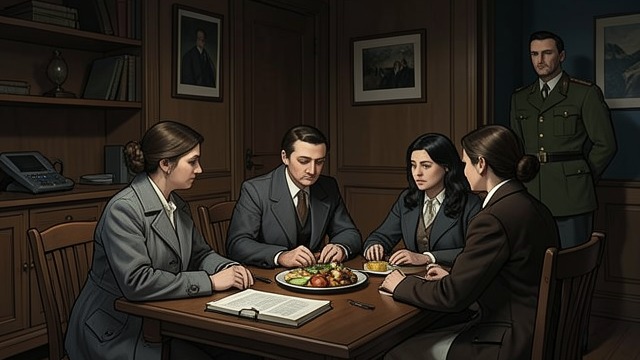
Gisela’s Unfinished Mission
A presence among the regulars
Gisela, a Salvation Army major, visits the taverns around St. Pauli to speak with people who are often dismissed as beyond help. Her manner is tactful; she tries to recognize when someone will accept conversation rather than force a religious approach.
Compassion at the table
She sits with women such as Agnes and Inge, offering food, shelter, or a patient listener. Her practical kindness contrasts with the harshness of the tavern and with the suspicion many of its customers feel toward religious authority.
A limited intervention
Gisela can sometimes bring vulnerable women away from immediate danger, but she cannot transform the circumstances that return them to the street. Her work makes compassion visible without pretending that goodwill alone can repair entrenched poverty, addiction, or abuse.
A Schoolboy Enters the Night World
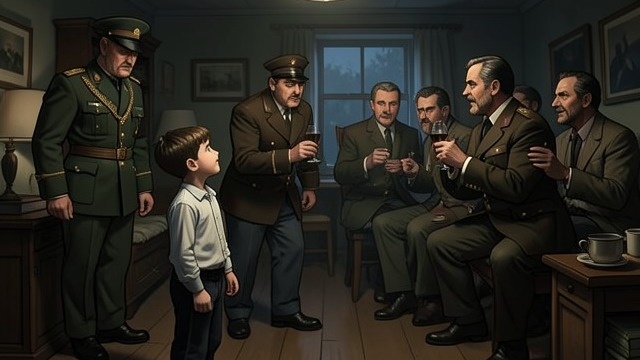
A Schoolboy Enters the Night World
A search for adult knowledge
WH 3 enters the tavern hoping to learn how to impress Petra. He believes that surviving a visit to a notorious bar will give him the adult confidence he lacks at school.
Encounters without protection
Inside, he sees men whose drunkenness and behavior unsettle him, and Soldaten-Norbert addresses him with a mixture of bleak observation and aggression. WH 3 is both fascinated by the spectacle and frightened of becoming part of it.
Confidence borrowed from the room
He leaves feeling changed, imagining that the experience has made him worldly. What he has acquired is a temporary pose and a collection of impressions, not immunity to humiliation or a better understanding of intimacy.
The Final Crossings
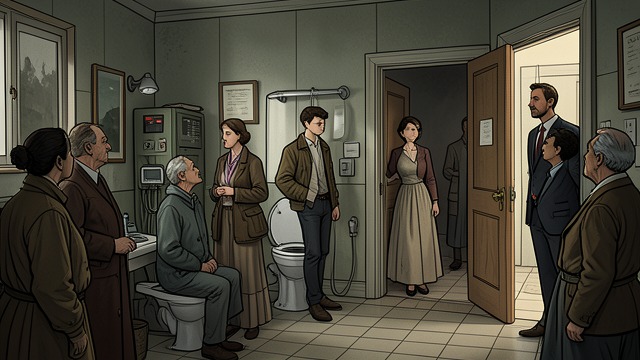
The Final Crossings
Separate lives in one room
Near dawn, WH 3 and Petra arrive at the Golden Glove as Fiete and other regulars occupy the same exhausted social world. At the same moment, Karl von Lützow enters from a different class and a different kind of loneliness, using alcohol and sexual pursuit to evade his emptiness.
A shared space without equality
The tavern permits these people to occupy the same room, but it does not give them the same power, history, or vulnerability. WH 3 is humiliated in the toilet; Petra leaves; Karl watches her and then chooses not to follow. Their paths cross without becoming a shared relationship.
A convergence, not a resolution
The parallel exits underline the novel’s refusal to offer the tavern as a place of redemption. Its customers seek connection, escape, or distraction, but their encounters mostly expose the limits of what any one night can change. The room gathers the novel’s social contrasts while leaving its characters to carry their separate injuries away.
The tavern’s established routine in the early 1970s
February–March 1974
During her rounds in the mid-1970s
One Tuesday night before WH 3 turns eighteen
Near dawn during WH 3 and Petra’s night out
