
Wealth and Poverty, Unequal Forms of Emptiness
Der goldene HandschuhThis thread contrasts the material security of the von Dohren world with the deprivation of the tavern and shows how neither prosperity nor poverty guarantees humanity.
increasing Bearing strength in each event
 decreasing
Bearing strength in each eventdecreasingThe estate’s insulated rituals

The estate’s insulated rituals
Comfort without warmth
At the von Dohren family estate, dinner follows a formal schedule in a room large enough for a crowd. The elaborate meal and controlled conversation make wealth visible as routine, while Margot experiences the room’s scale and inherited objects as oppressive rather than comforting.
The family selects safe subjects and avoids direct emotional exposure. Their material abundance does not make the household intimate; the ritual instead contains tensions that its members do not openly resolve.
Inherited privilege
WH 1’s fortune rests partly on property seized from the Jewish Arronge family during the Nazi period. He regards his loss of public standing as an unfair injury, revealing how privilege can protect a person from seeing the human cost of the advantages he inherited.
The novel’s upper-class setting is therefore not a simple counter-image to deprivation. It shows a different form of moral poverty: a capacity to preserve comfort and status while evading responsibility for the past.
The tavern’s shared ruin
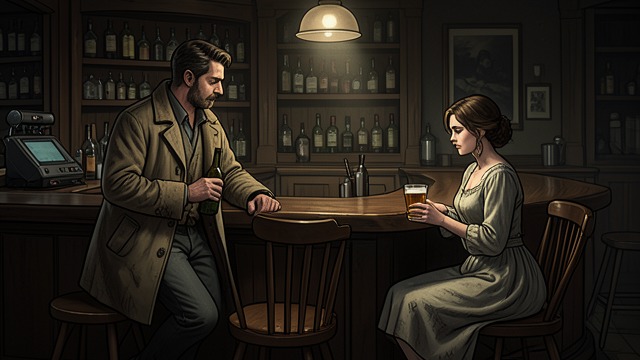
The tavern’s shared ruin
A refuge at the margins
The Golden Glove Tavern stays open around the clock, drawing people who have nowhere better to go or cannot yet face going home. Its customers include people living with poverty, addiction, disability, illness, and homelessness; their lives are exposed to one another in a space that offers drink but little protection.
The tavern’s grotesque humor and casual cruelty coexist with acts of practical care. Herbert helps some regulars with everyday problems, and Gisela approaches people without insisting that they change before she treats them as human beings.
Humanity without security
The customers are not presented as a uniform mass. Their jokes, habits, loyalties, and fears remain distinct, even as alcohol and deprivation wear down their bodies and prospects.
The place supplies companionship and temporary shelter, but it cannot repair the conditions that bring people there. Its limited kindness matters precisely because the surrounding social world offers so little dependable care.
A shipping dynasty in decline

A shipping dynasty in decline
Business fortunes turn
WH 2’s shipping business once benefited from trade between East and West Germany, but changing markets and business decisions undermine that success. The container revolution alters the industry, while a ship stranded in the Suez Canal adds years of expense and uncertainty.
His family’s position remains privileged compared with the people in the tavern, yet the company’s weakening fortunes expose how fragile inherited power can be. Money and status offer options, but they do not guarantee sound judgment or emotional resilience.
The limits of wealth
WH 2 feels his energy and prospects dwindling. He believes there may be no new life ahead, only the continuation of the one he has already lived, even as his family’s troubles remain buffered by property and social standing.
By setting the shipping crisis beside the tavern’s daily deprivation, the novel distinguishes different kinds of insecurity without equating them. The wealthy face loss of position; the poor already live close to hunger, exposure, and abandonment.
The failed public absolution

The failed public absolution
A reconciliation arranged
WH 2 persuades influential figures in Hamburg’s shipping community to restore WH 1’s standing after decades of exclusion. At the birthday celebration, Gerhard Leyendieker publicly offers a gesture of reconciliation, turning the family’s private history into a carefully staged social event.
The gesture is meant to grant WH 1 relief and to let the family close an old chapter. Its form, however, assumes that public recognition can settle a moral history shaped by dispossession and resentment.
Status cannot repair the past
WH 1 has spent years preparing a denunciation of his family and associates, but when the moment comes, he cannot deliver it. His silence is not forgiveness: the reconciliation arrives too late to transform the hatred in which he has made his home.
The scene shows both the power and the limits of wealth. The family can arrange access, ceremony, and public approval, but it cannot command memory, restore the stolen property, or compel the emotional release it wants.
Early in the 1974 narrative
During Fiete’s early nights at The Golden Glove Tavern
During WH 2’s account of the company’s troubles
At WH 1’s eightieth-birthday gathering
