Alcohol Dependence and Self-Destruction
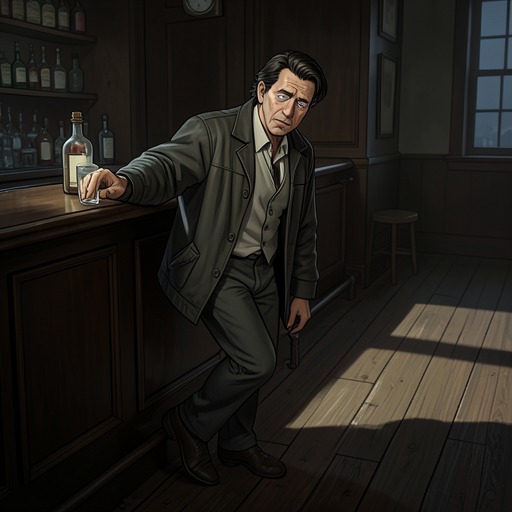
Der goldene HandschuhAlcohol Dependence and Self-Destruction names a pattern in Fiete’s life in which brief efforts at moderation repeatedly collapse into drinking, neglect, and harm. Alcohol is not merely a habit that accompanies his decline: his efforts to bargain with it shape his plans, threaten his employment, consume his wages, and finally blur his memory of violence. The narrative’s movement from cautious calculations to repeated drinking and forgetfulness makes self-destruction a cycle of both action and erasure.
A Conditional Plan for Control
After a comparatively restrained week, Fiete estimates that he has had no more than ten beers and a few measures of grain liquor. He treats Saturday as permission to indulge, but knows he cannot trust himself at the Zum Goldenen Handschuh. He fears losing the whole night, remaining there through Sunday, and failing to report for work on Monday. One ordinary week, he recognizes, cannot cancel out the many years before it. His self-awareness is concrete, but it does not yet give him reliable control.
Fiete tries to make the outing conditional on his brother Siggi’s presence. If Siggi is available, they can go to the bar; if not, Fiete will go home. He imagines that Siggi can set the right time to leave and keep the drinking to beer. Fiete’s distinction between beer and grain liquor supplies another safeguard: he believes that spirits are what burn and unhinge a person, while beer cannot make anyone lose their mind. Rather than trust his own judgment, he places the decision in Siggi’s hands. The plan shows both a real desire to preserve the new normality of work and the fragility of a control that depends on another person and on Fiete’s reassuring account of which drink is dangerous.
Relapse and the Cost of Boredom
A later episode exposes how little a vow can withstand when alcohol is close at hand. The day after an evening of drinking, Fiete feels guilty and promises that it will remain a one-time lapse. He tells himself that the matter is one of willpower. Yet the night shift that follows seems unbearably dull now that he knows how entertaining it can be. Time drags, a half bottle of liquor remains, and several beers are available. He postpones the first drink until midnight, but then finishes what is left. His delay is a small performance of restraint that ends not in moderation but in consuming the available alcohol.
The effects follow him into the next day. Although he is badly hungover, Fiete still wants to visit the zoo and gathers his strength to go. The journey to Lokstedt is difficult: he misses a connection, cannot understand the bus driver’s mumbled directions, and reaches his destination only after two hours. He nevertheless encourages himself with his familiar belief that a Honka can accomplish what he sets out to do. The episode sets determination against impairment. He can force himself through an ordinary excursion, but that effort does not undo the drinking or restore ease to his life.
Drinking as Material and Emotional Decline
Later, the scale of Fiete’s drinking has worsened. During some shifts he consumes a whole bottle of grain liquor and becomes so intoxicated that he cannot even make it to the Zum Goldenen Handschuh afterward. His wages go on alcohol and prostitutes; food has become a nuisance, and everything else has lost importance. The details describe a narrowing life in practical terms: money that might sustain him is spent, eating is neglected, and intoxication can prevent him from carrying out even the routine of going to the bar.
This deterioration unfolds alongside the collapse of Fiete’s hope that Helga might rescue him. Her rejection has deeply affected him; he imagines that she would have been his salvation and that he would have done anything for her. The day after the incident, she quits without giving a reason. The narrative places this loss amid his worsening drinking and his growing hatred of women, without turning that sequence into a promise that another person could have cured him. Instead, the abandoned hope becomes part of a life in which alcohol, resentment, and increasingly disturbing fantasies occupy more and more space.
Forgetting and Repetition
In the later scene with Frida, drinking works not as a solution to conflict but as a way of losing hold of it. After Fiete strikes her and she lies motionless, he returns from cleaning himself; when she begins to whimper, he tells her to be quiet and offers her something to drink. They drink together and eventually forget what has happened. The immediate sequence makes the cost of that forgetting plain: violence is followed not by an account or resolution, but by intoxication and a shared loss of memory.
Fiete is described as almost like a fish, quickly forgetting much of what happens. Frida’s rambling stories, her coarse voice, and her talk about strange bodily complaints fill the same scene, while the narrator calls both of them ruined by liquor. The detail does not soften the violence that preceded their drinking; it shows how drinking helps them pass over it. Across the episodes, Fiete repeatedly recognizes danger, constructs a rule or promise, and then drinks again. The returns—to the bottle, to failed control, and finally to forgetting—give the concept its destructive force: what alcohol erodes is not only his health and livelihood but also the possibility of facing what his actions have done.