Bauer Frerk
Der goldene HandschuhBauer Frerk is the farmer who turns Fiete Honka’s attempt to begin a new life after fleeing East Germany into an ordeal of violence, confinement, and near-fatal injury. His farm is not merely a place of employment: under Frerk’s control, it becomes a coercive enclosure from which Fiete twice tries to escape, and where the second attempt ends with a tractor attack that leaves him close to death.
Identity and Background
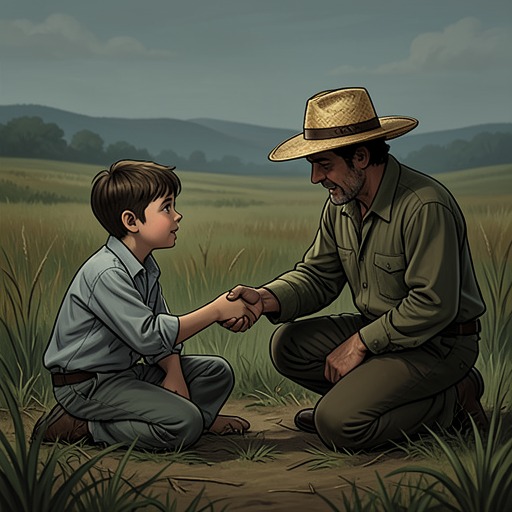
In 1951, at sixteen, Fiete Honka flees East Germany and finds precarious agricultural work with Bauer Frerk in Billwerder. At first, the job appears to offer a foothold in a new life. That hope collapses quickly. The narration presents Frerk as a man for whom no special provocation is needed: he beats Fiete every day, with fists, clubs, a manure fork, or whatever else the farm provides. His violence is described as arising from a general hatred of everything, directed especially at Fiete. The account supplies no grievance or dispute that might explain it; Frerk’s arbitrary hostility is itself part of the terror.
Fiete experiences the farm buildings as a dark, devouring place that consumes his physical strength. The language makes agricultural labor feel less like a job than an environment of relentless bodily depletion. Frerk controls not only the work but also Fiete’s freedom to leave, turning the apparent opportunity of employment into dependence on the person abusing him.
First Escape and Confinement
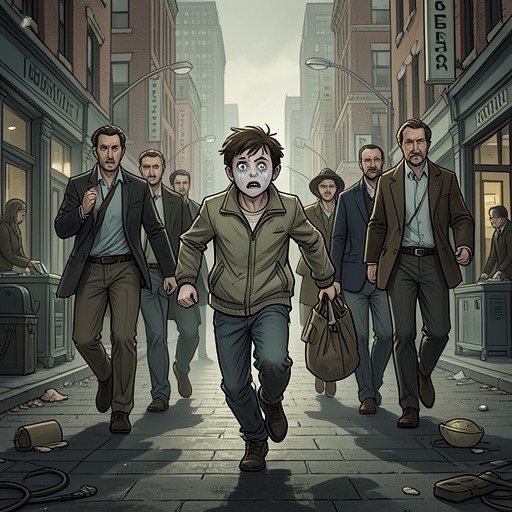
After two months, Fiete runs away on Frerk’s old bicycle. His flight is interrupted by a police patrol, whose intervention returns him to the farmer he has escaped. The chance encounter reverses the apparent promise of rescue: instead of being removed from danger, Fiete is delivered back into Frerk’s hands. The narrative marks this return as the point at which an already brutal situation becomes still worse.
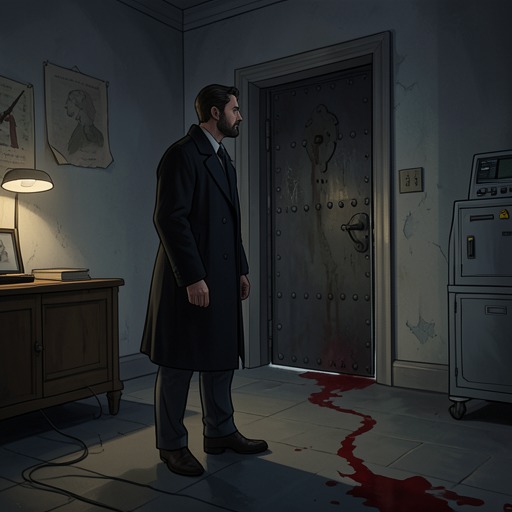
Frerk moves Fiete into a tiny chamber on the farm’s threshing floor. It is described not as merely damp but as wet. At night Frerk ties Fiete to his bed and comes in without warning to check whether the knots remain secure. Fiete wets himself almost every night; Frerk responds by pressing him into his own urine as punishment. The repeated emphasis on wetness, cold, and dampness makes the room a condition of captivity as much as a physical space: Fiete cannot keep himself dry, warm, or free to move.
Food is another instrument of degradation. Fiete is given half-rotten turnips and potatoes, green meat, spoiled vegetables, and foul water. Frerk also invents new humiliations. Fiete tries to hang himself, but his attempts are thwarted by obstacles on the farm: he cannot find a stool or chair, a watchdog barks, or some other circumstance intervenes. The account leaves the precise interruption uncertain, but makes clear that suicide becomes one of the few imagined exits from a life in which Frerk has narrowed every other choice.
The Second Flight
Eventually Fiete believes he cannot endure another week or two, let alone a month. One early morning he manages to free himself and takes the bicycle again, with less than half an hour before Frerk is likely to get up. His flight becomes a race toward a nearby forest. The road runs straight between drainage ditches, with ice floating on the water; the narrow entrance to the woods is less than two hundred metres ahead. Fiete expects the tractor will not fit through the path, while Frerk’s war-damaged hip seems to make pursuit on foot unlikely.
Frerk follows in a Fendt tractor. The account measures the remaining distance down from ninety metres to thirty, giving the escape the compressed rhythm of a countdown. Before Fiete reaches the forest, the tractor rams his bicycle. He is thrown through the air and crashes against a fence post. Frerk gets down and looks at the bloodied Fiete lying in the mud. His response is conveyed through his attention to the wrecked bicycle, which he considers a loss; the injured boy receives no comparable concern.
Injury and Abandonment
Fiete is left with a fractured base of the skull, a destroyed upper row of teeth, and deep cuts on his thighs. Fragments of his broken teeth are embedded in his upper jaw. After checking the damage, Frerk drives slowly back to the farm. He does not call an ambulance or a doctor, leaving Fiete to suffer without assistance. The violence therefore extends beyond the collision: Frerk’s decision to abandon him turns the injuries into a prolonged threat to his survival.
Twenty-five hours later, Fiete is found by chance, more dead than alive. His condition remains precarious for days. At Ginsterhof Hospital, tar is painfully washed from his wounds, including the small pellets lodged in them. He stays there for three months. His nose and teeth cannot be properly restored. The lasting damage gives the escape attempt a consequence that outlives Frerk’s immediate control of the farm: Fiete survives, but not without permanent bodily harm.
Narrative Role and Significance
Frerk’s place in Fiete’s story is defined by the stark sequence of work, escape, forced return, confinement, and renewed flight. The first escape shows how an outside authority can return a vulnerable worker to his abuser; the second exposes the lethal power Frerk exercises even when Fiete has reached the road. The farm’s everyday tools and spaces become means of violence, from the manure fork and the bed restraints to the tractor and the isolated road.
The episode also establishes a history of victimization that the narrative later recalls when Fiete speaks about his past. Frerk is not presented as the explanation for everything Fiete later becomes, and the account does not make that simple causal claim. It does show, concretely, the bodily terror, enforced helplessness, and near-death experience that form part of Fiete’s earlier life. Frerk’s defining action is not only that he attacks a boy trying to escape, but that he repeatedly closes off escape itself: first by having Fiete returned, then by pursuing him, and finally by leaving him injured in the mud.