Fiete Honka
Der goldene HandschuhFiete Honka is a lonely, physically battered man whose yearning for ordinary affection and stability turns increasingly destructive. In the drinking rooms of Hamburg, a new nickname can feel like a title of nobility and a sober workweek like a fragile reprieve; neither offers lasting protection against his alcohol dependence, resentment, and violence. The narrative makes his vulnerability visible without mistaking it for innocence: his hopes for love coexist with fantasies and conduct that make women targets of his desires.
Identity and Social Position
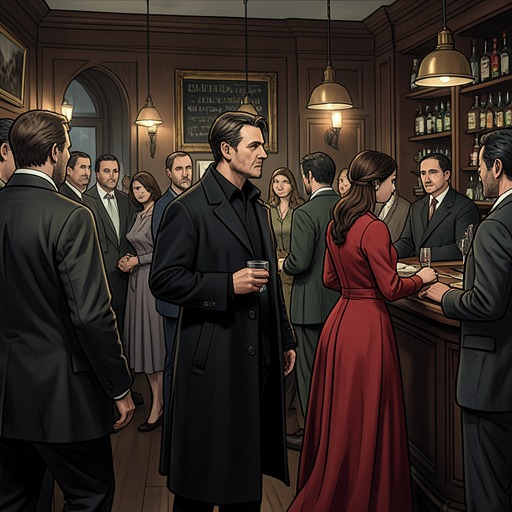
Fiete is introduced as a small, crooked man with a crushed-looking face and enormous hands. At three in the morning on an icy February day in 1974, he has already spent twelve hours at his usual place at the short end of the L-shaped bar, talking to Helmut Berger, known there as Leiche. His description of a woman he once loved dwells on her perfume and a birthmark on her belly; he imagines that she has gone but will return. The intimacy of the remembered details stands against the degradation of the present, where he confides in a man who is mostly asleep and whom the bartender sometimes has to shake to see whether he is still alive.
A recently acquired nickname gives Fiete a rare sense of distinction. He cannot remember who gave it to him or why, but he is proud to have one at all. In the bar’s hierarchy, nicknames function as marks of recognition, even when Fiete understands his own as second-rate beside more vivid labels such as Ritzen-Schorsch or Glatzen-Dieter. The name makes him feel distinctive and likable, a small social elevation in a world that otherwise sorts people by appearance, damage, and notoriety.
That world also shapes his expectations of intimacy. At the Zum Goldenen Handschuh, he believes he has better chances of meeting women than in other bars, but he considers women his own age unreachable and says he has long been drawn to older women, sometimes old enough to be grandmothers. His battered condition narrows his expectations further. On a Wednesday when he feels miserable and alone, his favorite song, Es geht eine Träne auf Reisen, plays in the jukebox; the melancholy of the music accompanies a loneliness he cannot easily express except through talk of past desire.
Flight and the Memory of Abuse
Fiete tells Helga that he fled East Germany in 1951, at sixteen, and soon fell into the hands of Bauer Frerk in Billwerder. What first looked like a precarious agricultural job became a daily regime of beatings. Frerk struck him with fists, clubs, and a manure fork, without needing any particular pretext. After two months Fiete escaped on Frerk’s old bicycle, but a police patrol found him and returned him to the farmer. The return transformed an already brutal situation into a more complete captivity: Frerk moved him into a tiny, soaking-wet room, tied him to his bed at night, checked the knots, and punished him for wetting himself by pressing him into his own urine. Fiete was fed rotten vegetables, bad meat, and foul water.
This history emerges because Helga asks him about his life, a question that is unusual enough to make him feel heard. He recounts it while they drink together, but his hope that her confidence might lead naturally to sexual intimacy runs alongside the account. The conversation reveals both a capacity to disclose his past and his tendency to treat another person’s trust as evidence that his own desires may soon be fulfilled.
The Fragile Project of Normality
Fiete sometimes tries to impose limits on his drinking. One Saturday he calculates that he has consumed no more than ten beers and a few schnapps during the week. He wants to go to the Zum Goldenen Handschuh, but recognizes that he may lose control, stay all night, and fail to report for work on Monday. He imagines that his brother Siggi could accompany him, keep the evening to beer, and decide when it is time to leave. Fiete therefore makes the outing conditional on whether Siggi is home: the brother becomes a safeguard against the possibility that Fiete cannot govern himself.
His effort to appear ordinary also surfaces in his clothes. When a man’s joking commentary singles him out for wearing black, Fiete realizes that he looks as if he is going to a funeral. He has worn black for as long as he can remember because stains show less, not because he has considered what is appropriate for an occasion. He resolves to buy two colorful outfits at Kaufhof on Monday. The decision is modest but revealing: normality, to him, includes clothes suited to the moment, just as it includes work, restraint, and a week begun in good spirits.
That project remains precarious. Fiete understands that a single week of normal behavior cannot outweigh the years before it, and his distinction between beer and schnapps lets him reassure himself that one kind of drinking is safe. The narrative shows how easily a practical plan becomes a bargain with a dependence he already knows can undo him.
Rejection, Alcohol, and Escalating Desire
Fiete invests particular hope in Helga, whose worries about cleaning offices, a small wage, Erich’s unemployment benefits, and the mortgage on their house she shares with Erich prompt him to listen. He takes her disclosure as a sign of trust and imagines that the rest may follow without his having to force the issue. Her rejection devastates him. She resigns the day after the incident, without explaining why; Fiete is relieved that she has left, even as her departure deepens his sense that the woman who might have saved him is gone.
Afterward, his life deteriorates. During some shifts he drinks an entire bottle of schnapps, becoming so intoxicated that he cannot make it to the Zum Goldenen Handschuh afterward. His wages go on alcohol and prostitutes; food becomes a nuisance, and other concerns lose their hold. His resentment of women grows together with a persistent sexual frustration. His fantasies become more extreme, including imagined sex with women marked by disability or illness and scenes in which he directs one woman to assault another before taking the remaining woman himself. The contrast between his longing to be loved and these fantasies is not a reconciliation of opposites: the longing increasingly takes a coercive, dehumanizing form.
The account also connects his later fantasies to an earlier assault. After escaping Frerk’s farm, Fiete found work elsewhere, but one evening two women and a man robbed him, forced him to drink Wermut until he lost consciousness, stripped him, and bound his hands behind his back; the man raped him while the women held his legs. The episode is a memory of violence done to him, not an excuse for the violence he later inflicts. Its presence makes the return of sexual coercion in his imagination especially disturbing: victimization and perpetration meet in his story without becoming equivalent.
Anna, Frida, and the Descent into Violence
When Fiete enters the Zum Goldenen Handschuh, Anna is sitting at his usual place beside a nearly full bottle of schnapps already paid for by a drinking companion who has collapsed in the toilet and been taken to hospital. Anus tells her to move because it is Fiete’s seat. Fiete gestures that she may stay, and Anna gives him a drink in thanks. They finish the bottle in less than an hour; after he orders more, they continue drinking. He is struck by how much Anna can consume and, wanting sex without paying, takes her home. Although he has two more full bottles in the cupboard and initially wants to have sex, Anna keeps drinking until Fiete himself collapses on the sofa, spent as if dead. The encounter begins not with courtship but with an accidental vacancy, an offered drink, and a contest of endurance that leaves him incapacitated.
Frida’s arrival later recalls Gerda for Fiete: Frida also carries a bag and appears to be wearing little beneath her coat. He knows her from a bar frequented by older, retired prostitutes; she was once regarded as one of Hamburg’s most beautiful sex workers and has twenty-seven theft convictions. Fiete imagines his future notoriety, once dreaming that his face might appear on a postage stamp and now picturing people across the world speaking of him a hundred years later. He asks Anus to serve Frida a Fako, and she asks to accompany him home without his having to persuade her. On the walk, he considers sending her away to prevent what he already expects may happen. The rain beginning on the way home repeats the weather associated with Gerda in his memory, a parallel that hints at repetition rather than renewal.
The first days with Frida are described as peaceful only with the explicit qualification that sex is not peaceful: Fiete behaves like a wild animal, and the more he drinks, the more violently enraged he becomes. Frida tries to get through the encounters quickly, relying on experience that includes both partly voluntary and wholly forced sex. She had been forced into prostitution in a concentration camp from 1937 until the end of the war and bears a seven-centimeter scar on her right wrist. Her history gives the apparent domestic arrangement a grim context: the violence is not a sudden break from Fiete’s desire for intimacy, but the outcome of a pattern in which women’s vulnerability and his expectations of access converge. The material presented here does not supply a settled ending for Fiete; it traces instead how a fragile wish for recognition and normal life gives way to increasingly destructive repetition.