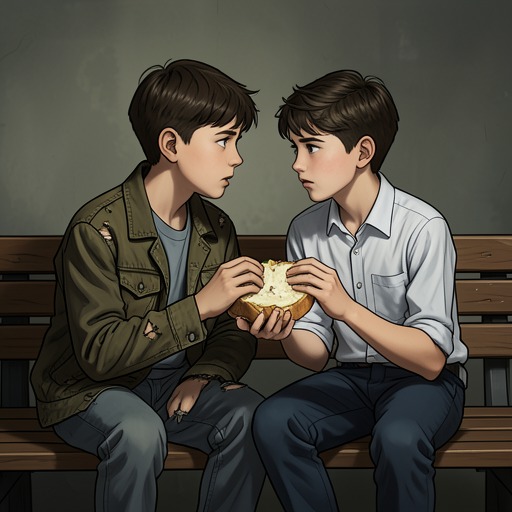
Fiete and Siggi’s Brotherly Support During His Recovery
Der goldene HandschuhFiete Honka and Siggi’s brotherly relationship is presented not as an abstract bond but as a safeguard Fiete actively seeks when he distrusts his own ability to stop drinking. Siggi can help him preserve a fragile stretch of ordinary routine, and their easy introduction to Gisela reveals a family connection that reaches back to Leipzig and includes an unresolved disappearance.
A fragile return to routine
Fiete weighs a Saturday visit to Zum Goldenen Handschuh against the routine he has managed to maintain during the week. He estimates that he has had no more than ten beers and a few schnapps over the whole week, but the weekend gives him a reason to want a drink: in his reasoning, an ordinary working person should be able to treat himself after work and begin the next week in good spirits. The wish is ordinary; his fear of what may follow is not. He does not trust himself to go to the bar alone, because one evening could turn into staying through the night, drinking until Sunday is lost, and failing to report for work on Monday.
Fiete measures that danger against the shortness of his recent progress. A single week of normality cannot outweigh the many years before it, he recognizes. The thought makes his restraint feel provisional rather than secure: wanting to go out is already entangled with the possibility of losing the routine he has just begun to recover. His brother enters this calculation as someone who might make the difference between an evening out and a return to the pattern Fiete fears.
Siggi as a practical safeguard
Fiete imagines Siggi accompanying him to the bar and taking on specific responsibilities. Siggi would watch for the evening to get out of hand, decide when it was time to leave, and keep the drinking to beer. Fiete distinguishes beer from schnapps in his own account, treating hard liquor as the thing that burns and drives a person mad, while believing that beer cannot have the same effect. This is Fiete’s reasoning, not proof that beer is harmless; what matters to the relationship is that he sees Siggi as someone who can help him enforce a limit he may not reliably enforce alone.
Rather than deciding outright whether to go, Fiete plans to visit Siggi at his home in Holstenstraße. If his brother is there and has time, they will go to Zum Goldenen Handschuh; if not, Fiete will go home. He leaves the decision to what he calls fate in the form of Siggi. The phrasing makes the dependence plain: his brother’s presence is not simply company for a night out, but a condition that may keep Fiete from making a choice he fears he cannot control once made.
Acknowledgment and family history
At the bar, Fiete introduces Siggi to Gisela, explaining that he comes there only rarely now and identifying Siggi as his brother. The introduction is brief, but it places their connection in public and lets Gisela encounter the brothers together. She has not known that Fiete has siblings. Fiete answers that there are several, but that they live elsewhere or are dead, a sweeping account that Siggi immediately corrects.
Siggi explains that one sister is missing and may be dead, though he does not believe that she is. Most of the siblings live near Leipzig, where the family came from. He expects the missing sister might turn up when no one is expecting her. His response supplies more than a correction to Fiete’s account: it shows him preserving a possibility that Fiete’s blunt summary has closed off. Gisela hopes the sister will return, and the exchange ends with a shared reflection that a person’s inner life cannot be seen from the outside. The brothers’ family history is therefore present not only as a list of absent or distant relatives, but as an uncertainty Siggi continues to hold open.
The shape of their support
The episodes show two complementary forms of closeness. Before going out, Fiete relies on Siggi’s capacity to impose practical limits; at the bar, Siggi speaks for the family and corrects Fiete without turning the encounter into a quarrel. His support is concrete rather than ceremonial: accompanying Fiete, judging when to leave, and keeping a missing sister from being treated as certainly dead. Fiete, in turn, makes his brother part of the decision about whether to go out at all.
The bond does not erase the risks surrounding Fiete’s attempt to return to ordinary life, and the evidence does not establish that Siggi can resolve them. It shows instead how Fiete tries to make restraint possible by tying it to another person’s presence. Against the scale of the many years he says cannot be undone by one good week, the plan to knock on his brother’s door is a small but consequential act of trust.