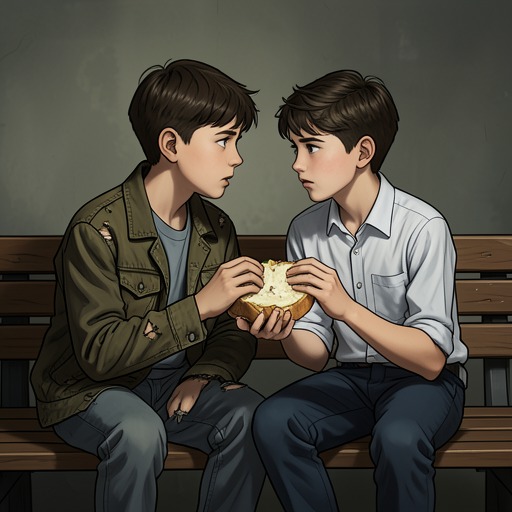
Fritz Honka and Siegfried (Siggi), Brothers Bound by Weekly Visits
Der goldene HandschuhFiete Honka and his younger brother Siggi share the one sustained family bond Fiete has left: Siggi looks after him, visits every Wednesday, and once saved his life. Their loyalty is neither simple rescue nor uncomplicated comfort. Siggi’s cheerfulness gives their meetings warmth, while his private thought that Fiete’s life only deteriorated after the rescue makes that devotion painfully ambivalent.
A Brother Who Became His Guardian
Siggi has looked after Fiete for as long as he can remember, despite being the younger of the two. He sees this as a particular responsibility because he was the one who, more or less by chance, saved Fiete during an attempted suicide in the apprentice home. Their attachment is mutual: Siggi is deeply fond of his brother, and Fiete is equally attached to him. The age reversal matters. In this relationship, the younger brother assumes the protective role, trying to keep Fiete from slipping further into ruin and onto what Siggi understands as the wrong path.
The rescue belongs to a much earlier and formative period in Fiete’s life. He had wanted to train as a motor mechanic, but because academic theory did not suit him, he was sent into a bricklayer’s apprenticeship at only fourteen. He was not allowed to leave the apprentice home. There he developed a chromium allergy known as cement scabies: a severe rash covered his body from neck to feet, with blisters and open, weeping sores. Because he did not report the condition, the camp supervisor punished him in front of the other boys with ten strokes of a cane on his bare buttocks. Fiete reached what the narrative describes as his breaking point and tried to hang himself in the tool shed. Siggi’s intervention saved him from that immediate crisis, but it did not undo the isolation, illness, or punishment that had driven him there.
A Family Reduced to One Continuing Tie
Siggi is the only one of Fiete’s many siblings with whom Fiete still maintains contact. Three siblings are already dead; one sister is known to be living in Leipzig, while the rest have disappeared from view and may also be dead. Against that attrition, the brothers’ regular contact is not incidental: it is the surviving shape of Fiete’s family life. Siggi’s Wednesday visits provide a dependable point of return in a life otherwise marked by estrangement and uncertainty.
The text also refuses to turn Siggi’s role into an uncomplicated story of rescue. He sometimes thinks secretly that it might have been better if Fiete’s attempt had succeeded, because everything that followed brought further deterioration. That thought coexists with, rather than cancels, his sense of responsibility and affection. Siggi keeps coming and keeps watching over his brother, even while recognizing the bleak course Fiete’s life has taken. The relationship’s tenderness therefore includes a painful awareness of its limits: love can preserve contact without making the life it sustains better.
Wednesday Visits and the Meal for Three
The weekly rhythm becomes especially visible when Fiete decides that the next day will be Gerda’s test in the household. Since it is Wednesday, Siggi will come, as he does every week, and Fiete expects Gerda to cook for three. He imagines his brother being astonished by a princely meal. The plan shows how much importance Fiete places on the visit: he wants to make the occasion impressive, even though the domestic scene is far from secure or comfortable.
The preparation quickly reveals the imbalance beneath that performance. Gerda finds old packets, stock cubes, and prewar boxes of seasoning and puts them into the pot. When she asks whether she may have a glass to drink, Fiete pours it into the soup instead, supposedly to improve it, and she is moved to tears. Fiete’s concern is fixed on the meal and on the effect it will have when Siggi arrives; Gerda bears the immediate cost of that expectation. The brothers’ bond is therefore presented within a household where Fiete’s desire to stage hospitality does not translate into consideration for the woman doing the work.
When Siggi arrives, he is in high spirits and greets Fiete with an irreverent joke about the smell in the home. His easy manner contrasts with the discomfort and tension surrounding the cooking. He notices Gerda at the pot and asks his brother to introduce her. Fiete has forgotten her name, as happens to him with women he lives with, and falls back on pet names when he cannot remember. This awkward moment places Siggi briefly between the brothers’ familiar routine and Fiete’s treatment of Gerda: he recognizes that someone else is there, while Fiete struggles even to name her.
Temperament, Humor, and the Limits of Care
Siggi’s cheerfulness is not merely a mask supplied by the scene; it is connected to a few settled convictions that have helped him get through life. He accepts that people differ, that life brings both sunshine and rain, and that brooding only generates more brooding and harms the soul. He fires off one saying after another, including jokes whose meaning Fiete does not always grasp. Fiete has difficulty remembering such expressions and often cannot tell whether Siggi intends them as humor, seriousness, or something else. Their difference in temperament is part of their closeness: Siggi can fill a room with effortless talk, while Fiete receives the jokes without reliably understanding their point.
That contrast also gives the weekly visits their particular emotional shape. Siggi offers a practical, undramatic kind of care—showing up, keeping watch, and continuing to treat Fiete as his brother—rather than a promise that he can repair what has happened. His humor and Fiete’s dependence on him coexist with Siggi’s knowledge that the rescue did not lead to recovery. The relationship remains vital precisely without becoming a solution: it is Fiete’s one enduring sibling connection, a recurring act of loyalty set against the losses and worsening circumstances that neither brother can reverse.