Fritz Honka’s Suicide Attempt in the Apprentice Dormitory
Der goldene HandschuhFiete Honka’s suicide attempt in the apprentice dormitory was a crisis brought on by illness, confinement, and punishment, and its survival bound his younger brother Siggi to a lasting role of care. The episode also carries a bleak retrospective weight: Siggi often thinks that, had Fiete’s attempt succeeded, what followed might not have been worse.
Apprenticeship and illness
Fiete had wanted to become a motor mechanic, but theoretical study did not suit him, and at just fourteen he was placed in a bricklayer’s apprenticeship. He was not allowed to leave the apprentice dormitory. The work brought on a chromium allergy known as cement scabies: a severe rash covered his body from neck to feet, with blisters and open, weeping sores.
Punishment and the attempt
Fiete did not report the condition. In front of the other boys, the camp leader punished him with ten strokes of a cane on his bare buttocks. The account presents the beating as more than he could bear at that point: everyone, it observes, has a breaking point, and Fiete had reached his. He tried to hang himself in the tool shed. The evidence gives no further detail about the attempt or the precise circumstances of his rescue.
Siggi’s intervention and lasting bond
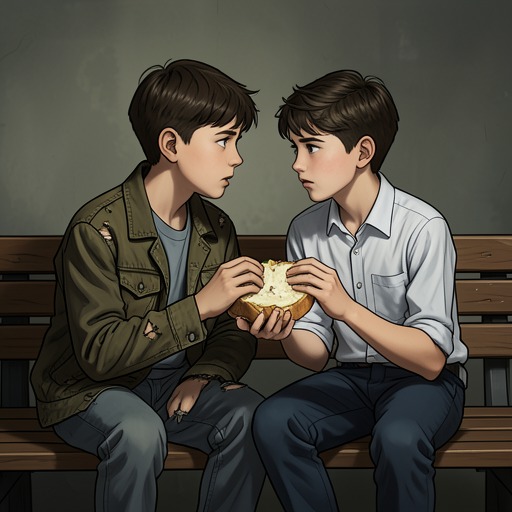
Siggi, though younger than Fiete, saved him then, more or less by chance. The rescue became a source of particular responsibility for Siggi, who thereafter watched over his brother to keep him from sinking further and going irretrievably astray. The account describes their attachment as mutual: Siggi was deeply devoted to Fiete, and Fiete to Siggi. Siggi was also the only one among their many siblings with whom Fiete maintained contact; three siblings had died, one sister was known to be living in Leipzig, and the rest were unaccounted for or possibly dead.
Retrospective significance
Siggi privately wonders whether Fiete’s life might have been better if the attempt had succeeded, because, in his view, everything that came afterward meant further decline. That thought gives the rescue a painful double edge: it kept Fiete alive, but it did not lead to recovery or release from hardship. The event explains the unusual weight of Siggi’s later vigilance, while making clear that his care could not undo the suffering that had already begun in the dormitory.