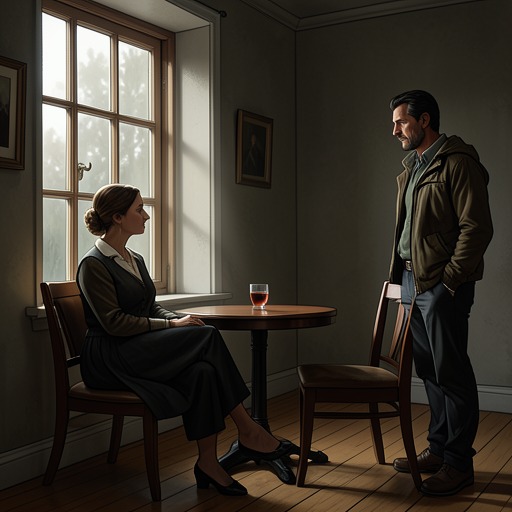
Gerda Voss Controlled and Exploited by Fritz Honka
Der goldene HandschuhFritz Honka’s control and exploitation of Gerda Voss turn a drunken invitation into confinement, forced labor, and prostitution. The relationship moves through sharply different forms of captivity: first the locked apartment and the withheld identity card, then the fish factory, and finally a home in which Gerda is made to serve Fiete Honka while he imagines himself generous. Her eventual departure with a stranger ends his immediate hold over her, but the account gives no assurance of what becomes of her afterward.
From the bar to confinement
Fiete Honka asks Gerda to come home with him from the Zum Goldenen Handschuh. She agrees at once. He sends her outside to wait about fifty metres down the Reeperbahn, saying he will follow in ten minutes, then spends his remaining money on two double shots of grain liquor. It is bitterly cold, and Gerda has only a thin coat over her work smock. When Fiete eventually looks for her, she is near a sausage stand; a passing smell of bratwurst offers some relief from the wind. He is angry that she did not wait where he had instructed, but Gerda has reached the limit of her patience. They set off together for his home, a walk of roughly two and a half kilometres that the exhausted pair take far more slowly than he expects.
After they return, drinking replaces any ordinary welcome. Fiete alternates two records, Es hängt ein Pferdehalfter an der Wand and Es geht eine Träne auf Reisen. There is no food, though Gerda is hungry and afraid to complain because she has no money. That night, Fiete takes her identity card, calling it security and collateral. The next morning, before leaving for work, he locks her inside and takes the card with him. A document that establishes her identity becomes part of the mechanism that restricts her movement; the locked door makes the dependence immediate and physical.
Domination in the apartment
Fiete’s control is not presented as a single act but as a daily arrangement in which Gerda’s needs and choices are made subordinate to his. She tries to make the apartment more bearable by cleaning it. When Fiete comes home to a cleaner room, he is moved to tears and rewards her by taking her out to the Zum Goldenen Handschuh. He treats this outing as evidence of his own generosity, despite having confined her in the apartment and withholding the means to leave independently. At the bar, the two drink heavily. Watching Gerda keep pace, he worries about the cost and decides that she must work.
His thoughts turn toward enslavement with pleasure. When Gerda tells him she has a daughter, Rosi, he becomes interested less in their relationship than in the prospect of meeting her. Gerda describes Rosi as a thirty-year-old who works in a butcher shop, and gives an affectionate account of her appearance and scent. Fiete turns this into an elaborate sexual fantasy, imagining Rosi displayed as meat for sale and Gerda presenting her to him. The fantasy makes his outlook unmistakable: he recasts both women as objects available for his appetite, even though Rosi is not present and he never meets her.
The daily abuse becomes explicit when Fiete demands that Gerda collect her fallen dentures. He makes her repeat the word for teeth before allowing her to gather them, then tries to repair the dentures with glue. When his attempts fail, he throws them down, threatens to give her only food she can manage without teeth, and strikes her again when she cries. Gerda gathers the pieces and puts them in a cup. The next day she searches the apartment for something to eat and tries to mend the dentures herself, eventually finding cement glue that holds them together. Hunger and the damaged dentures are not incidental discomforts: they show how completely Fiete’s power reaches into the most basic conditions of her survival.
Forced work and sexual exploitation
As days dissolve into heavy drinking, Fiete sends Gerda to work in a fish factory. She adjusts to the physically demanding job, but the money she earns does not give her independence: every Friday she hands it over to him and receives a small treat in return, such as sweets or filter cigarettes. The exchange makes her labor another part of his control. She works, surrenders the wages, and is given only a token reward.
When Fiete suffers another serious workplace accident, including a broken pelvis and a double fracture of the nose, he spends six weeks in hospital. Gerda goes to the Elbschlosskeller after work, as she had done before. One night an older man offers her ten marks to take him home. Soon she stops going to the factory and goes only to the cellar. The apartment becomes a brothel: Gerda has sex with elderly men who come and go, while the household and her sense of what she can manage seem to disintegrate. The account does not frame this as a stable escape from Fiete’s exploitation; prostitution emerges within the same precarious life, with Gerda unable to see a way forward and fearing that Fiete may beat her to death.
Departure and narrative significance
Gerda finally asks a visiting man from Hanover whether she can go with him. He agrees, and she leaves with him; after that, her trail disappears from the account. The ending is a departure, not a documented recovery. It breaks the immediate arrangement in which Fiete confines her, takes her wages, and determines what work she does, but it does not reveal where she goes or whether she reaches safety.
The episode’s progression—from the borrowed identity card to the locked apartment, from wages surrendered every Friday to men brought into the home—shows control operating through both confinement and economic dependence. Fiete’s self-image as a benefactor sharply contradicts the conditions he imposes: he takes Gerda’s documents and freedom, then regards an outing or a small treat as proof of kindness. Gerda’s labor, hunger, damaged dentures, and eventual disappearance give the story’s account of exploitation its concrete measure. Her exit comes not through a negotiated release but through a chance offer from someone passing through, leaving her fate unresolved.