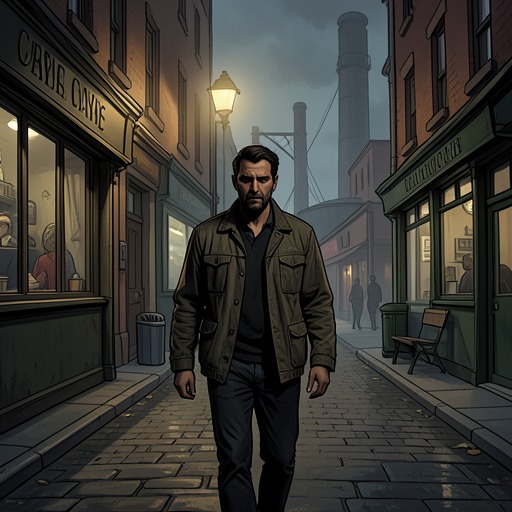
Hamburg Landungsbrücken
Der goldene HandschuhHamburg Landungsbrücken is the waterfront setting for a rare interval of clear attention in Fiete Honka’s life. On a bright Saturday, he walks there from a neglected swimming pool, watches a disabled artist paint the harbor at the Elbe River, and, instead of simply passing through, decides to see the port by boat. The place turns an ordinary outing into a measure of what sobriety lets him notice—and of how little he knows about a harbor he has lived near for years.
The Walk to the Waterfront
Fiete Honka reaches the Landungsbrücken on foot in fine weather, encouraged by a boundless blue sky and towers of cloud showing through it. On the way, he pauses at an abandoned swimming pool: concrete slabs have burst apart, a plywood kiosk is partly collapsed, the basin is empty and mossy, and the lawn has become a rubbish dump. The signs of decay hold his attention rather than sending him on. A little girl sticks out her tongue at him; his inward response turns abruptly cruel, imagining her years later among the women he calls the Pflaumenspeicher.
At the Elbe River, the contrast is sharper still. A man without arms or legs sits before an easel, holding a brush in his mouth and painting a portrait of the Hamburg harbor from a paintbox. He moves his head with practiced precision and remarkable speed. Fiete registers the skill with admiration. The encounter belongs to the same attentive walk as the derelict pool, but it offers a different image: not simply deterioration, but concentrated work carried out with an astonishingly limited means.
Seeing the Harbor Sober
At Hamburg Landungsbrücken, Fiete notices that he takes in far more while sober than when hungover or drunk. His word for the blurring effect of heavy drinking, Schmiersuff, suggests something smeared over the world; the harbor visit makes that loss of perception tangible. The change is not a grand revelation but a practical discovery made while walking and looking: without alcohol clouding him, details that would usually go unseen come into view.
The harbor itself is familiar territory only in appearance. Fiete reflects that someone might think he knows it, yet a random tourist can learn more from a single harbor tour than he has in many years. The thought turns familiarity into a kind of ignorance, and the excursions advertised along the waterfront offer him a modest way to address it.
Choosing a Small Cruise
After wandering uncertainly, Fiete buys a roll with Bismarck herring and sits on a bench to weigh the options: a large or small harbor cruise, with or without the Speicherstadt, or trips to the Altes Land and Finkenwerder. There is no shortage of choices, but he settles on the smallest beginning—a short tour aboard a small vessel. The ship’s name, Wilma, appeals to him, and its departure is listed for every full hour. A sign directs passengers to buy tickets on board.
The cruise begins with the guide, Kuddel, welcoming the passengers in a broad Low German comic routine. His patter jokes that every ship has someone aboard who talks foolishly, and turns the prospect of sinking into a punchline. One passenger, whom he addresses as a young woman, is plainly about fifty; she ignores the performance, unpacking bread with sausage and cheese while her small, stout husband peels boiled eggs. The detail keeps the outing grounded in the unceremonious reality of a public excursion. For Fiete, however, choosing the Wilma is itself a first step toward seeing a familiar place from a new vantage.