Homelessness
Der goldene HandschuhHomelessness in the novel is not simply the absence of an address: it means facing the cold without money, not knowing where the night will be spent, and depending on precarious offers of shelter. Through Gerda Voss and Agnes, the narrative shows how little separates a momentary refuge from renewed exposure, while making the bar both a gathering place for people at the margins and a space with its own conditions of entry.
Exposure and the Bar
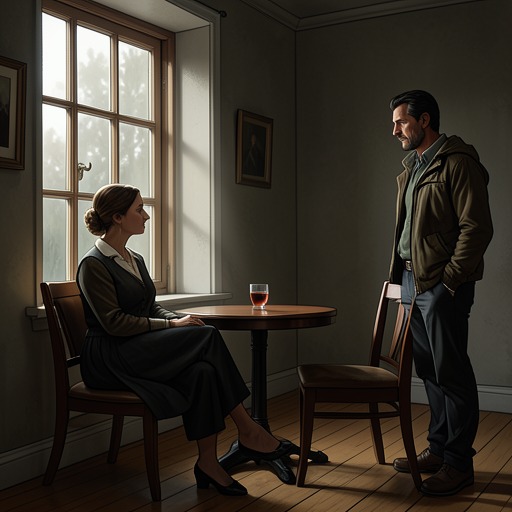
At the Zum Goldenen Handschuh, Fiete Honka recognizes Gerda Voss as a woman without a fixed residence. She has no money to buy herself a drink, and the bar’s rule leaves her with a stark choice: drink, or go back outside in below-freezing temperatures. Fiete pays for her drink, using the purchase as a way to prompt an introduction. The gesture secures Gerda Voss a little time indoors, but it also makes clear how conditional that shelter is: she must be brought into the bar’s social exchange to remain there.
The scene presents homelessness through bodily vulnerability rather than abstraction. Gerda Voss enters trembling with cold, her appearance marked by neglect and exhaustion. The bar gives her warmth and human contact for the moment, but it is not an unconditional refuge. Its protection lasts only while she can meet the threshold imposed on her, or while someone else chooses to pay it for her.
Eviction and Life on the Street
Agnes’s homelessness follows the loss of the home in which she had spent nearly twenty years largely shut away from the outside world. She had treated the outside as a source of danger; when her apartment is terminated, that retreat ends, and she is left on the street. The reversal is severe: a place that had allowed her to hide from the world is gone, while the world she feared becomes unavoidable.
Agnes does not know where she will sleep. In the company of Inge and Hildegart, she belongs to a precarious circle of women surviving at the edges of ordinary life. When opportunities arise, Agnes turns to prostitution; Inge and Hildegart get by through small-time scams. The narrative gives these acts as circumstances of survival, not as a route out of insecurity. The women believe they will die earlier than others, yet even the time remaining to them feels too long. Their expected disappearance from public view makes homelessness seem not like a brief interruption but a condition from which they may simply vanish.
Temporary Refuge and Dependence
When Fiete Honka asks Agnes where she will sleep that night, she can only shrug: she genuinely does not know. He offers to take her with him, promising that she can sleep properly and eat her fill. The offer answers immediate needs—rest and food—as well as the more basic question of where to go. Agnes gathers her few belongings quickly. She is also afraid that Inge will turn her anger on her and Hildegart, so the prospect of leaving the group carries its own risk and urgency.
The scene places the promise of refuge beside the fragility of Agnes’s situation. Fiete’s offer gives her a possible night indoors, not a secure home or lasting independence. Even the act of gathering her possessions suggests how little she has to carry and how quickly she may have to move. Shelter appears as a temporary arrangement mediated by another person’s decision, rather than as something Agnes can reliably claim for herself.
Social Marginality and Narrative Significance
Gerda Voss and Agnes encounter homelessness in different immediate circumstances: Gerda Voss needs someone to buy a drink to remain inside a freezing night, while Agnes has lost the apartment that had contained her isolation and cannot say where she will sleep. In both cases, access to shelter depends on fragile personal exchanges. The bar can admit someone for a drink; Fiete can offer a place to sleep and food. Neither scene describes a dependable safety net.
By placing these encounters amid the Zum Goldenen Handschuh’s regulars and other marginal figures, the novel makes homelessness part of the social world of the bar rather than a distant condition. Yet visibility there is not security. A person may be noticed, named, or briefly helped and still have no assured place to go when the night ends. The contrast gives the bar’s warmth a double meaning: it is a refuge from the cold, but one governed by immediate bargains and the uncertain goodwill of others.