Karl von Lützow
Der goldene HandschuhKarl von Lützow, the younger brother of Margot von Dohren, is a man of inherited privilege whose polished social position conceals an empty, restless life. He craves novelty but resists genuine intimacy; in one relationship he responds to a woman’s fear with force and then tenderness, while his bond with Margot is marked by routine, acceptance, and quiet affection. Across these contrasts, the story presents a character who can recognize the comfort of care without extending the same freedom or respect to everyone around him.
Identity, Privilege, and Ennui
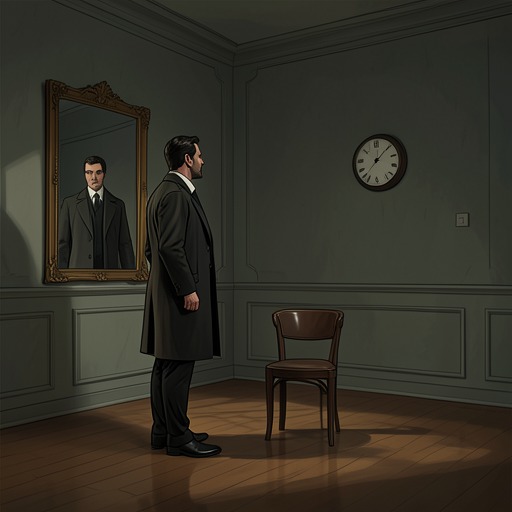
Karl spends an afternoon alone in his office, his feet on the desk and his gaze turned toward the fjord. Both appointments have been cancelled, leaving him with a stretch of empty time he experiences not as freedom but as a kind of pain. He remembers the sadness and diffuse melancholy of his youth, but says that these have given way to an almost unbearable vacancy. He once walked for hours expecting a revelation that might solve his life; now he has stopped trying to understand himself. Boredom is not a passing inconvenience for him but the atmosphere in which his days collect.
His class position shapes what he considers natural. A tax bill delays his bathroom renovation by six months, irritating him even though he does not especially care about money: he believes that someone of his standing is entitled to more of it. His sense of superiority is so ingrained that he defines himself by ordinary things he considers beneath him, including bargain shopping, camping, community festivals, and lawn-mower rental. The passage makes privilege visible through his tastes and disdain, not simply through wealth: even the everyday vocabulary of other people becomes, to him, a catalogue of social inferiority.
Karl’s self-regard does not protect him from humiliation or despair. He dislikes being seen drunk and avoids the social rituals that make drinking communal. He once enjoyed drunken revelry, but now fears appearing ridiculous and becoming the subject of contemptuous remarks. He usually prefers to drink alone, with rare exceptions when lively young women draw him into company. His occasional thought of trying cocaine is checked by fear for his mind, sharpened by the example of a cousin who has spent years in a psychiatric institution after a disastrous early experiment with drugs.
Drinking, Despair, and the Need for Control
Alcohol is both Karl’s private refuge and a force that undermines his control. Asked whether he can stop drinking once he has begun, he answers uncertainly before settling on yes. At his lowest point, he imagines putting a pistol to his temple and firing, and finds the fantasy of ending everything strangely soothing. Because he considers an impulsive suicide possible, he keeps the revolver in a tool shed about thirty metres away; when drunk, he believes he cannot manage the distance. The separation is a grim practical barrier, not a resolution of the thoughts themselves.
His conduct toward the gardener exposes another side of his appetite for control. After urinating in a houseplant, Karl is seen by the startled, soaked-through man. Rather than conceal what he has done, he calmly finishes dressing and lets the gardener witness the breach between the aristocratic exterior and the vulgar act beneath it. His attention turns to the man’s discomfort and exhaustion. The scene joins carelessness to deliberate provocation: Karl is not simply caught behaving badly; he chooses to make another person bear the awkwardness of seeing him.
Margot: Routine and a Rare Place of Safety
Karl’s relationship with Margot is the most dependable source of warmth in his life. Once a month, on a Saturday, she visits him: he collects her at the station in Kiel shortly after noon, they spend the day together, and she returns to Hamburg in the early evening. He loves the repeated shape of these visits and believes he would be in a bad way without her. Although the family is large and widely dispersed, Margot is, in effect, his own personal family.
Their shared habits make room for him as he is. At lunch in the Alte Mühle, Margot orders her familiar roast beef meal, while Karl, hungover from schnapps and cigarettes, manages only pasta and a small drink to steady himself. He imagines that another woman would reproach him for appearing so wretched. Margot instead strokes his hand and leaves him free to speak or remain silent. Their conversation rests on agreement and ease rather than interrogation. The contrast is significant: Karl expects criticism from others, but with his sister he experiences attention without pressure to perform or explain himself.
Margot tells him about an invitation from Peter Thiessen to go fishing, an idea that amuses them because Karl cannot picture himself dressed for such an outing. She also mentions a serious problem facing the von Dohren shipping business. A vessel ordered by WH 2 in 1971, at the height of the tanker boom, was delivered after prices had collapsed; the oil crisis had sent crude from three dollars to forty dollars a barrel, and the ship now lay idle in a remote cove, costing thousands of dollars a day. Karl nods and assumes a solution will be found. He would rather not hear of the difficulty, but trusts Margot’s judgment that its mention means it is not yet too grave to discuss.
After lunch, the siblings walk beside the Baltic Sea at Laboe. Moving silently in the rhythm of the waves calms Karl, and the dark thoughts that had risen that morning finally recede. He stops and embraces Margot without warning, a gesture he would not imagine making toward anyone else. Later, as a summer storm drives them into a café, they exchange family news under an unspoken rule not to speak ill of relatives. Margot’s capacity to concentrate on what comforts her, acquired during a serious illness that once kept her in bed for nearly a year, helps her endure a difficult family life. Karl sees that ability as a gift he himself lacks. Their closeness is genuine, though the shared avoidance of painful subjects also helps preserve its calm.
Frauke and the Collapse of Restraint
With Frauke, Karl’s pursuit of novelty becomes more troubling. He considers inventing a dental appointment to explain his slurred speech when he calls her, and deliberately keeps his invitation uncertain, treating that uncertainty as a tactic. Later, when he wakes aroused, he thinks of elaborate sexual games he has not discussed with her. He imagines making her squeeze into an old, now-too-small costume and insulting her about her weight, persuading himself that she must be waiting for this. His certainty is not based on any conversation with Frauke; it replaces her consent with his own fantasy of what she wants.
The scene turns from fantasy into a violent struggle when Frauke tries to get away. After Karl falls asleep, she attempts to leave, but trips over a lamp cord and crashes to the floor, waking him. Afraid that she will go to the police, he grabs her skirt as she kicks, strikes, and bites at him. He pins her down with his knees until her resistance fades. She begs and weeps. Karl then shifts abruptly into soothing gestures: he strokes her head, kisses her, apologizes repeatedly, and tells her that he loves her. He washes her face and hands, cleans her neck, moistens her lips, and waits beside her as they breathe together until her terror subsides.
That care does not undo the violence that made it necessary. The abrupt change from restraint by force to patient consolation reveals how Karl can recognize fear once it is directly before him, while still making his own desire and fear of consequences the scene’s governing forces. His relief that the episode has passed without further trouble centers on his own exposure. Tenderness appears, but it follows coercion and serves to quiet the danger rather than repair the imbalance between them.
Family Performance and the Unfinished Turn
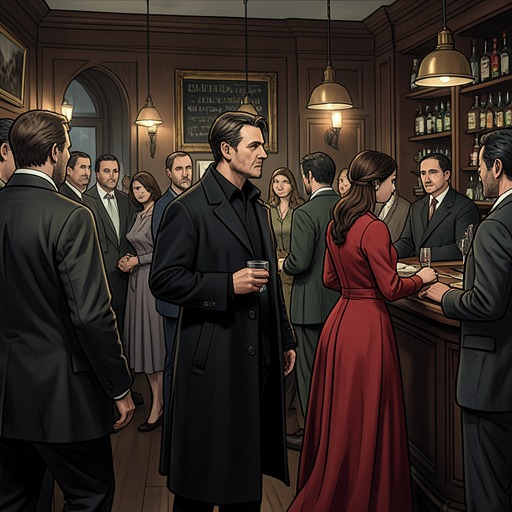
Karl also appears in the family gathering for WH 1’s eightieth birthday. The reception is planned for Saturday, with the evening reserved for relatives; Karl and Manuela arrive with August and the sixteen-year-old twins the day before. WH 1 longs for a final, irreparable family rupture and entertains lurid imagined catastrophes, but there is no buried feud among the siblings to set them off. At the evening gathering, WH 2 keeps hosting and steers the conversation through familiar public questions. Karl speaks only when addressed. He finds the talk lifeless and imagines instead the strangers and possibilities the night might bring. Even amid family ceremony, his attention moves away from the people present toward an anticipated experience elsewhere.
That pursuit continues in the Triangel, where a gin and tonic leaves him unsteady and he switches to water. He notices a trio of women and singles out a dark-haired woman with dimples and a bobbed haircut, deciding that he wants her that night. His attention is selective but still organized around his own appetite: the evening matters as an opportunity for novelty, not as an encounter whose meaning must be shared. At the Golden Glove Tavern, after a night in which nothing has gone as he hoped, even the woman who let him put an arm around her has left with her companions. Karl reads this as a last warning to stop chasing wishes that cannot be fulfilled and tells himself that he must adapt to reality, as other men supposedly learn to do.
The apparent resolution remains uncertain. He arrives exhausted and calls the tavern his final stop for the night—and, in his wish, for the following days or even forever. He recognizes the cost of pursuing desire without restraint, but recognition alone does not establish lasting change. His story is held between two kinds of relationship: Margot’s settled companionship, in which silence and habit can be comforting, and a wider social world in which women risk being reduced to instruments of his stimulation. At the end, he can name the need to accept limits; whether he can live by it is left open.