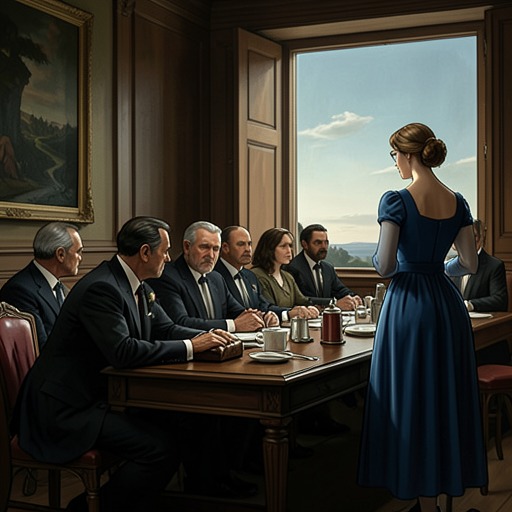
Manuela
Der goldene HandschuhManuela is the eldest daughter of WH 1 and the wife of August, a shipping-company owner whose life in the marriage is presented as one of prolonged submission to her. At her father’s eightieth-birthday celebration, she appears composed and attentive to the family’s social performance, while privately, as the narration frames it, keeping an eye on the inheritance she expects. That expectation rests on a crucial misunderstanding: she does not know that the shipping company is bankrupt or that WH 1 has already transferred his wealth to a foundation.
Identity and Family Position
Manuela arrives on the Friday before WH 1’s Saturday birthday reception with August and the sixteen-year-old twins Helene and Martina. The formal gathering is scheduled to begin at eleven in the morning and continue into the late afternoon; the evening is reserved for family. Juliane and Gunter are expected later on Saturday. The arrangement gives Manuela a prominent place in a carefully staged family occasion, but the gathering does not produce the reckoning WH 1 longs for.
WH 1 has saved up his hatred in the hope of provoking a final, irreparable rupture. He imagines spectacular disasters involving the people around him, including Manuela, but the actual family holds no concealed reserve of sibling hatred or envy. The narration describes its members as largely indifferent to one another. Manuela, for her part, puts a good face on what she regards as a dull occasion and keeps watch over the inheritance. She neither recognizes the scale of the company’s financial crisis nor knows that the fortune she counts on is no longer available to inherit. Her apparent focus on future wealth thus unfolds against a family conflict that exists chiefly in her father’s fantasies, and against an economic reality hidden from her.
Marriage to August
The marriage is described in unusually stark terms: almost everything that could go wrong has gone wrong. Manuela is characterized as domineering and unpredictable, while August is cast as her lifelong dependent, enduring punishment without knowing what he has done to deserve it. The image is one of a household hierarchy that has lasted for half a human lifetime, with no end in sight. The account does not offer a scene of Manuela explaining or defending her conduct; instead, it presents the imbalance through August’s condition and the narrator’s sharp assessment of their domestic life.
That account also complicates the picture of August as simply trapped. His subordination is said to fit him as though made to measure: if released from one dependent role, he would immediately enter another. WH 1’s suspicions about August’s capacity for a secret double life are therefore not wholly misplaced. Given the opportunity and enough courage, August would pursue multiple parallel lives, perhaps as many as three and a half families or relationships, until the arrangement destroyed him. The imagined schedule—different families across the Christmas holidays, then a mistress later in the evening—makes his appetite for escape look less like a plan than another form of self-erasure. Manuela’s control is real within the marriage as described, but the narration does not portray August as an independent figure waiting only to be freed from it.
The Birthday Gathering
During the Saturday celebration, Manuela’s concern for appearances stands out against the family’s awkward, strained sociability. August has mixed himself a strong gin and tonic too early and, briefly buoyed by the drink, tries to entertain the gathering with prepared anecdotes, jokes, and shipping jargon. The narration says Manuela finds his performance embarrassing and directs poisonous looks at him, while he is so absorbed in his own stream of talk that he does not notice. WH 2 eventually takes over as host, steering the conversation and drawing others into it. Manuela’s presence is therefore part of a social scene in which her husband’s effort to perform cheerfulness becomes another source of discomfort between them.
By eight in the evening, the family has assembled in the red salon. August sits collapsed in his chair, staring ahead, with his jacket buttoned incorrectly; he repeatedly thinks about how ill he feels and imagines the illnesses working inside him. He longs for retirement, for his daughters to leave home, and for his wife to die, because he believes only then will there be peace. These are August’s thoughts, not a statement of what Manuela knows. The narrative nevertheless stresses the visible contrast between his distress and her response: she lets him sit and suffer, and the account calls attention to her mercilessness.
As August’s condition rapidly worsens, sweat gathers on his forehead and he twists in his chair. Gunter, already drunk, tries to discuss the new ship-manning and training regulations, which require German shipowners to employ twenty-five German sailors on each freighter while foreign competitors can use eighteen cheaper sailors. The subject touches directly on WH 1’s shipping concerns, but Gunter can barely make himself understood. Before he can finish, August collapses with a loud wheeze. A later call from the hospital establishes that the episode was not a heart attack but an attack from which he can be discharged the next day. The evening is over all the same. The scene does not show Manuela intervening or disclose her private response; it leaves her role sharply defined by the narration’s account of her allowing his suffering to continue.
Characterization and Narrative Role
Manuela is presented through the collision of social composure, financial expectation, and marital dominance. At the birthday, she maintains a good face while pursuing an inheritance that no longer exists in the form she imagines. At home, the narrative depicts her as a formidable presence before whom August has spent much of his life in submission, even as his own inclination toward dependency makes that arrangement more complicated than a simple story of escape and captivity.
Her significance in these scenes lies partly in what she does not know. She watches the family gathering with an eye on future wealth without realizing that the company is bankrupt and WH 1 has already placed his assets beyond her expectations. Meanwhile, her husband’s collapse interrupts the birthday before the family’s ordinary tensions can become any dramatic confrontation. WH 1’s hoped-for catastrophe never arrives; instead, the evening exposes quieter failures—an inheritance misread, a marriage sustained by domination and passivity, and a family whose members remain largely indifferent to one another.