Nachkriegszeit
Der goldene HandschuhNachkriegszeit is not merely the setting left behind by the Second World War; it is a condition in which war and Nazi rule keep determining who can recover, who retains wealth, and whose past is publicly acknowledged. The novel sets the lasting damage suffered by veterans beside the advantages and resentments of a shipping magnate whose fortune benefited from the dispossession of Jewish families, then follows the afterlife of these histories into later generations and public acts of remembrance.
War's Human Aftermath
Soldaten-Norbert embodies a particularly damaged passage from the end of the war into the postwar years. Captured in April 1945, he moved directly from captivity into the French Foreign Legion, whose recruiters sought men among former Wehrmacht and SS personnel. From 1948 to 1953 he served in Indochina. After his discharge, he never found stable footing: work as a longshoreman, night watchman, and laborer ended quickly, usually because of alcohol. By the time he works in garbage collection, early starts have made him drink somewhat less, but he regards the descent from SS man to refuse collector as intolerable.
His response to that humiliation is self-injury. He strikes his ankle with an aluminum cane to make it swell and secure a week of sick leave, during which he can drink without interruption. At the bar, his stories of war take over the room: he recounts the grotesque injuries and death of a comrade, speaking for five, ten, fifteen minutes before falling silent mid-sentence into a vacant delirium. The narration presents memory not as a past Norbert can put away but as something that has eaten into him. His postwar degradation and his wartime recollections meet in a life still organized around violence.
Wealth, Complicity, and Postwar Judgment
Wilhelm Heinrich von Dohren, later called WH 1, represents a different inheritance from the same history. He had joined the Nazi Party in the 1920s, not, as he sees it, from conviction but because he anticipated the Nazis' rise to power. In 1935, the Arronge family was among the first Jewish families to be dispossessed. Their villa on Harvestehuder Weg, their estate at Hornbek, and their entire fleet passed to WH 1, a party member positioned to benefit from the transfer.
After the war, information emerged about the Arronges' fate: some had escaped abroad, while most of those who remained were deported to camps and murdered. The Allies also confiscated two-thirds of the von Dohren fleet. Ostracized by Hamburg's merchant community, WH 1 faced enough pressure to surrender management of the business to his son. Yet he treats this consequence as an injustice to himself, reasoning that other established families also derived their fortunes from the slave trade. His grievance does not amount to an acknowledgment of the people whose property he acquired; instead, it becomes another item in an expanding account of his own injuries.
Silence, Resentment, and Delayed Recognition
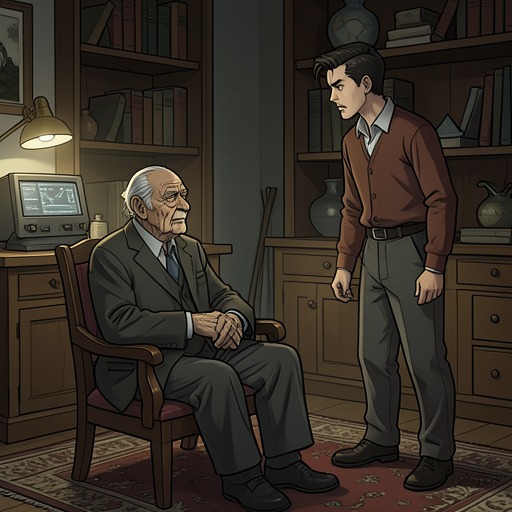
For decades after losing control of the company, WH 1 turns withdrawal into a performance. After his wife Emily's death, he speaks even less, moves with an exaggerated slowness, and lets his family believe that age and senility are overtaking him. Beneath that appearance, he preserves his anger and records insults, slights, and failures to show him respect in a book, assigning points and corresponding punishments for a future moment when he can take revenge. The postwar transfer of power thus persists in private as a grievance, even as the history behind his wealth remains unaddressed in his own account of himself.
That private story collides with public recognition when his son arranges a ceremony intended as WH 1's rehabilitation. WH 1 is kept unaware until five minutes before noon, leaving no time to protest; even the presence of the senator for the interior does not make the occasion feel like an honor to him. Seeing Leyendieker again after a quarter-century, WH 1 rejects reconciliation and gratitude. What is staged as an exonerating gesture lands, in his understanding, as an insult. The scene exposes the gulf between public commemoration and personal change: the ceremony cannot undo the history of dispossession, and it cannot dislodge the hatred in which WH 1 has made himself at home.
A History That Outlasts Its Generation
The novel places Norbert's unprocessed war memories and WH 1's resentment side by side without making them equivalent. Norbert is broken by the violence he remembers; WH 1 remains embittered after benefiting from persecution and then losing his grip on the business. Their contrasting lives show how the postwar period distributes consequences unevenly: traumatic memories can disable a veteran, while the consequences faced by a powerful beneficiary appear chiefly to him as a loss of status.
The afterlife of the period reaches beyond these older men. In 1993, Fritz Honka agreed to take the name Peter Jensen and was transferred to a care home in Scharbeutz. Alcohol remained forbidden. During a two-month trial period he adapted well, and his condition visibly improved; in later years he lived quietly in a single room, leaving it for meals and, in good weather, to go outside. This much later episode does not erase the violence of the earlier decades. Instead, the novel's movement across time keeps the postwar past present in changing forms: in a veteran's recurring delirium, in a family's disputed inheritance and remembrance, and in the long institutional afterlife of a notorious criminal.