Public Attempt at Reconciliation at WH 1's Eightieth Birthday
Der goldene HandschuhWH 1’s eightieth-birthday celebration becomes the setting for a public attempt to rehabilitate him, engineered by WH 2 and delivered by Gerhard Leyendieker. The gesture is meant to end two decades of exclusion from Hamburg society and offer WH 1 a late-life vindication. Instead, the ceremony exposes the distance between the reconciliation others have arranged and the hatred WH 1 still inhabits. He has prepared to confront his former associates, but when the moment arrives, he cannot speak.
Background and the campaign for reconciliation
With the family business facing bankruptcy, WH 2 wants to accomplish something for his father before time runs out: obtain a unanimous, official absolution and restore him to the standing from which he was excluded. WH 2’s purpose is not simply to secure a ceremonial compliment. He has begun, perhaps to his own surprise, to feel solidarity and something close to pity for an old, broken man who has already lost much and whose old mistakes continue to be held against him. Reconciliation is an unfamiliar impulse in him, but he believes twenty years of banishment from Hamburg society are enough.
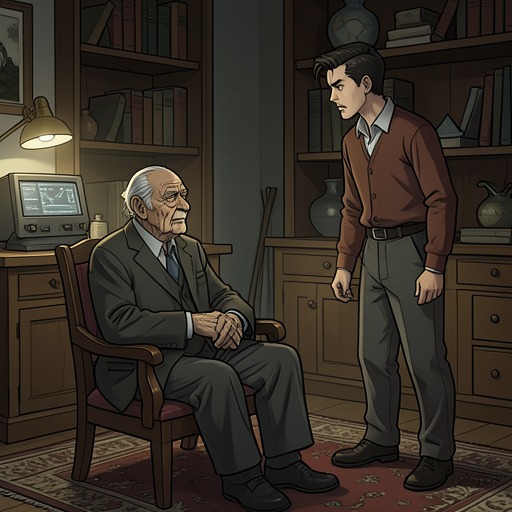
For almost a year, WH 2 patiently cultivates the people whose agreement matters. He approaches Peter Marquardt, chair of Verein Deutscher Reeder; maritime coordinators Ernst von Telkow and Raimer Moritz, responsible for lobbying in Bonn; and Peter Vossbuhr, head of Vereinigung Hamburger Schiffsmakler und Schiffsagenten. Gerhard Leyendieker is the last person he must persuade. Born in 1895, the same year as WH 1, Leyendieker went to the same school as him. Their relationship has passed from friendship to rivalry and then to estrangement. WH 1 still hates Leyendieker with all the force he can muster; for Leyendieker, by contrast, WH 1 has become a person who no longer matters.
WH 2 waits while Leyendieker talks with Bertram Theissen, the head of Hapag Lloyd. The two men dislike one another and disguise their hostility with exaggerated, false cordiality; on this occasion they shout over each other as if the antagonism were a joke, though it is not. WH 2 holds back until Leyendieker addresses him. Theissen, already heavily drunk, eventually gives way and leaves. Leyendieker then agrees to the rehabilitation, presenting it as time to bury the conflict and insisting that even a grave mistake can be forgiven. He adopts the part of a magnanimous, softened-by-age peacemaker. They decide that WH 1’s approaching eightieth birthday will be the occasion, and that Leyendieker himself will bring him the news.
The public ceremony
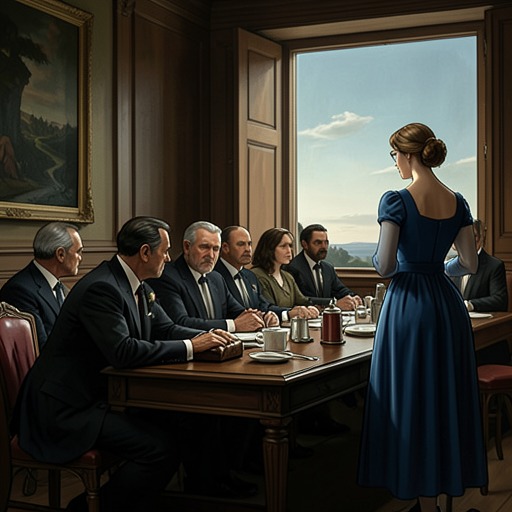
WH 1 is the only person who has not been told that his rehabilitation is coming. The gathering catches him off guard: prominent guests have assembled, including the interior senator. WH 2 has arranged to explain the purpose of the occasion only at five minutes to twelve, leaving his father no opportunity to protest beforehand. The timing makes the public gesture difficult to refuse without first having to confront it before the assembled company.
The celebration takes place in oppressive heat. The temperature is already close to thirty degrees; sunlight breaks across the river, and the air seems to boil. At noon, Gerhard Leyendieker makes his way to the microphone, exhausted by the short walk, sweating and visibly struggling to remain upright. He grips the lectern and gives one of his three standardized speeches, a familiar performance whose wording has been settled in advance.
He begins with Hamburg’s standing as a port, praising its infrastructure and connections to the hinterland while acknowledging the difficulties of the long approach up the Elbe and the tide’s effect on heavy ships. From there he turns to the obligations of the Hanseatic merchant tradition and the need to accept the globalization of trade. He recalls the construction of the first container terminal at Burchardkai and mentions that Aristotle Onassis had a tanker built in Hamburg in the 1950s. The speech is padded with tedious jokes, including familiar remarks about the difficulty of understanding women. Its businesslike port history and prepared humor delay the occasion’s real purpose: the tribute to WH 1’s life’s work.
That phrase carries a troubling implication. There is little to say about WH 1’s postwar years, and the narrative suggests that Leyendieker’s reference to his life’s work must reach back to WH 1’s role during the Nazi Era. Leyendieker nevertheless manages to steer the speech to its conclusion. He shakes WH 1’s hand with conspicuous solemnity, warmth, and duration. The handshake is not merely a sign of peace: it is also staged as a gesture of domination, turning the public act of reconciliation into a physical encounter WH 1 has not chosen.
The speech WH 1 cannot deliver
WH 1 has spent his strength saving himself for this moment. He has rehearsed the response a thousand times and arranged it in exact sequence. He would begin with flag registration: the practice of registering ships in Liberia and other countries to save money. In his furious, nationalist conception, shipowners who did this were betraying Germany, and he planned to draw a parallel with military deserters. The planned speech would then move from public accusations to claims about dirty deals and illegal business, including transactions associated with Café Lausen and Susis Show Bar, and the way commercial agreements were celebrated with visits to brothels.
After exposing what he regarded as the respectable men’s hypocrisy, WH 1 intended to turn on the people around him one by one. He had insults and curses prepared for Margot, August, his son, and his grandson; in his imagination, the reckoning might last for hours or even days. He also imagines what could follow his denunciation: the others might beat him to death, hang him upside down in a cold room among frozen carcasses, and leave his body until its blood darkened and its entrails congealed. This is not a speech he actually makes, nor an assault that takes place. It is the elaborate private script of a man who has preserved his anger as if it were his last remaining power.
When the moment comes, nothing comes out. WH 1 is old, paralyzed, exhausted, and spent; he has waited too long. The lethargy, weakness, and senility that he had once only pretended to possess have entered him without his noticing. Instead of the denunciation he has rehearsed, his throat produces a steady, low snoring sound, like a rough foghorn. Leyendieker looks at him and waits. When WH 1 says nothing, Leyendieker releases his hand and strides toward the buffet.
Consequences and significance
The ceremony gives WH 2 the public outcome he worked to secure, but it does not produce a mutual reconciliation. WH 1 neither feels honored nor grateful; the intended act of release lands as a slap in the face because it mistakes him for someone ready to be reconciled. His hatred and fantasies of revenge have become so settled that he could not simply exchange them for forgiveness, even if he wished to. Yet by the time he might have voiced that refusal, his body has failed him. His silence is therefore neither acceptance nor a triumphant restraint: it is the consequence of a decline that has overtaken the performance of weakness he once controlled.
Afterward, WH 1 listens to his heartbeat and feels his body jolted by its dull, light blows. He no longer wants to go on living. His thoughts turn toward vanishing—being hurled against a wall by a violent gust, dissolving, or being swallowed by the earth—and he longs only to be gone. The public occasion intended to restore his place instead leaves his private despair exposed to the reader, even as it remains unspoken to the guests. WH 2, meanwhile, is immensely relieved that everything has gone smoothly as far as the ceremony is concerned. He expects to get through the rest of the afternoon and evening, after which quiet will return for a long time. That relief sharpens the event’s central irony: the family’s formal success and WH 1’s inner defeat coexist, without bringing father and son, or former friends, into genuine accord.