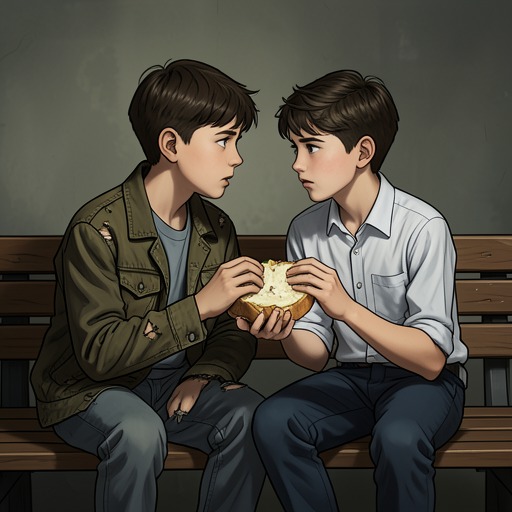
Siegfried
Der goldene HandschuhSiegfried, usually called Siggi or Brother Siggi, is Fiete Honka’s younger brother, his only continuing connection to the many siblings with whom he grew up, and the person who once saved his life. His Wednesday visits bring food, laughter, and a rare sense of company into Fiete’s home. Yet Siggi’s genial performance has a limit: as the drinking accelerates, his buoyant talk gives way to the unresolved grief of a man still waiting for his wife to return.
Identity and Family History
Siggi is younger than Fiete, but he has watched over his brother for as long as he can remember, trying to prevent him from sinking further and ending up irretrievably on the wrong path. Their bond is unusually close in a family whose other members have largely vanished from Fiete’s life. Three siblings are dead; one sister is known to be living in Leipzig; the rest are missing, or may also be dead. Siggi is the only sibling with whom Fiete still keeps in touch.
That loyalty is rooted in a crisis from their youth. Fiete had hoped to become a motor mechanic, but struggled with the theoretical work and, at fourteen, was placed in a bricklayer’s apprenticeship instead. He was not allowed to leave the apprentice dormitory. After developing a severe reaction to cement, known as cement scabies, his body was covered from neck to feet with rash, blisters, and open, weeping sores. Because he did not report the condition, the camp leader punished him in front of the other boys with ten strokes of a cane on his bare backside. Fiete reached his breaking point and tried to hang himself in a tool shed. Siggi saved him, more or less by chance.
The rescue became a lasting responsibility. Siggi is deeply attached to Fiete and feels a particular duty toward him because he intervened at that moment. His private reflection that it might have been better if Fiete’s attempt had succeeded reveals the bleakness he sees in what followed; it does not undo his attachment, but gives it a painful, conflicted edge. The brothers’ support is real, even when Siggi cannot believe that saving Fiete led to a better life for him.
The Wednesday Visits
Fiete looks forward to Siggi’s regular Wednesday visit and plans a special meal for the occasion. He wants Gerda Voss to cook for all three of them, expecting his brother to be surprised by a feast. The meal is an improvised stew: Gerda uses old packets, stock cubes, and prewar boxes of seasoning, while Fiete drinks and supervises. When Gerda asks for a drink, Fiete pours it into the pot instead, leaving her in tears. Her anxious hope that Siggi will arrive soon and then leave again captures how much depends on his presence in the room.
Siggi arrives in high spirits, joking about the smell and greeting Fiete with an easy, familiar warmth. He is described as an uncomplicated optimist, someone who believes that life includes both sunshine and rain, and that brooding only produces more brooding. His jokes come rapidly, often in coarse or absurd turns of phrase. Fiete does not always understand whether a saying is meant seriously or humorously, and cannot easily remember such expressions himself, but Siggi’s way of delivering even an ordinary remark can make people laugh. His humor is less a set of polished lines than a social gift: he can change the atmosphere with the same words simply by the way he says them.
When Siggi notices Gerda at the stove, he asks Fiete to introduce her. The meal soon becomes a small, shared ritual. Siggi eats with blunt enthusiasm, repeating a sound of enjoyment instead of making conversation; Fiete imitates him, and Gerda joins in. The three continue the playful exchange whenever one of them falls quiet. For a time, the household’s usual strain gives way to a silliness that lets Gerda forget her thirst and leaves Fiete relieved that the food has pleased his brother. The warmth is modest and temporary, but it marks the visit as more than a routine meal: Siggi helps make a household that is otherwise organized around hardship feel briefly communal.
Comic Philosophy and the Turn in Mood
After eating, Siggi takes over as entertainer, delivering a succession of maxims about accepting one’s lot and dancing to whatever tune life provides. Their form suits his outlook: the sayings turn experience into something simple enough to bear, and Fiete and Gerda respond by nodding along. His comic observations also include crude remarks about women and sexual access. The easy confidence of his performance gives way, however, to a more personal account of love. He describes relationships as ending once a woman realizes that a man loves her more than she loves him, and insists that a woman who has finished with a man will not return for money or persuasion.
The talk is not merely abstract. Siggi has been left by his wife, Monika, years earlier, and he has never got over it. He continues drinking schnapps and beer, and the change comes quickly: he loses the thread of the story he is about to tell, the atmosphere turns, and the comic stream of talk becomes less coherent. The man who has just argued that a departed woman will not come back now declares his certainty that Monika will return. He plans to write her love letters on pink and light-blue paper until they move her to tears and bring her to his door.
Character and Narrative Role
Siggi’s Wednesday visit brings out a contrast between his role as Fiete’s dependable protector and his own inability to recover from abandonment. In Fiete’s life, he is the surviving sibling who came when needed, saved him from the tool shed, and continues to check on him. At the dinner table, he offers jokes and ready-made philosophies that briefly make hardship seem manageable. But his own cheerful principles do not protect him from grief: as the alcohol takes hold, his confidence about how love works collapses into a fantasy of reunion.
The scene also complicates the idea of Siggi as simply a cheerful, uncomplicated man. His humor is genuine, and the meal becomes warmer because he is there, but the speed of his intoxication exposes the hurt beneath the performance. His certainty that Monika will return contradicts the hard rule about women he has just laid out. That contradiction makes his talk both comic and sad: the man who warns that a finished relationship is final cannot bring himself to accept that his own may be over. Through Siggi, the novel gives Fiete a rare source of familial loyalty while showing that the person who tries to keep another from falling can remain trapped in a loss of his own.