St. Pauli
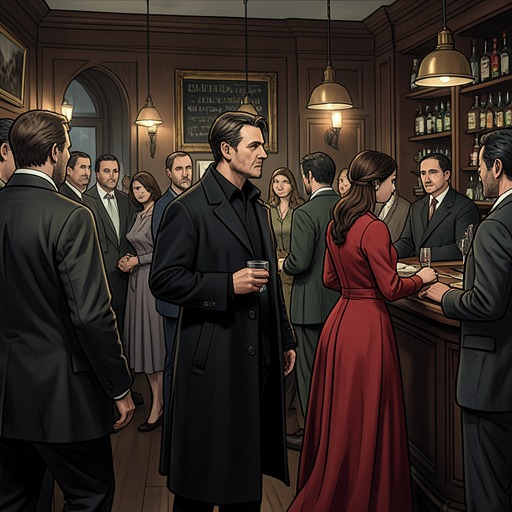
Der goldene HandschuhSt. Pauli is more than a backdrop in the book: it is a tightly drawn social world where night-time drinking, violence, religious outreach, adolescent fantasy, and severe personal decline occupy neighboring streets and rooms. Its most vivid anchor is Zum Goldenen Handschuh, an all-hours bar at Hamburger Berg 2. Around it, the narrative sets lives moving in sharply different directions, from Gisela’s patient work on the Reeperbahn to WH 3’s first nervous excursion and Fritz Honka’s eventual identification with the neighborhood’s lowest milieu.
Setting and the all-night bar
The book introduces St. Pauli through a February night in 1974. At three in the morning, after twelve hours at his customary place along the short side of the L-shaped counter, a small, crooked man speaks to his neighbor about a woman he loved and lost. His account moves between longing and crude sexual appraisal: he remembers her perfume and a birthmark, then measures his own present degradation against the possibility that she might see him as he is now. The bar is thus established as a place where private histories surface in drink-sodden conversation, without becoming a refuge from the damage around them.
The physical arrangement of Zum Goldenen Handschuh makes this world unusually concrete. Open since 1962, it operates every hour of every day. There is a front room with four tables and a rear room with three; the L-shaped counter stands to the right of the entrance, and the toilets are downstairs. Herbert Nürnberg, the founder, owner, and publican, is often behind the bar himself. A four-time German and two-time European lightweight champion, he is also an attraction in his own right. The text presents his practiced ability to distinguish a loudmouth from a fighter, or a thief from a murderer, as part of the bar’s daily economy of attention.
That routine does not make the place safe. One morning, after nearby establishments have closed and the bar has become a last stop for people unable or unwilling to go home, a group of English sailors arrives. Two attack without warning, angry after spending the night on the Reeperbahn without finding sex. The smallest and most aggressive uses brass knuckles; one man suffers a devastating injury to his jaw. Herbert cannot contain the group by himself, and Anus retreats to the office. The sailors are eventually caught two corners away, and the man with the knuckles, heavily under the influence of Captagon, is taken to Ochsenzoll General Hospital’s locked ward. The assault is one of several storms that day, making the bar’s ceaseless opening hours a condition of both its function as a gathering point and its exposure to violence.
Routes into the neighborhood
St. Pauli also represents a destination approached from outside and imagined before it is known. WH 3 has been there only twice, both times to the Operettenhaus with his parents, and on each occasion he went straight home after the performance. When he plans a return alone, on a Tuesday night just after ten, he is nervous enough to nearly fall from his bicycle. His stated plan is modest: first to look around a few bars, learn the terrain, and make more systematic explorations later. He locks up the bicycle and walks up the Reeperbahn with his head down, convinced that his appearance gives away his inexperience and background.
His movements are shaped as much by anticipated humiliation as by curiosity. He avoids businesses with touts outside, imagining that they would single him out for a particularly cruel joke. Across the street lies Hans-Albers-Platz, where he sees prostitutes; he is relieved not to be walking on their side, and imagines how badly a remark from them might wound him. Yet his embarrassment coexists with elaborate romantic fantasy. He pictures a girl his own age becoming a regular client, then a friend whom he might take to dinner or the cinema. St. Pauli is, in this passage, neither simply a place of danger nor a place of opportunity: it is a landscape onto which a sheltered teenager projects both his fears and his desire for an ordinary intimacy.
A different kind of arrival is made by WH 2. After leaving Süllberg through a back entrance, he takes a taxi to Zum Goldenen Handschuh, where he has also ended up after a previous shipbrokers’ dinner. He had not known such bars existed. The world he encounters is so foreign to him that his technical knowledge of shipping cannot bridge the gap: a conversation about the electronics on a new container ship goes nowhere, as does an explanation of how rapidly containers can now be transferred. He learns that conversation is futile and prefers not to try. In the bar, he is known as Ernst vom Katasteramt, a name he receives for free rather than earning through the neighborhood’s more personal nicknames. The visit offers him anonymity and an escape from his professional setting, but not fellowship on equal terms.
Work, violence, and neighboring lives
Gisela’s rounds show another way St. Pauli is inhabited. She is a Salvation Army major based at Talstraße 11, a parallel street only a few hundred meters away, and works on the northern side of the Reeperbahn. A refugee who escaped from East Germany shortly before the building of the Wall, she came to the Salvation Army after having been an atheist. Her faith gives her work a clear purpose: she regards caring for the neighborhood’s sinners as a task assigned by God. The narrative emphasizes not only that conviction but her restraint. She senses when to sit with someone and when advice is unwanted, and the local publicans welcome her partly because her presence does not create trouble. She dislikes grand labels that turn her into a saintly emblem; her work, as presented, is practical and bounded by what she can actually do.
Her presence also interrupts an attempted approach between Fiete and Gerda. The interruption connects the everyday circulation of people through the bar to Gisela’s prior history with Fiete: on his first visit, he had made an obscene advance while drunk and had to be restrained from going further. He later apologized, an apology she valued. The bar is therefore not a succession of disconnected encounters. People return, remember, and meet again under changed circumstances, while the neighborhood’s informal knowledge of conduct shapes who can move through it without friction.
The bar’s ordinary crowd can turn suddenly into a mass. Later that same violent day, the full pay packets at the beginning of the month prompt rapid, heavy drinking. Strangers become friends at startling speed, swearing enduring loyalty; by early afternoon, the most intoxicated have moved to the rear room, while those still able to walk leave for home or try their luck at Elbschlosskeller. The sequence contrasts loud claims of brotherhood with the bar’s recurrent disorder. St. Pauli’s social ties are real in the moment, but the narrative does not mistake their intensity for permanence or safety.
A place in the story’s judgment
St. Pauli’s meaning changes with the people who approach it. For WH 3 it is an intimidating field of possible embarrassment and imagined romance; for WH 2 it is an anonymous drinking place beyond the habits of business life; for Gisela it is a specific territory of care, defined by a few streets and repeated visits. At Zum Goldenen Handschuh, these different relations meet within a room whose layout and uninterrupted hours make it a durable point of return. Its routine scenes and sudden violence belong to the same setting.
The place acquires its harshest significance in the judgment concerning Fritz Honka. The court’s account links years of serious alcohol misuse and resulting physical consequences to a collapse of personality and a long decline in his way of life, whose lowest point it locates in the milieu of St. Pauli, naming Zum Goldenen Handschuh as an example. It also cites his ability to live in his apartment with decomposing bodies, their smell in the air and insects among them, as evidence of his compulsive condition. St. Pauli is not presented as the cause of his crimes; rather, the judgment uses the neighborhood and its bar to mark the extremity of his social descent. That distinction matters to the book’s portrait of the setting: it contains vulnerability, fantasy, care, commerce, and violence, but it is not reduced to a single moral explanation for the people who pass through it.