The Golden Glove Tavern
Der goldene HandschuhThe Golden Glove Tavern is a round-the-clock bar on St. Pauli’s Hamburger Berg, founded by former boxing champion Herbert Nürnberg. Open every day of the year since 1962, it is both a working neighborhood tavern and a place where people who have nowhere else to go can spend long stretches of time. Its significance lies in the way its ordinary routines—drinking, sleeping, watching, and being named—bring the book’s degraded social world into close view.
Setting and Physical Layout
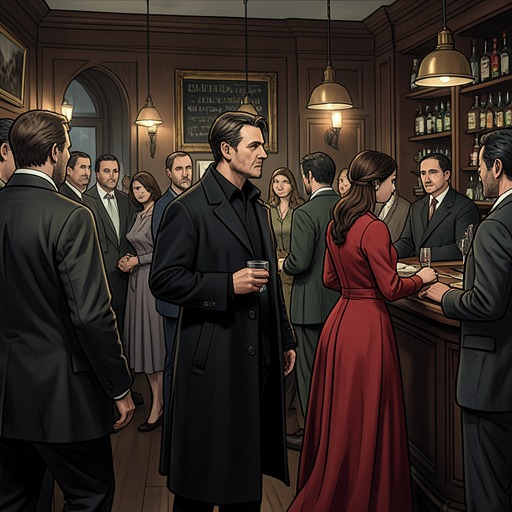
The tavern has been open 24 hours a day, 365 days a year since 1962. Its interior is divided into a front and a rear section: four tables stand at the front and three at the back, while an L-shaped counter sits to the right of the entrance. The toilets are downstairs. The arrangement distinguishes a visible drinking area from a rear space where exhausted or heavily intoxicated patrons retreat to sleep, but neither section offers an escape from the constant presence of other people.
The counter is a principal fixture in Fiete Honka’s nights there. At three in the morning on a freezing day in February 1974, he has already occupied his usual place at its short end for twelve hours, talking to the man beside him. Later, after falling asleep in the rear, he returns to find that man gone and Soldaten-Norbert in his place. The shift in who sits beside Fiete makes the tavern feel less like a private refuge than a room whose company is continually rearranged by drink, fatigue, and chance.
The Proprietor and the Tavern’s Social Order
Herbert Nürnberg, the founder, proprietor, and landlord, is often personally behind the counter. A four-time German and two-time European lightweight champion, he is also one of the tavern’s attractions: people come in part because of him. His practiced discernment extends beyond running the bar. He can distinguish a loudmouth from a fighter, a thief from a murderer, and judge whether someone has money or a weapon in a pocket. The tavern’s daily order therefore rests partly on his close attention to the people passing through it.
That order is also expressed through nicknames. Fiete has only recently acquired his, and cannot remember who gave it to him or why. He is nonetheless proud: having a nickname feels like recognition, even though his is considered second-rate beside names such as Ritzen-Schorsch, Glatzen-Dieter, and Nasen-Erni. In the tavern, a name can confer a small measure of belonging while reducing its bearer to a feature others find memorable. Fiete’s pleasure in the name reveals how scarce recognition is in this environment.
Patrons, Exposure, and Unequal Shelter
The bar accommodates people whose circumstances are sharply different but whose bodies all bear the effects of time, poverty, drink, or confinement. Fiete’s neighbor, Helmut Berger, is known by a nickname meaning Corpse. He has served thirteen years in prison for murder and now sleeps more than he is awake. His clothes are wet from incontinence, his body has deteriorated, and his interest in the world has ebbed away. After damaging his stomach by drinking industrial alcohol, he suffers ulcers and loses most of his teeth. His presence makes the tavern’s long hours seem less like comfort than a setting in which collapse can continue in public, unnoticed or unanswered.
Sleep in the rear is similarly precarious. Fiete has smoked around sixty cigarettes and drunk about a liter of Fako, a mixture of Fanta and grain liquor in equal parts, before the drink’s numbing effect and exhaustion overcome him. He falls asleep with his head in his hands and wakes when another patron is trying to pull off his shoes. Fiete kicks out in his half-sleep; the man loses his balance and cuts his hand on broken glass. The incident turns a brief rest into a sudden injury, and Fiete returns to the front of the bar. The tavern offers a place to sleep, but not dependable safety or privacy.
Women also enter this space under conditions of cold, poverty, and limited choice. One small, elderly-looking woman arrives shivering, wearing only a blue cleaner’s smock beneath her coat. Fiete recognizes that she has no money and asks Anus to bring her a drink. The offer is a tactic for getting her to approach and thank him, but it also allows her to remain inside when the temperature outside is below freezing. The scene makes the bar’s hospitality conditional: a drink can secure temporary shelter, while the person receiving it is drawn into the social exchange that follows.
Fiete and the Tavern’s Recurring Company
For Fiete, the tavern is one of the few places where he tries to meet women. He believes he has little chance with women his own age and has long sought older women instead. On one Wednesday, feeling miserable and lonely, he listens to his favorite song playing on the music box. Gerda enters, and he buys her a drink. Their meeting begins in the bar’s familiar economy of drink and approach, against a background of cold outside and Fiete’s wish for company.
The regular clientele is not constant. When Fiete and Gerda arrive on another occasion, the earlier crowds have dispersed, leaving Soldaten-Norbert, Fanta-Rolf, a few chance visitors, and three newly arrived women near the jukebox: Inge, Hildegart, and Agnes. Agnes has spent nearly twenty years rarely leaving her apartment; after losing it, she is now on the street. Inge and Hildegart get by through petty fraud, while Agnes sometimes turns to prostitution. Their different routes into destitution meet for a time in the tavern, where they are observed and described through harsh judgments about their appearances as well as through the circumstances that have brought them there.
The bar also links patrons across age and status. Soldaten-Norbert greets Fiete with a heavy blow on the shoulder, and Herbert unusually shakes his hand. Fiete takes these gestures as signs that he might be someone special. In another encounter, Norbert fixes his attention on the young WH 3, whose fear is so acute that he soils his trousers. The contrast between Fiete’s hunger for recognition and WH 3’s terror shows how the same room can offer one person a fleeting sense of importance and make another feel trapped under an intimidating gaze.
Narrative and Institutional Significance
The Golden Glove Tavern is more than a backdrop for drinking scenes: it gathers people whose lives otherwise remain socially marginal and keeps their conditions in view. Its sleepless schedule permits prolonged encounters, while its counter and tables repeatedly bring strangers into proximity. The place’s rough familiarity does not erase differences in age, money, safety, or power; it makes those differences part of the everyday traffic of the room.
That association acquires a stark institutional echo in the later court judgment on Fritz Honka. The judgment describes his long decline through severe alcohol abuse and neglect, and identifies his eventual presence in what it calls the lowest milieu of St. Pauli by reference to the Golden Glove Tavern. It also cites his ability to live in an apartment with decomposing bodies as evidence of the depth of his deterioration. The tavern is not presented as the cause of his crimes; rather, its name marks the social world to which the court says his decline brought him. In the book, the bar’s continuous opening hours and recurring patrons make that world concrete, one encounter and one exhausted night at a time.