WH 1 and WH 2’s Father-Son Conflict over the Family Business
Der goldene HandschuhWH 1 and WH 2’s Father-Son Conflict over the Family Business is a long reversal of power, shaped first by WH 1’s postwar disgrace and enforced withdrawal, then by WH 2’s rise and the later collapse of his enterprise. At the family’s formal dinner table, their shared position in the business conceals radically different private histories: the father has spent two decades waiting to avenge his displacement, while the son, nearing sixty, sees no way to rescue the company or begin again.
A family arranged around the business
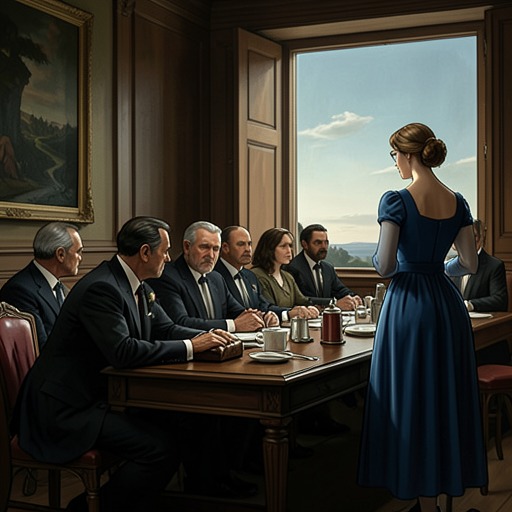
The relationship appears within the family’s evening ritual at the von Dohren estate. At 7:30, WH 1, aged seventy-nine, sits with his fifty-seven-year-old son, WH 2, and the rest of the household in the vast Red Salon. Dinner’s orderly routine and safe conversation offer a public surface of family continuity. Beneath it lies the history of a business whose management passed from father to son under pressure, making the meal a scene of proximity without any open reckoning between them.
Their differing ages mark more than a generation gap. WH 1’s authority had once been dominant; WH 2 now occupies the position that his father lost. Yet the account does not present a direct argument at the table or explain whether WH 2 knows the extent of his father’s resentment. Instead, it places the two men in a shared domestic ritual while revealing how differently each inhabits the family’s fortunes: WH 1 is absorbed by past injuries, and WH 2 by a present crisis that seems to leave him no future.
WH 1’s disgrace and concealed resentment
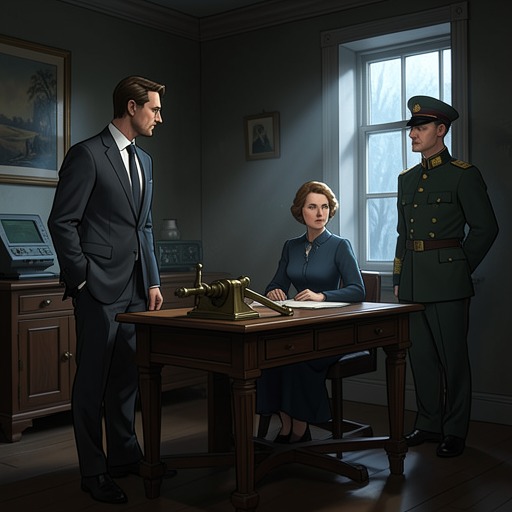
After his wife Emily died the previous year, WH 1 withdrew into silence. The family takes his diminished speech and slowed movements for signs of senility and assumes he will soon die. He deliberately encourages that impression, making himself seem like an irrelevant old man whose role in the family no longer needs to be considered. His apparent passivity is thus a performance: he wants others to stop reckoning with him while he waits for a moment to retaliate.
That performance has roots in the company’s postwar history. WH 1 had joined the Nazi Party in the 1920s, not from conviction, but because he foresaw the Nazis’ seizure of power. In 1935, the Arronge family was among the first Jewish families dispossessed; its villa, estate, and entire fleet passed into WH 1’s hands. After the war, details emerged about the Arronges’ fate: some escaped abroad, while most of those who remained were deported to camps and murdered. WH 1 had benefited from the transfer of their property, and the revelations destroyed his standing.
The Allied authorities also confiscated two-thirds of the von Dohren fleet. Ostracized by Hamburg’s merchant community, WH 1 faced pressure that eventually forced him to transfer management to WH 2. He regards this outcome as an injustice done specifically to him, resenting that other shipping families also derived their wealth from slave trading and similar practices. The narrative presents that complaint alongside the account of his own gain from the Arronges’ dispossession: his grievance does not erase the history that made his position untenable.
For twenty years, WH 1 has preserved that grievance in a book devoted to slights, exclusions, insults, and failures to show him respect. He assigns each injury a score according to its severity and links it to a punishment intended for the time when circumstances are right. His hatred is not a passing response to losing the company; it has become a system that organizes his days. At dinner he hacks at his sauerbraten as if sentencing the meat, while controlling his expression so that his anger does not openly break through.
WH 2’s rise and reversal
WH 2 initially succeeded after taking over the company, earning large sums through compensation trade with East Germany. Since East Germany lacked foreign currency, its trade relied on exchanges of goods: when it needed shipbuilding steel that Russia could not supply to specification, it could obtain the material from West German producers, then sell completed ships to West German shipowners. Specialized shipbrokers arranged the transactions and collected enormous commissions. WH 2 became one of the principal beneficiaries of this system, a success that distinguishes his tenure from the forced transfer that preceded it.
That prosperity ended abruptly. The Hinnebergs displaced WH 2 under circumstances described as ugly, while business mistakes, mismanagement, and bad fortune further weakened the company. The container revolution of the mid-1960s was one decisive change he and many other shipowners recognized too late. His father’s fall had come through postwar political and commercial consequences; his own decline combines rivalry, errors of judgment, and a transformation of shipping that outpaced him.
The Suez Canal crisis compounds the damage. One of the eleven ships in the von Dohren fleet was caught in the canal after Egypt closed it in 1967 in response to the Six-Day War. Seven years later, the ships stranded there still have no predictable departure date, and the prolonged delay has cost the company enormous sums. Fine yellow desert sand covers their decks, giving the trapped vessels the name Yellow Fleet. For WH 2, a distant political closure has become a continuing business loss, adding to the pressure created by his rivals and his own missed changes in the industry.
Two different forms of entrapment
By the time of the dinner, WH 2 is nearly sixty and stands with his back to the wall. He no longer believes he can pull the company out of trouble; his energy is spent, and he gives himself at most a year or a year and a half. His despair is not simply the loss of his father’s former authority. WH 2 has had his own period of success, but cannot see a new life or a reversal of fortune ahead. The narrative gives his prognosis a stark contrast with WH 1’s long fixation on what happened twenty years earlier: the father keeps the past open as a ledger of possible punishments, while the son sees the future closing.
The conflict therefore does not resolve into a clear confrontation or reconciliation. Its force comes from the unequal burdens the two men carry within the same family enterprise. WH 1’s silence masks a continuing wish for revenge after the transfer of power; WH 2’s position as successor has brought both prosperity and a later collapse he feels unable to repair. The formal dinner holds them together, but it offers no evidence that either man can undo the history binding them to the business.