WH 1's Deep-rooted Resentment and Refusal to Reconcile
Der goldene HandschuhWH 1's Deep-rooted Resentment and Refusal to Reconcile is the force that turns a public gesture of forgiveness into a private defeat. For years WH 1 has preserved his hatred for Gerhard Leyendieker and imagined a final reckoning with the people around him. When Leyendieker arrives at WH 1's eightieth-birthday reception to announce his rehabilitation, the gesture is meant to end an old estrangement; WH 1 receives it as an insult. He has planned what he will say, but when his chance comes, he cannot make it happen. The encounter shows how thoroughly resentment has shaped his identity—and how little power remains to give it the ending he desires.
The Old Friendship and Its Rupture
WH 1 and Gerhard Leyendieker were born in 1895, attended the same school, and were once friends. Their relationship then passed through rivalry into estrangement. The break is not reciprocal in feeling: Leyendieker has come to regard WH 1 as no longer significant, whereas WH 1 hates Leyendieker with all the force he can summon. This imbalance matters to the later ceremony. For Leyendieker, agreeing to reconciliation can be presented as a generous act of an elder; for WH 1, the former friend remains a target against whom a grievance has been kept alive.
WH 1's resentment also reaches beyond Leyendieker. He longs for a family disaster, an irreversible rupture that would give his life a dramatic climax and let him spend the hatred he has saved. In private fantasies, he imagines August exposed as a criminal, gambling alcoholic with a secret second family; Manuela then kills herself, and the twins disappear before their bodies are found in the river. These are imagined catastrophes, not events that occur. Their extravagance reveals the scale of WH 1's appetite for an ending: ordinary family indifference will not satisfy him, and he pictures violence and ruin as the proof that his final years still matter.
The Confrontation He Rehearses
WH 1's hoped-for outburst has a carefully imagined sequence. He intends to begin with shipping matters, condemning companies that register vessels abroad to save money as traitors to Germany. From that political accusation he plans to move to allegations of dirty deals and illegal business, including transactions associated with Café Lausen and Susi's Show Bar. He expects these charges to disgrace the respectable men in the room and threaten their businesses. The speech is imagined as both public exposure and retaliation: commercial disputes become evidence in a larger indictment of a world that, in his view, has betrayed the country and evaded its obligations.
After the public accusations, the rehearsal turns personal. WH 1 plans to attack Margot, August, his son, and his grandson in succession, with insults and curses that he imagines could keep the accounting going for hours or even days. He even pictures the aftermath of his own death as a final act of revenge: his body beaten and hung by the ankles in a cold-storage room among frozen carcasses. Nothing in this sequence is carried out. Its importance lies in the contrast between the complete, endlessly replayed speech and the silence that follows when the opportunity is real. The fantasy gives WH 1 a script in which he controls the room and chooses the terms of his ending; reality does not grant him that control.
A Reconciliation Arranged Without Him
WH 2 has spent nearly a year persuading maritime decision-makers to support his father's rehabilitation. He has approached, among others, Peter Marquardt of the Verein Deutscher Reeder, maritime coordinators Ernst von Telkow and Raimer Moritz, and Peter Vossbuhr of the Vereinigung Hamburger Schiffsmakler und Schiffsagenten. Leyendieker is the last person whose agreement is needed. WH 2's effort is tied to the impending collapse of the family business, but it also reflects an unexpected sympathy for his father. After decades of estrangement from Hamburg society, WH 2 wants an official, unanimous absolution to bring reconciliation and peace at the end of WH 1's life. His wish to do something good surprises even himself.
Leyendieker agrees to make the announcement at WH 1's eightieth birthday. The decision is therefore prepared as a public honor, with prominent guests present, but WH 1 is kept ignorant until the event. WH 2 tells him only shortly before noon, deliberately leaving no time for protest. This timing makes the reconciliation less a conversation than a fait accompli: others have agreed on the meaning of the occasion before its central subject knows what is happening. The gesture may be offered as a gift, but WH 1 has neither asked for it nor been given the chance to refuse it in advance.
The Birthday and the Refusal
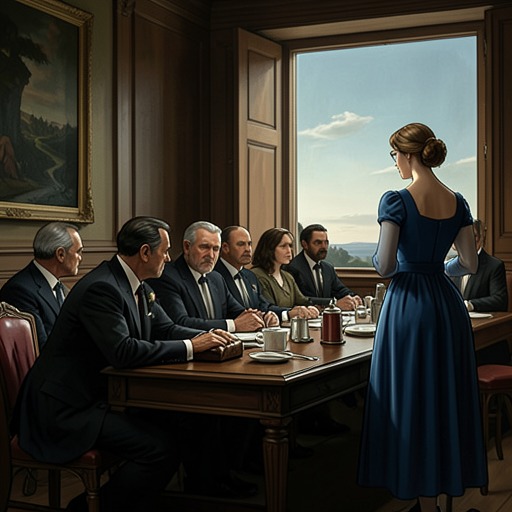
The reception takes place in oppressive heat, with the sun glittering on the river and the crowd gathered to celebrate WH 1. Leyendieker gives a standardized speech about Hamburg's port, its infrastructure and trade, the obligations of the Hanseatic commercial tradition, and the spread of globalization. He also recalls the building of the first container terminal at Burchardkai and a tanker Aristoteles Onassis had built in Hamburg. Only after this conventional address does he turn to WH 1's life and the promised rehabilitation. The ceremonial language of recognition cannot bridge their estrangement: Leyendieker's formal, prolonged handshake becomes, in the narration, a gesture of domination rather than intimacy.
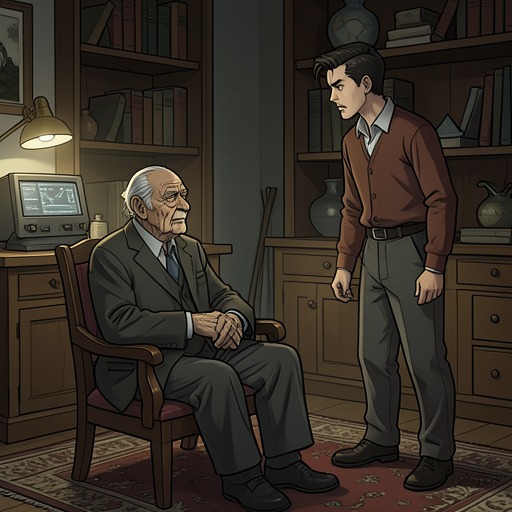
WH 1 is the only person at the gathering who did not know his rehabilitation was coming. Seeing Leyendieker again after a quarter-century, he feels neither honored nor grateful and has no wish to make peace. What others interpret as a liberating act is, to him, a slap in the face, a profound misreading of who he is. His resentment has become so comfortable and so central that even the possibility of change cannot draw him out of it. The scene makes the difference between forgiveness offered and reconciliation shared unmistakable: an official declaration cannot undo a grievance for someone who still wants the grievance to rule.
The Speech That Never Comes
The public announcement creates precisely the opening WH 1 has rehearsed for, but the opening does not release his anger. He is old, paralyzed, groggy, and spent; the speech remains unspoken. He has waited too long. The failure is not a change of heart or a belated acceptance of the reconciliation. Rather, the body prevents the reckoning that the mind has rehearsed a thousand times. WH 1's refusal thus persists even as his ability to act on it collapses.
The episode closes the distance between fantasy and consequence without resolving the conflict. WH 2 has tried to restore his father to public respect, while WH 1 has wanted an irreparable rupture that would let him condemn everyone on his own terms. Neither outcome arrives as intended: the rehabilitation cannot produce peace, and the planned denunciation never becomes speech. The silence leaves WH 1's hatred intact, but also exposes its limit. He has reserved his strength for a final confrontation and reaches its appointed moment with no strength left to spend.