WH 3's First Visit to the Zum Goldenen Handschuh Bar
Der goldene HandschuhWH 3’s first visit to the Zum Goldenen Handschuh is a small adventure that changes how he sees himself. He arrives as an inexperienced teenager rehearsing his entrance into adult life; after witnessing violence and encountering the bar’s strange, unembarrassed regulars, he goes home feeling transformed. The episode makes his imagined bravado collide with the place itself, while letting the reader see a world whose inhabitants WH 3 can only begin to interpret.
The plan and the approach
On a Tuesday evening shortly after ten, WH 3 sneaks out of his house. His previous trips to St. Pauli had been with his parents to the Operettenhaus, followed immediately by the journey home. This time he is alone, and even the bicycle ride nearly overwhelms him: he is so excited that he almost falls. He has delayed the outing for two weeks, and now intends only to look around, enter a few bars, and become familiar with the terrain before returning on later excursions.
His ambition is bound up with Petra. He has been turning over ways to impress her, but athletic achievement is out, and his background is no advantage: Petra is from modest circumstances and has made clear that she dislikes capitalists. He longs to turn eighteen so that he can obtain a driving licence, and imagines that even a moped might help, but his parents oppose what they call such machines. Alcohol occurs to him as another possible way to impress her; he has also considered hashish, though he does not know how to get it and has never asked Petra whether she drinks or smokes it. Rather than risk exposing his ignorance, he has avoided the subject. The excursion is therefore both a practical reconnaissance and an imagined performance: he hopes to acquire something remarkable to bring back to Petra, though he does not yet know what that will be.
On Reeperbahn, he walks with his head down and a brisk, deliberate step, convinced that his inexperience must be written on his face. He avoids establishments with touts outside, anticipating that they would single him out for ridicule. Across the street, Hans-Albers-Platz is lined with prostitutes; he imagines the humiliating remark one of them might make if he passed close by. At the same time, he entertains a romantic fantasy in which he eventually becomes a regular client of a pretty girl his own age, befriends her, and takes her to dinner or the cinema. His first steps into the district are thus governed by fear of being exposed and by an elaborate wish to belong.
The street incident and the threshold
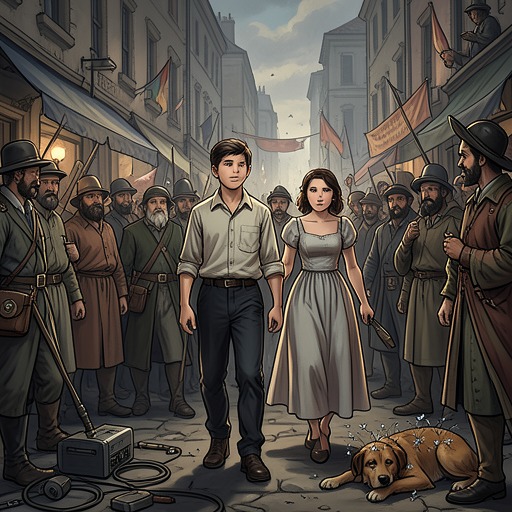
Near Davidwache, WH 3 turns into a side street, hoping that a quieter entrance will make it easier to go into a bar. The street is dark, dirty, and nearly deserted; after walking to its far end, perhaps two hundred metres, he finds the bars apparently empty or closed. He turns back towards Reeperbahn. Then a small, potato-shaped man flies out of an open doorway and lands in the street. A second man, wearing a torn shirt marked with blood, rushes after him and kicks him while he is down. The attacker turns on WH 3 as well, challenging him for staring and telling him to go home to his mother.
WH 3’s literal conclusion is that the attacker must have been drinking. The observation is naive, but it does not send him home. The man initially appears to be going back inside, then changes his mind and walks in the direction from which WH 3 has come. WH 3 watches, finds the whole incident interesting, and concludes that there is more happening here than he had expected. He reads the sign above the doorway: Zum Goldenen Handschuh. Without knowing much more about the place, he decides that this is his trial by fire and goes in.
The choice is a reversal of his cautious plan. He had hoped to build confidence by looking into quieter bars; instead, a public assault has drawn him to the very doorway where it began. His first encounter with the bar is not a welcome or an explanation but a body thrown into the street and an insult aimed at him. Yet the violence that might have confirmed his fears also gives him a reason to cross the threshold. The place appears to him as a scene of danger, but also as proof that his tentative outing has become a genuine adventure.
A bar seen from the outside and within
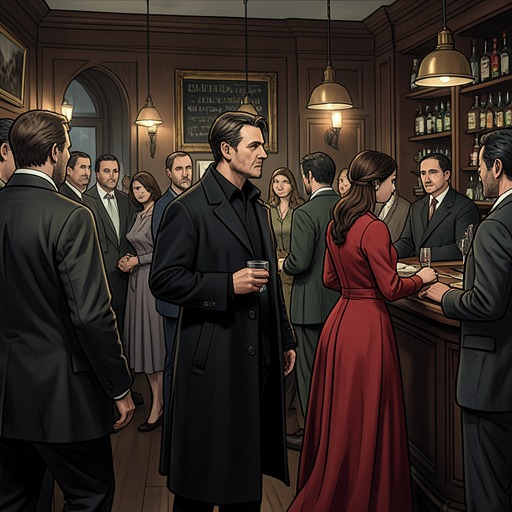
WH 3 sits at the table to the left of the entrance. Anus comes over to take his order. WH 3 asks for a Braun’sche Röhre, the school slang for cola, but Anus does not recognize the expression, so he asks for a Coca-Cola instead. Nobody asks him for identification. He watches through the greasy window as the man who was thrown out staggers towards the Elbe Castle Cellar, moving hesitantly and slowly wiping blood from his coat. WH 3 supposes that the two bars must be connected. The inference is described as not entirely wrong, though he does not know the larger network or history of the people around him.
The contrast between what WH 3 sees and what the reader is told is central to the scene. The bar contains Soldaten-Norbert, Fanta-Rolf, and Fiete Honka with Oma, but WH 3 cannot identify them. He is surprised that nobody pays him any attention and thinks that someone like him ought to stand out. Their indifference gives him room to sit and observe; it does not mean that he understands the room. He orders a beer after the cola, reasoning that drinking is something one has to learn and worrying that he might be thrown out if he stretches one drink over the whole evening.
His attention settles on Tampon-Günter, a high-seas fisherman whose reputation is as outsized as his appearance. The narration describes him as a man who can endure almost anything: in January 1969, he went overboard and survived for nearly five hours in the North Sea, in water only just above freezing. He is said to be able to take on a dozen men, sense a change in the weather, and smell out shoals of fish. He comes to the Zum Goldenen Handschuh only four or five times a year and prefers peppermint schnapps and cherry liqueur. Herbert brings him the drinks, and Günter produces two tampons from his coat pocket, soaking one in each glass. Once they have absorbed the liquor, he sucks them dry and hangs the green one over his right ear and the red one over his left, explaining the arrangement through the nautical colours for starboard and port.
Günter’s performance turns a mundane barroom drink into a private ritual and a comic adornment. The guests enjoy it, especially Herbert, who has a deep respect for him. The narration underlines the difference between Günter and anyone else attempting the same act: on another person it would make a fool of him, but Günter carries it off. WH 3 sees only a towering, two-metre-tall man, built like a Viking, with tampons dangling from his ears. He has tried to imagine what the district might hold, but not this. The scene is funny and grotesque, yet its humour depends on a form of authority WH 3 cannot yet read: the spectacle belongs to a regular who is accepted in the room, not to the nervous newcomer watching him.
The walk home and its afterimage
After the bar, WH 3 imagines that Anus might recognize him next time and set a beer down without being asked. This imagined future regular status matters to him as much as anything he has actually done. Only moments earlier, the place had seemed frightening; now he feels like a new and different person, hardened and worldly. He tells himself that the evening was something real, something that Petra will be astonished to hear about. The change is not an objective proof of maturity but a new story WH 3 tells about himself, built from having gone in, stayed, ordered drinks, and endured the bar’s strangeness without retreating.
On the way back it begins to rain. Old women hurry across the broad street like little black clouds, then duck under cover, while WH 3 savours the air and thinks he can see the curve of the earth between the buildings. This expansive perception follows his night of close observation: a dirty window, blood on a coat, a stranger’s improvised ornaments, and finally the wet city opening into something immense. His first visit has not made him an experienced adult, nor has it brought him closer to Petra in any demonstrated way. It has given him a vivid tale and the feeling of having crossed a boundary. The reader, meanwhile, has seen how much of the bar remains beyond his understanding, making his triumphant self-image both touching and ironic.