
The Boundary Between Rescue and Revenge
DianaThis thread traces how the novel contrasts coercive violence with protective action, honorable combat, and mercy.
increasing Bearing strength in each event
 decreasing
Bearing strength in each eventdecreasingThe Savages’ Threat

The Savages’ Threat
Desire turns coercive
Three savages seize the nymphs and claim that their suffering entitles them to the women. Dorida rejects the premise, insisting that love cannot justify violence against the beloved.
Conflict becomes physical
The attackers bind the nymphs, forcing the shepherds to choose between safety and intervention. Their rescue attempt begins with stones rather than arms, emphasizing their vulnerability.
Felismena’s Defensive Force

Felismena’s Defensive Force
Force used to protect
Felismena kills two attackers with arrows and defeats the third with her staff. Her violence is framed as a response to an immediate threat against captives.
Courage redefines her role
The shepherdess’s appearance conceals the training and resolve of a noblewoman. Her intervention saves the nymphs and demonstrates that force can serve protection rather than domination.
Narváez and the Moorish Knight
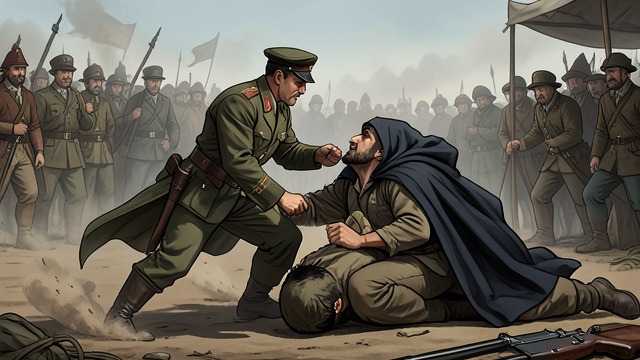
Narváez and the Moorish Knight
A fight between opponents
Narváez’s patrol clashes with Abindarráez, who fights skillfully despite his wounds and the numerical odds. Narváez recognizes his opponent’s courage even as he wins the encounter.
Combat allows respect
Unlike the savages’ assault, the battle operates within a recognized contest of martial ability. Its aftermath makes it possible for the victor to treat the prisoner with dignity.
A Promise Instead of Punishment
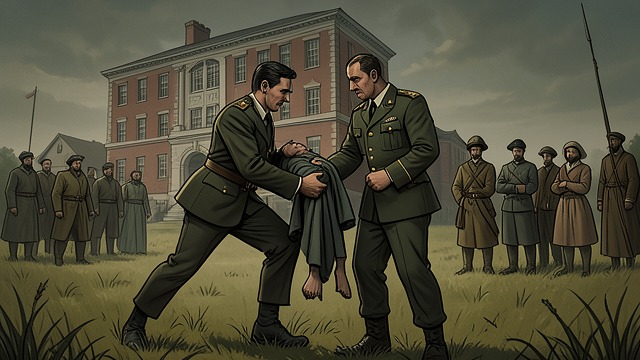
A Promise Instead of Punishment
Mercy limits power
Narváez releases his captive temporarily, trusting him to return rather than keeping him by force. His decision recognizes that the prisoner’s word may be more reliable than confinement.
Honor answers clemency
Abindarráez returns as promised, bringing Jarifa with him. Their conduct validates Narváez’s trust and changes the encounter from adversarial capture to mutual regard.
Felismena Saves Don Félix
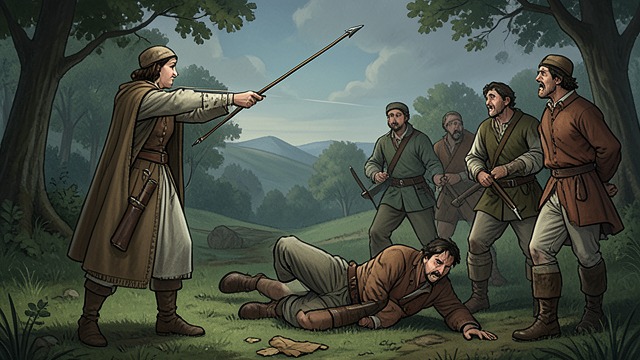
Felismena Saves Don Félix
A second act of rescue
Felismena finds Don Félix outnumbered by three knights and intervenes with her bow. Her actions prevent his death before he knows who has come to his aid.
Rescue enables reckoning
Once safe, Don Félix must hear the identity and history of his rescuer. Protective force leads directly to the emotional confrontation that makes reconciliation possible.
after the nymphs finish singing
during the nymphs’ captivity
during the night patrol near Álora
immediately after Narváez hears Abindarráez’s story
near the conclusion of the seventh book
