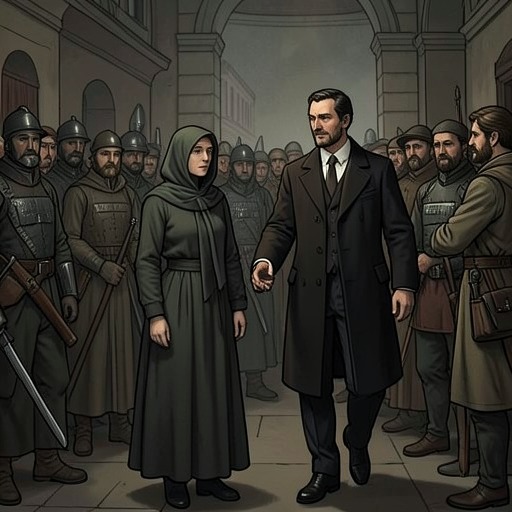
Felismena and Celia's Love Affair
DianaFelismena and Celia's Love Affair grows out of a painful triangle: while disguised as the page Valerio, Felismena serves Don Félix by carrying his messages to Celia, the woman he now loves, even as Felismena remains devoted to him herself. Celia, meanwhile, becomes attached to the page who repeatedly pleads Don Félix’s case. Their connection is therefore real in its emotional consequences but founded on a concealed identity and a fundamental mismatch: Celia believes she is loving Valerio, while Felismena’s deepest love is directed toward Don Félix.
A Love Shaped by Disguise
Felismena’s disguise places her inside Don Félix’s service and makes her the chosen go-between in his courtship of Celia. When Don Félix asks her to assess a letter he has written, she answers that the woman he once loved has reason to feel betrayed: in her view, love that can be extinguished by absence was never true love. Her judgment speaks from personal pain. She is herself the woman Don Félix left behind, but she keeps that identity hidden and accepts the task of helping him win Celia.
The errand forces Felismena to act against her own desire. She takes Don Félix’s letter to Celia and presents herself as a new servant of his, praising Celia’s beauty and discretion while asking her to answer the man who loves her. Celia notices the striking new page and asks what fortune has brought Valerio to court and into Don Félix’s service. Felismena replies with flattering courtesy, turning the encounter into a performance that advances Don Félix’s suit even as it exposes her to the woman who has displaced her.
Celia agrees to respond, though she says she had resolved not to love a man who had abandoned another woman for her. Felismena counters that Don Félix could hardly forget Celia for someone else, praising Celia’s qualities while belittling her rival. The praise serves its immediate purpose, but it deepens the irony: Felismena must speak as though her own beauty and former claim to Don Félix did not matter. She presents herself as a discreet, perceptive messenger, while the history she cannot disclose gives her words a second, private meaning.
Celia’s Attachment to Valerio
Celia’s attraction takes shape through repeated encounters over the course of more than two months. She responds not only to Valerio’s appearance but to the intelligence, courtesy, and attention with which the page speaks to her. After reading Don Félix’s letter, she tells Valerio that her favorable reply is for his sake, not because she owes anything to Don Félix. Felismena recognizes that Celia’s favor has turned toward her assumed identity, but the response brings little uncomplicated comfort: she is still securing affection for the man she loves from the woman he loves.
The messenger’s role becomes a daily emotional trial. Don Félix sends Valerio back to Celia because other servants fare badly, and Felismena repeatedly carries messages and solicits favors on his behalf. When another servant delivers one, Celia receives the message so poorly that Don Félix learns to entrust the errands to Valerio alone. Felismena also sheds tears before Celia, pleading that she treat Don Félix kindly. Those tears move Celia, who takes them as evidence that Valerio might love her if he were not so diligently serving another man.
Felismena cannot resolve the conflict without injuring someone she cares about. If she openly returned Celia’s affection, she feared Celia would turn against Don Félix; if Celia returned to Don Félix, Felismena’s own hopes would be no nearer fulfillment. Yet pretending to love Celia might also make her refuse Don Félix and deepen his despair. Felismena therefore continues to ask for Celia’s favor for another, concealing the cost of her service and, at times, inventing messages rather than allowing Don Félix to suffer. The disguise is not merely a way to enter court: it makes Felismena the instrument of the courtship that wounds her.
Misrecognition and Rupture
The arrangement breaks when Celia realizes that Valerio is sincerely seeking her favor for Don Félix, not using the errands as a pretext to enjoy her company. She had believed the requests were an excuse for the page to visit; now she interprets the truth as proof that Valerio does not love her. The discovery reverses the meaning of the same repeated acts: what Felismena has undertaken as loyal service becomes, to Celia, evidence of rejection.
Celia responds with tears, reproaches, and a declaration that Don Félix must not see her again. She also turns on Valerio, accusing the page of ingratitude and ordering her not to return. Felismena tries to make amends outside the closed chamber, calling on Celia to open the door and accept whatever satisfaction she demands, but Celia refuses. Her anger is not based on knowledge of Felismena’s true identity; the woman she rejects is still, in her understanding, Valerio, the desired page who has chosen Don Félix over her.
Rather than tell Don Félix what happened, Felismena says she could not speak to Celia because she was occupied with a visitor. This concealment postpones the revelation of the quarrel but cannot prevent its consequences. The next morning the court learns that Celia suffered a fainting spell during the night and died. The account establishes the suddenness of her death, not that she carried out her earlier threat to take her own life; its cause remains unspecified. Don Félix grieves intensely, and Felismena is left mourning Celia while also witnessing his pain.
The Cost of the Intermediary Role
The relationship links secrecy, service, and unreturned love without making any of them emotionally simple. Celia’s attachment to Valerio is not a calculated device: she grants the page favor and believes the affection is hers to offer. But because Felismena cannot reveal who she is or whom she loves, Celia’s feeling has no chance to meet the person it is actually addressed to. The disguise creates intimacy and blocks recognition at the same time.
For Felismena, carrying Don Félix’s letters and pleading his cause are acts of extraordinary self-denial, but they also entangle her in Celia’s growing affection. She grieves the woman she has helped court and loses any prospect of being understood by her, while Don Félix remains unaware of the identity and sacrifices behind his successful messages. Celia’s death ends the triangle abruptly; Don Félix disappears from the household that night, leaving Felismena to bear both the immediate grief and the consequences of the concealed history that preceded it.