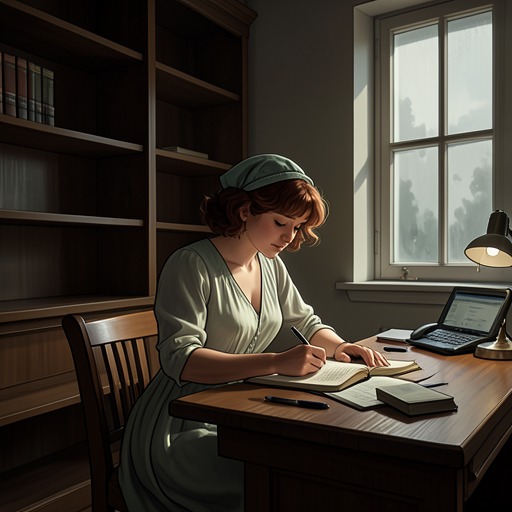
“I still believe, in spite of everything, that people are truly good at heart”
Diary of Anne FrankAnne Frank’s statement that she still believes people are truly good at heart is a hard-won conviction, not a claim that suffering is unreal. In the diary, it appears amid the collapse of ideals and the knowledge of persecution, yet remains joined to her insistence that people must preserve hope, moral purpose, and the capacity for goodness.
A Conviction Tested by Reality
Anne places the belief in the midst of a direct reckoning with the young people confined in the Secret Annex. Their problems, she argues, weigh especially heavily because they are too young to master them, yet are repeatedly forced to seek solutions that crumble against the facts. Ideals, dreams, and cherished hopes rise only to be crushed by grim reality; she finds it astonishing that she has not abandoned her own ideals because they seem so impractical.
That surrounding argument gives the statement its force. It does not emerge from protection against knowledge: Anne sees a world turning into a wilderness, hears the approaching thunder that may destroy the people in the Annex, and feels the suffering of millions. She says she cannot build her life on chaos, suffering, and death. Her belief in human goodness persists in the same passage as these perceptions, making it an act of resistance to despair rather than a denial of what war has done.
Faith, Nature, and the Possibility of Consolation
The diary connects moral endurance with religious reflection, though Anne’s relationship to religious practice is not simple. Her father encourages her to read German writers and begins reading Goethe and Schiller’s plays with her, starting with Don Carlos. Her mother gives her a prayer book; Anne reads several prayers out of politeness, finds them beautiful in sound, but says they mean little to her. This contrast shows that inherited religious forms and personal conviction do not always coincide.
Elsewhere, however, Anne turns toward God as part of an effort to understand suffering and sustain hope. After seeing Hanneli Goslar in a dreamlike encounter, she recognizes that she had misjudged her friend and failed to think about her suffering. Anne asks why she has been chosen to live while Hanneli may die, and whether there is any difference between them. The encounter sharpens the moral meaning of her belief: the knowledge that she is comparatively safe does not quiet her conscience, but leads her to acknowledge another person’s pain and regret her own earlier selfishness.
Nature offers a different, immediate form of consolation. Looking out across Amsterdam’s rooftops toward a nearly invisible strip of blue sky, Anne reflects that the best remedy for fear, loneliness, or unhappiness is to go outside and be alone with the sky, nature, and God. She believes that nature’s beauty and simplicity can bring solace to people who suffer. This is not proof that suffering has ended; it is a source of steadiness from which the possibility of happiness can still be imagined.
From Personal Hope to Jewish Survival
Anne’s reflections also place individual belief within the threatened continuity of Jewish life. In a passage about Jews being set apart and made to suffer, she wonders whether their religion might teach the world goodness. She rejects the prospect of being only Dutch or English: Jews, she writes, will always be Jews, and they will have to continue to be so, but will also want to be. Faith here is not merely private comfort; it is bound to identity, collective endurance, and the hope that suffering will not erase the people who endure it.
The belief in human goodness thus holds together ideas the diary refuses to simplify: grievous injustice and hope, doubt about religious forms and appeals to God, fear of death and confidence that cruelty will end. Near the diary’s close, Anne says she somehow feels that the world will change for the better and that peace and tranquillity will return, even as she describes approaching danger and the suffering of millions. She insists that she must hold on to her ideals, perhaps one day to realize them. The statement’s significance lies in that continuing tension: goodness is not presented as a fact that makes history harmless, but as a possibility Anne chooses not to surrender.