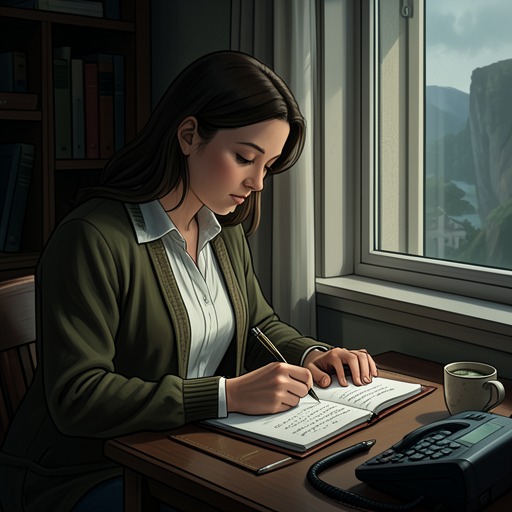
“Paper has more patience than people”
Diary of Anne Frank“Paper has more patience than people” names the emotional logic behind Anne Frank’s decision to write: when she feels depressed, bored, and friendless, the diary offers a listener who will not tire of her thoughts. The saying makes the page more than a container for recollection; it becomes a provisional companion, while the hope of finding a real friend remains unresolved.
The saying and its moment
Anne introduces the thought in her June 20, 1942 diary entry, describing a day when she sat at home with her chin in her hands, listless and uncertain whether to stay in or go out. She stayed, brooding, and recalled the saying that paper has more patience than people. Its force comes from this unexceptional scene: the diary begins not with a dramatic event, but with the familiar loneliness of having no one to talk to.
The diary as confidante
The line follows Anne’s account of how strange it feels to write in a diary for the first time. She doubts that she—or anyone else—will later be interested in the musings of a thirteen-year-old schoolgirl, yet she feels an urge to write and a stronger need to get things off her chest. The notebook gives that need a form: paper can receive what she wants to say without interruption or impatience.
Anne qualifies the diary’s role. She does not plan to let anyone read the stiff-backed notebook, grandly called a diary, unless she should ever find a real friend. Writing therefore serves as both private disclosure and a possible substitute for friendship, not as a settled replacement for human intimacy. The condition she sets—finding a real friend—leaves open the possibility that the pages might eventually be shared.
Loneliness and the phrase’s significance
After reflecting on paper’s patience, Anne returns to the reason she began keeping a diary: she has no friend. That sequence gives the saying its emotional weight. The page can patiently hold her musings, but it cannot erase the absence that prompted them. The diary’s intimacy is consequently double: it gives loneliness somewhere to speak while making clear that Anne still longs for a human confidante.
As a compact expression, the saying links the diary’s everyday material—a stiff-backed notebook and its paper—to the need for trust and attention. It also frames the diary as an act undertaken in the present despite uncertainty about its future readers: Anne doubts that anyone will care, but writes because the need to express herself is already pressing.