“The time will come when we’ll be people again and not just Jews”
Diary of Anne Frank“The time will come when we’ll be people again and not just Jews” is a declaration of hope written amid the confinement and persecution recorded in Anne Frank’s diary. The phrase names the injury of being reduced to a targeted identity while refusing to imagine freedom as escape from Jewishness: the hoped-for future restores ordinary human standing, but does not require the Jewish people to disappear.
The conditions behind the statement
The diary places the phrase within a history of tightening restrictions. Before the German occupation, news of Hitler’s anti-Jewish laws had already reached Anne’s family through relatives suffering in Germany; after the 1938 pogroms, her two maternal uncles fled to North America, and her elderly grandmother came to live with the family. Following the German arrival in 1940, a succession of decrees narrowed Jewish life in the Netherlands: Jews had to wear a yellow star, give up bicycles, shop only during restricted hours, attend Jewish schools, and avoid public transport, entertainment, sports, and many ordinary social activities. The list’s repeated prohibitions make exclusion cumulative: everyday choices become matters governed by imposed rules.
Religious identity appears in the diary not as a single, settled practice but as lived experience. During Hanukkah, the hidden group exchanged modest gifts and lit candles for only ten minutes because candles were scarce; Mr. van Daan made a wooden menorah. Elsewhere, Anne records reading German prayers at her mother’s urging, finding them beautiful but of little personal meaning. These domestic details sit alongside the public classification imposed by persecution, showing that Jewish identity is at once inherited, practiced, questioned, and forcibly made consequential.
From confinement to collective resolve
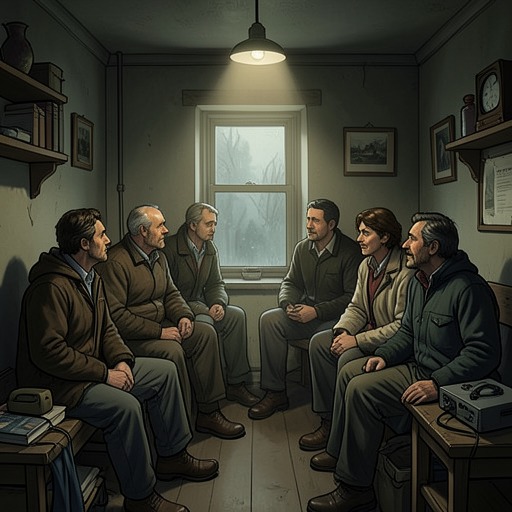
The statement comes in the wake of a security scare in the Secret Annex. The residents respond with new precautions: Fritz Pfeffer is to work in the bathroom, Peter van Pels patrols the house, the toilet must not be flushed after half past nine, and a barricade is planned from white bedsteads. Anne turns from these immediate restrictions to their larger meaning: the residents are Jews “in chains,” fixed in one place, deprived of rights and burdened with obligations. The phrase’s future tense answers that present condition. It does not deny confinement; it insists that confinement is not the final definition of those living through it.
The declaration is joined to an appeal for endurance and responsibility. Anne urges the group to put feelings aside, bear discomfort without complaint, do what is within their power, and trust in God. She imagines a way out, drawing strength from the persistence of Jewish life through centuries of suffering. In that sequence, hope is not passive reassurance. It is bound to conduct in the present: courage, mutual obligation, and continued survival.
Jewishness, faith, and belonging
The diary’s hope of becoming people again is not a wish to become something other than Jewish. Anne asks why Jews have been set apart and made to suffer, and reflects that God made them as they are but may also raise them up again. She imagines that Jewish religion could teach goodness to the world, while insisting that Jews will always remain Jews and will have to continue to do so. The passage thus holds faith, doubt, and collective identity together rather than resolving them into a simple answer to suffering.
That insistence takes on added weight when Anne hears that some German Jews who had immigrated to the Netherlands before the war and were later sent to Poland might not be allowed to return after Hitler’s defeat. Even the promise of a postwar settlement, she fears, may leave Jews regarded as lesser beings. The language of eventual human recognition therefore answers not only Nazi policy but also the prospect that exclusion might survive the war in altered form.
Anne’s attachment to Holland complicates the distinction between Jewish identity and national belonging. She writes that she loves the country that once received her and hopes it can still become a fatherland to her, despite the threat that Jews may be made to leave. Her hope is not framed as a choice between being Jewish and belonging to the Netherlands: both remain part of the future she longs for.
The phrase’s significance
The statement gathers the diary’s recurring tension between imposed identity and personal humanity into one compact contrast. The residents are marked as Jews by laws, danger, and exclusion, but Anne resists the implication that this designation exhausts who they are. Her answer is simultaneously universal and particular: Jews should again be treated as people, and they will remain Jews. The sentence’s confidence is not evidence that safety has arrived; it is a commitment voiced while the outcome remains uncertain.
Its later public life is connected to Anne’s deliberate work as a diarist. She began writing for herself, then, after hearing Gerrit Bolkestein call for wartime letters and diaries to be collected as testimony, decided to shape a book from her writing. She revised an edited version while continuing her original diary. The phrase belongs to a private record formed under pressure, but that process of writing also helped make the diary an intended witness to the suffering of the Dutch people under occupation.