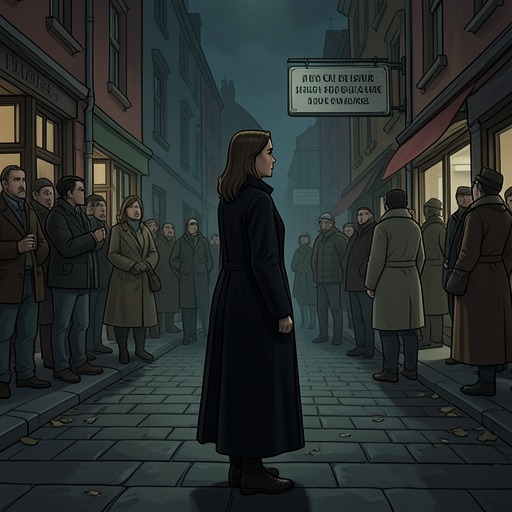
Air-raid danger in Amsterdam
Diary of Anne FrankAir-raid danger in Amsterdam is a persistent pressure in Anne Frank’s account of hiding: the war reaches the Secret Annex not only through news of destruction elsewhere, but through sirens, gunfire, planes overhead, and the residents’ effort to decide what safety can mean when escape itself is dangerous. The diary places each alarm beside ordinary routines, making the threat recurrent rather than exceptional and exposing the fragile boundary between the hidden household and the war around it.
Reports of Destruction and the Limits of Safety
The danger is first understood through reports that turn the city’s suffering into a continuing presence in the Annex. After North Amsterdam is heavily bombed, Anne records that entire streets lie in ruins, that two hundred people are reported dead and countless others wounded, and that the hospitals are overwhelmed. The report that children are searching among the ruins for their dead parents makes the scale of destruction legible through the consequences for families. Anne also remembers the distant drone that announced the approaching attack; even when the bombing is not seen directly, its warning remains with her.
News from outside reaches the residents through people and broadcasts, but it cannot give them control over what happens. When Fritz Pfeffer arrives, he tells them that military vehicles are going from house to house, taking Jewish families away, sometimes using lists and offering payment for each person captured. Anne contrasts this danger with the relative quiet of hiding: the Annex is safer, yet the safety brings guilt because friends and other people are suffering beyond their reach. Elsewhere, the diary describes families torn apart, people permitted to take only a small bag and money, and Dutch men being sent to Germany for labor. These accounts place bombing within a wider landscape of wartime peril, without making the hidden residents’ refuge seem secure in any absolute sense.
The Repeated Alarms of a Single Day
One day’s sequence of alerts shows how quickly the household’s sense of security can change. A morning siren is initially dismissed because it signals that planes are crossing the coast. Later, after Anne has rested and gone to the office, Margot finishes her work and is gathering her things when the sirens sound again. They return upstairs, and within minutes the guns are booming loudly enough to send them into the hall.
The house shakes as bombs fall. Anne clutches her escape bag, not because she believes they can safely flee, but because having something to hold offers a small response to helplessness. Leaving the building would expose them to danger in the streets as well as to the raid. When the engines recede, the residents emerge from separate positions: Peter from his lookout in the front attic, Fritz from the front office, Auguste from the private office, Hermann from the loft, and others from the landing. They watch smoke rise above the harbor; soon the smell of fire is everywhere and the city appears veiled by haze. The Annex’s occupants have survived that attack, but the view confirms that danger has reached the city around their hiding place.
The reprieve does not last. As the residents begin dinner, another alarm sounds; this time the alert passes without an attack, and the all-clear comes after forty-five minutes. After the dishes are washed, a further warning brings gunfire and planes. The diary reports that British accounts identify Schiphol Airport as the target. Anne describes the repeated approach and retreat of the aircraft and her fear that the next moment may be decisive. The sequence makes routine itself unstable: meals, chores, and sleep proceed only in the intervals the alarms allow.
That night, the fear continues after the immediate attack has passed. Anne’s legs are still shaking when she goes to bed at nine. At midnight, more planes wake her; she moves between her own bed and Otto’s, listening as the firing continues, and does not fall asleep until half past two. The raid’s consequence is therefore not limited to physical damage elsewhere in Amsterdam. It enters the Annex as disrupted rest, bodily fear, and an expectation that the next sound may require another response.
The Threat Beyond the Immediate Raid
By early 1944, the diary records a different form of air-raid anxiety: anticipation of an Allied landing and the possibility that German forces might flood parts of the country to resist it. Reports in the newspapers warn that the Germans may flood the land if the British invade the Netherlands, and maps mark the areas considered at risk. Because large portions of Amsterdam are shaded, the residents begin asking what they would do if the street water rose above their waists. The question shifts the household’s attention from bombs falling to a possible transformation of the city itself, while offering no reliable plan for what would follow.
The fear of an attack also exists alongside a wider expectation of liberation. In the broadcast that moved Anne to plan a book based on her diary, Gerrit Bolkestein, speaking from London for the Dutch government in exile, calls for eyewitness accounts of life under German occupation, including letters and diaries. Later, as invasion expectations mount, newspaper reports make military developments part of the Annex’s daily attention. Such news offers a horizon beyond the immediate danger, but it cannot settle when or how the war will end.
Witnessing, Refuge, and the Diary’s Perspective
The diary keeps distinct what Anne experiences in the hiding place and what she learns about the world beyond it. The alarms, the shaking house, the escape bag, and the smoke across the harbor are recorded from within the Annex. Reports about the ruins of North Amsterdam, the destruction of Schiphol Airport, and the fate of families outside reach her through accounts and broadcasts. That difference matters: the diary is a personal record of danger and a record of how distant suffering becomes known to people who are sheltered from it, not an all-seeing account of each attack.
Air-raid danger also sharpens the moral unease of refuge. The residents can return to their chores after an attack and use their money to buy food, while the diary repeatedly sets that relative safety against the deaths and losses suffered elsewhere. Anne’s account of friends being taken away intensifies the same conflict: relief at being hidden is inseparable from helplessness about those who are not. The city’s danger therefore persists as more than an immediate physical threat; it shapes how safety is felt and judged.
In this structure, the alarms interrupt ordinary life, but the diary’s return to ordinary details does not erase the danger. A meal can resume, dishes can be washed, and sleep can be attempted, only for another warning to break the sequence. The recurring pattern gives the threat its force: Amsterdam remains exposed, the residents cannot leave without risking discovery, and each temporary quiet is only a pause whose duration they cannot know.