Anne Frank
Diary of Anne FrankAnne Frank was a Jewish Dutch teenager whose diary traces a sharp passage from a lively prewar life into hiding under Nazi persecution, while following her emergence as a writer who consciously reshaped her own story. The diary began as a private confidante, became a project Anne revised for future publication, and ultimately reached readers through editorial choices made after her death. Its successive versions preserve both the immediate voice of a young person in confinement and the later work of an author trying to make that voice public.
Identity and Background
Anne was born on June 12, 1929, and spent her early childhood in Frankfurt am Main before her family moved to the Netherlands. Her father, Otto Frank, had immigrated in 1933; Anne and her sister, Margot Frank, initially stayed with their grandmother in Aachen before joining their parents. Anne attended the Montessori nursery school and later the Jewish Lyceum, where she said goodbye in tears to a teacher who had been her principal. These details place her early life within a family already displaced by antisemitism and the changing conditions facing Jews in Europe.
The German occupation brought restrictions into everyday routine. Jews were required to wear the yellow star, give up bicycles, shop only during specified hours, and avoid public entertainment and sports; a curfew and restrictions on social contact further narrowed their lives. Anne’s account conveys how regulation accumulated as a list of prohibited actions, even as ordinary life continued. Her recollection of a friend’s fear of doing anything that might not be permitted shows how the decrees shaped not only movement but also a sense of what was safe to do.
The Diary as Confidante and Craft
Anne began her diary on June 12, 1942, hoping to confide what she had never been able to tell anyone. She had friends, admirers, relatives, and a good home, yet felt that her conversations with friends remained at the level of everyday topics. The lack of a trusted confidante was, in her account, the reason she started writing. Rather than record facts impersonally, she imagined the diary as a friend and named that friend Kitty. By September, she wrote that Kitty and the diary had indeed become sources of comfort, and that she looked forward to writing.
The diary’s form therefore registers a relationship as well as events: Anne addresses Kitty, explains what the imagined recipient would need to know, and turns private experience into a continuing conversation. That intimacy does not make the record all-knowing. Anne distinguishes what she experiences from news she receives from others, and her descriptions of persecution beyond the hiding place include information brought by visitors. In one account, she reports what Fritz Dussel told the residents about raids, deportations, and the fate of friends and acquaintances. The resulting testimony joins the immediate details of life in hiding to the distressing outside world as it reached her.
Anne’s writing also became an intentional craft. After hearing Gerrit Bolkestein, a member of the Dutch government in exile, call on the radio for postwar eyewitness accounts, she decided to make a book based on her diary. She began revising it as version b, improving the text, omitting passages she considered uninteresting, and adding material from memory, while continuing her original diary, later called version a. She also devised pseudonyms for people in the planned book, first considering Anne Aulis and later Anne Robin. The act of revision shows that Anne was not only recording a life as it happened; she was imagining how that life might be read.
Hiding and the Pressure of Persecution
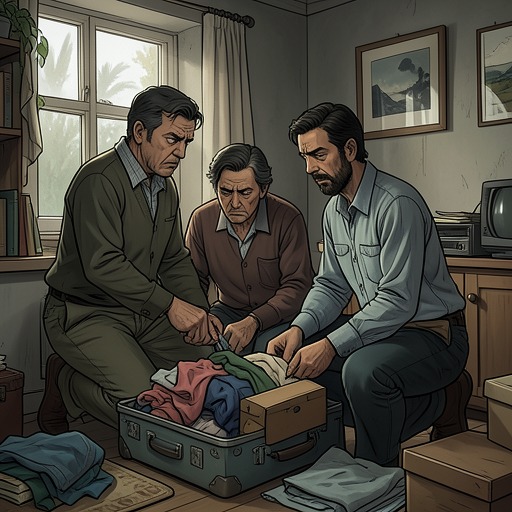
The family had been preparing to hide for months, moving furniture and clothing out of their apartment, with July 16 set as the intended date. Margot’s call-up notice forced them to leave ten days early. Anne recalls learning the plan while the family walked through the rain with schoolbags and shopping bags, the yellow stars on their clothing making their situation visible to passersby. The hiding place was in Otto Frank’s office building. The helpers in the office knew the family was coming, while warehouse staff were not informed, a distinction that made concealment depend on carefully limited knowledge.
The diary records hiding as a practical discipline as much as a change of address. During the day, residents had to avoid noise that might be heard downstairs and take account of workers in the building. A break-in made these routines more urgent: after Peter went to the warehouse and found the doors open, the residents followed instructions to stay quiet, avoid water, dress, and keep away from the bathroom. The burglars took cashboxes, blank checkbooks, and the household’s entire allocation of 330 pounds of sugar coupons. The episode joined physical danger to material insecurity, since the stolen coupons could not easily be replaced.
A later security scare brought further changes. The residents were told not to go downstairs; Peter was assigned to patrol, could no longer open his window, and had to observe restrictions on flushing the toilet at night. A night watchman was hired, and a carpenter from the underground was expected to build a barricade from the white Frankfurt bedsteads. These concrete adjustments reveal how a threat outside the rooms reorganized the smallest habits within them. Anne describes the residents as Jews deprived of rights but burdened with obligations, while holding on to the hope that the war would end and they would again be regarded as people, not only as Jews.
Relationships and Coming of Age
Anne’s account of her relationships changes alongside her circumstances. Looking back at 1942, she remembers herself as surrounded by admirers and friends, popular with teachers, spoiled by her parents, and generous with candy. She describes her earlier public manner as flirtatious and entertaining, supported by quick answers and a critical mind. In the same reflection, she recognizes that being suddenly deprived of admiration forced her to adjust: it took more than a year to get used to living without it. The contrast is not simply between comfort and confinement; it is between a self sustained by the attention of others and one learning to assess herself without that audience.
Her relationship with Peter develops out of loneliness and a wish for conversation. In January 1944 she deliberately sought an excuse to spend time in his room, where he was absorbed in crossword puzzles. Sitting across from him, she noticed his bashfulness and uncertainty, but found it easier to think of questions than to ask them. By late February, she wrote that her thoughts and dreams were filled with him and tried to understand their apparent differences through their troubled relationships with their mothers. Her account presents closeness as an attempt at mutual recognition, not merely as a change in her feelings toward him.
The emotional intensity of this attachment did not end Anne’s separate ambitions. One Saturday night, after remaining cheerful with Peter and the van Pels family, she was overcome by misery when alone and struggled to keep her crying from being heard. The entry turns from this private distress toward a decision: she needed to study, avoid ignorance, and pursue the work she wanted. The movement from concealed grief to a plan for her future shows her attempting to claim direction over a life whose external conditions remained beyond her control.
Writing, Ambition, and the End of the Record
Anne identified journalism as her goal and judged her work with both confidence and reserve. She thought some stories were good and that her descriptions of the Secret Annex were humorous and vivid, but did not assume that these qualities proved she had talent. She named “Eva's Dream” as her best fairy tale and assessed “Cady's Life” as promising in parts but not wholly successful. Her self-criticism is part of the evidence of ambition: she was measuring herself against work she hoped to improve, not treating writing as an incidental pastime.
That ambition had a larger purpose. Anne did not want to be defined only by a future of marriage and children, or to live and then be forgotten. She hoped to be useful or bring enjoyment to people she would never meet, and to continue living through what she wrote. This wish connects the diary’s private address to Kitty with its envisioned public life. The young writer who began by seeking someone to confide in came to understand writing as a means of self-development, expression, and a possible contribution beyond her immediate circle.
Anne’s final diary entry is dated August 1, 1944. Three days later, the eight people in hiding were arrested. The manuscript’s survival and publication then depended on others: Miep Gies and Bep Voskuijl found the diaries scattered on the floor and Miep put them away unread; after the war, when Anne was known to be dead, she gave them to Otto Frank. The end of Anne’s written record is thus not the end of the diary’s history, but a break between her authorship and its later custody.
Versions and Public Legacy
After long deliberation, Otto Frank chose to fulfill Anne’s wish to publish a book. He combined material from her original diary and her revised version into a shorter text, version c, which became the first published book. Its length had to suit the Dutch publisher’s series. Otto also omitted passages about Anne’s sexuality, which were considered unsuitable for a young-adult book in 1947, and unflattering passages about his wife and the other residents, out of respect for the dead. These editorial decisions shaped the first public image of Anne: they made the book publishable in its time, but left parts of her own selection and self-portrait outside that edition.
When Otto died in 1980, he left Anne’s manuscripts to the Netherlands State Institute for War Documentation in Amsterdam. Because the diary’s authenticity had been challenged, the institute commissioned a thorough investigation. After the diary was established as genuine, the complete texts were published with the investigation’s findings. The Critical Edition included versions a, b, and c, along with material on the Frank family, the arrest and deportation, Anne’s handwriting, and the documents and materials used. The edition made the history of the text itself available alongside the diary.
The Anne Frank-Fonds, which inherited the copyrights as Otto Frank’s sole heir, later commissioned an expanded edition for general readers. Mirjam Pressler compiled it, supplementing Otto’s selection with passages from versions a and b. The resulting definitive edition contains approximately 30 percent more material; it does not replace or compromise the earlier edition. It gives readers a fuller view of the young author’s changing judgments and unreserved likes and dislikes, while preserving the distinction between Anne’s successive texts and her father’s posthumous selection. Anne’s legacy is therefore both the witness her diary offers and the record of how a private manuscript passed through revision, protection, selection, authentication, and expansion before reaching the public.