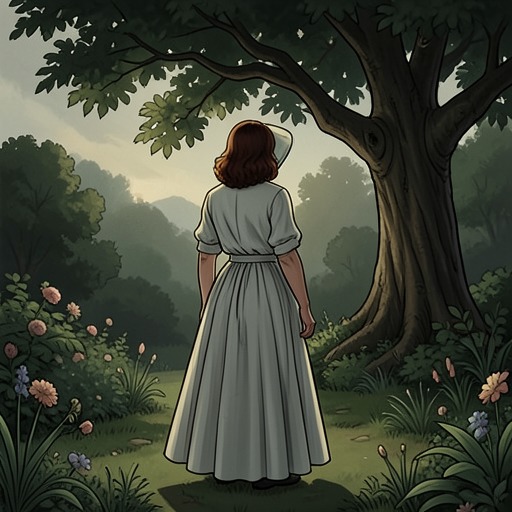
Anne Frank's chestnut tree
Diary of Anne FrankAnne Frank’s chestnut tree is a recurring presence in her diary and a measure of the natural world continuing beyond the Secret Annex. Its seasonal changes bring beauty into a life shaped by concealment, scarcity, and domestic strain; by spring 1944, the tree’s blossoms and leaves give that contrast a striking form.
A Presence Beyond the Annex
In April 1944, Anne notes that the winter has been mild and spring beautiful, with occasional light showers. The chestnut tree is “in leaf,” and small blossoms are already visible. The brief description places the tree within the view from the Annex: it is not something the residents can possess or alter, but a living presence whose growth registers time passing beyond their confinement.
The diary’s attention to leaves and blossoms is precise rather than abstract. The tree’s changes belong to the same spring landscape as the flowers brought into the Annex: Bep presents four bouquets, three of daffodils and one of grape hyacinths for Anne. The outdoor tree and the cut flowers make nature present in different ways—one rooted and changing with the season, the others carried indoors—while both interrupt the enclosed routine.
Full Bloom in May
A month later, on the day after Otto Frank’s birthday and his nineteenth wedding anniversary, Anne records that the sun is shining as it has not shone before that year. The chestnut tree is now in full bloom, covered with leaves and “even more beautiful than last year.” The comparison makes the tree a recurring point of reference: Anne has watched it across seasons and can recognize the return of its beauty, renewed rather than merely repeated.
The occasion is crowded with the small exchanges of Annex life. Otto receives books from Johannes Kleiman and Victor Kugler, a carefully wrapped box from the van Daans containing three eggs, beer, yogurt, and a green tie, and roses that Anne says smell wonderful beside the red carnations from Miep and Bep. Against this inventory of gifts and scarce provisions, the tree’s abundance is not a possession or a ration. It stands outside the household’s arrangements, beautiful on its own terms.
Beauty Under Confinement
The tree’s significance lies partly in the contrast between its seasonal freedom and the residents’ unbroken confinement. Anne describes the strain of living under pressure that never lifts, while immediate domestic problems make that pressure tangible: the drains clog again, the water runs only in a trickle, the toilet cannot be flushed normally, and dirty water must be stored in a large earthenware jar until a plumber can come. The tree’s spring growth does not resolve these conditions; it offers a visible counterpoint to them.
Across the diary, the chestnut tree recurs as a natural measure of change during the years in hiding. Its leaves and blossoms in April and its full bloom in May give the passage of time a form Anne can observe from within the Annex. The beauty matters not because it erases confinement, but because it remains perceptible alongside it: the world outside continues to change, and Anne continues to look.