Auguste van Pels
Diary of Anne FrankAuguste van Pels, known in Anne Frank’s manuscript and the published book as Petronella van Daan, was one of the eight people who hid in the Secret Annex. Born on September 9, 1890, she joined the hiding place with her husband, Hermann, and their son, Peter, in July 1942. Anne’s diary gives her a vivid, sometimes comic presence in the Annex’s crowded daily life, while the record of her deportation and successive transfers reveals the mortal danger behind those domestic scenes.
Identity and Arrival
Auguste came from Osnabrück, Germany. The book’s identification material gives her birth date as September 9, 1890, and clarifies the names through which readers encounter her: Anne used Petronella, Hans, and Alfred van Daan in her manuscript, while the published book gives the family as Petronella, Hermann, and Peter van Daan. The pseudonym marks a distinction between the diary’s literary presentation and the family’s historical identities; both refer to the same woman.
The van Pels family reached the Annex earlier than expected. With German call-up notices causing unrest, they decided it was safer to leave a day early rather than risk waiting. Peter arrived at nine-thirty in the morning, while the Frank family was still at breakfast; Auguste and Hermann followed half an hour later. Their arrival brought three more people into the concealed living space where the Frank family had already taken refuge.
The new household formed quickly around shared routines. The residents ate together from the beginning, and Anne wrote that after three days the seven people then present felt like one big family. That early sense of collective belonging did not eliminate the pressure of living at close quarters. Anne’s later entries show how meals, parental authority, political arguments, and security rules repeatedly made the Annex a site of negotiation and conflict.
Domestic Authority and Friction
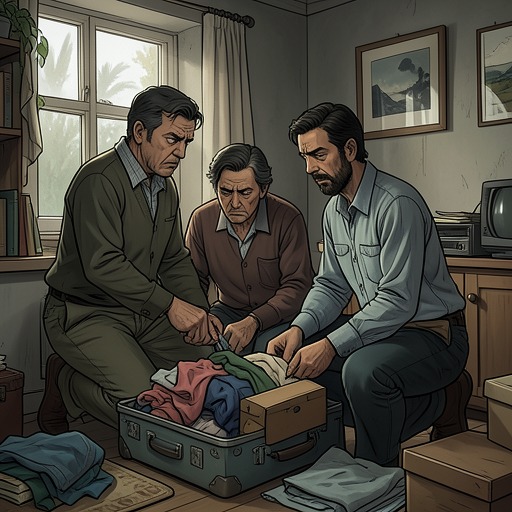
Auguste’s first memorable entrance is inseparable from the practical, faintly comic business of making a home in hiding. She carried a hatbox containing a chamber pot, explaining that she did not feel at home without it; the pot found a permanent place under the divan. Hermann, by contrast, carried a collapsible tea table under his arm. The objects are ordinary household necessities, but their arrival also captures how the family brought domestic habits into a place where comfort and privacy were scarce.
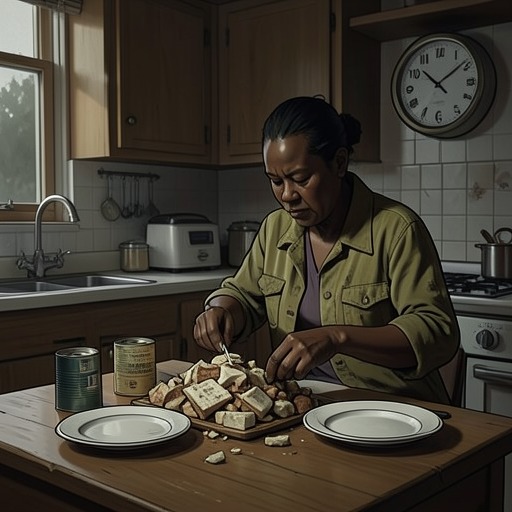
Anne depicts Auguste as one of the adults who took an interest in raising the Frank children. She writes that the van Daans seemed to take particular delight in helping bring up other people’s children, and that their admonitions, along with Anne’s saucy replies, could fill the room. Auguste is especially prominent when Anne takes only a small helping of a vegetable she dislikes and eats potatoes instead. Auguste urges her to eat more vegetables, invoking their value and Anne’s mother’s agreement; Anne answers politely but firmly that the potatoes are enough. The brief exchange shows Auguste asserting adult authority over a child who resists being managed, while also making the shared meal a recurring stage for disagreements over Anne’s behavior.
The diary also records a severe quarrel between Auguste and Hermann. Anne calls it a terrible fight and remarks that she had never seen anything like it, contrasting their shouting with the way her own parents behaved. In her telling, the argument began over something trivial, making its intensity more striking. Peter was caught in the middle, but Anne notes that the others no longer took him seriously, describing him as hypersensitive and lazy. The episode presents a family under pressure without reducing the conflict to a single cause: the apparent smallness of the dispute sits beside the strain of a household living together in concealment.
Life Under Confinement
Auguste’s life in hiding was shaped not only by family relationships but by the external danger surrounding the building. Before the Franks went into hiding, occupation authorities had progressively restricted Jewish life: the rules described in Anne’s account limited movement, shopping, transport, schooling, and access to public activities, and required Jews to wear the yellow star. The family’s move into the Annex was brought forward after Margot received a call-up notice. Auguste entered a hiding place made necessary by persecution, not a freely chosen domestic retreat.
A later break-in exposed the fragility of the arrangements on which all the residents depended. When Peter went downstairs early one morning, he found the warehouse and street doors open and reported the danger. The group followed emergency instructions: they kept quiet, avoided washing or running water, dressed by eight, and stayed away from the bathroom. The burglars had forced the doors with a crowbar, taken cashboxes, blank checkbooks, and sugar coupons, and tried to continue upstairs. The loss of coupons for 330 pounds of sugar threatened the residents’ entire allotment, linking a security breach directly to the already precarious business of obtaining food.
The break-in led to tighter rules that reached into the smallest routines. Peter and Hermann made a final round at night, after which nobody could go downstairs; toilet flushing was restricted, and windows could be opened only at specified times. A night watchman was hired, and a carpenter from the underground was expected to construct a barricade from the residents’ white Frankfurt bedsteads. Anne records the resulting anger as well as the procedures: Fritz objected to being barred from downstairs and to the restrictions on air, while Hermann was involved in the new nightly patrol. The security response was collective, but its burdens were felt in personal habits, arguments, and the loss of ordinary freedom.
Political Arguments and the Diary’s View
Auguste appears as part of the Annex’s lively, contentious political household. Anne describes optimists, pessimists, and realists voicing their views with seemingly inexhaustible energy, each certain of possessing the truth. A dispute between a wife who resented her husband’s faith in the British and a husband who objected to her disparaging remarks about his beloved nation becomes another example of political argument spilling into family life. Anne says that she could set the entire household going by beginning to talk about politics. The diary passage does not identify the couple by name, so it supports a picture of Auguste’s social setting and the residents’ recurring debates, rather than a definite attribution of each opinion to her.
The form of the account matters. Auguste does not narrate her own experience; she is seen through Anne’s dated, personal observations, where a chamber pot, a vegetable dish, or a quarrel can make confinement legible at household scale. Anne’s perspective can be impatient and comic, especially when recording adult advice or family disputes, but these particulars also register the conditions under which the residents tried to preserve routines. The same household that argues over vegetables and national loyalties must also observe restrictions on movement, water, windows, and nighttime noise.
Deportation and Fate
After the eight residents were arrested, they were taken first to a prison in Amsterdam and then deported to Westerbork, the transit camp in the north of the Netherlands. On September 3, 1944, they left on the last transport to depart Westerbork and arrived three days later at Auschwitz. The retrospective account of Auguste’s fate follows a route that continued after Auschwitz: she was transported to Bergen-Belsen, then to Buchenwald, and on April 9, 1945, to Theresienstadt. She was apparently sent to another concentration camp afterward.
The record establishes that Auguste did not survive, but gives no certain date or location of her death. That uncertainty contrasts with the diary’s close attention to the timing of meals, arrivals, quarrels, and new rules. Its domestic scenes preserve the person Anne knew as Mrs. van Daan; the later account traces the sequence of deportation and dispersal that ended her life, without supplying a final moment. Together, the two kinds of record show both the daily person in the Annex and the historical fate that the diarist could not know while writing.