BBC
Diary of Anne FrankThe BBC is the wartime broadcaster whose reports become a vital connection between the residents of the Secret Annex and events beyond their hiding place. Heard under strict rules and often in company, its news makes the distant war present in the rooms: Italy’s surrender becomes a moment of exhilaration, while the D-Day broadcasts bring the prospect of liberation close enough to argue over, hope for, and fear. In Anne Frank’s diary, the radio is both a practical source of information and a medium through which the hidden group experiences uncertainty together.
A restricted link to the outside world
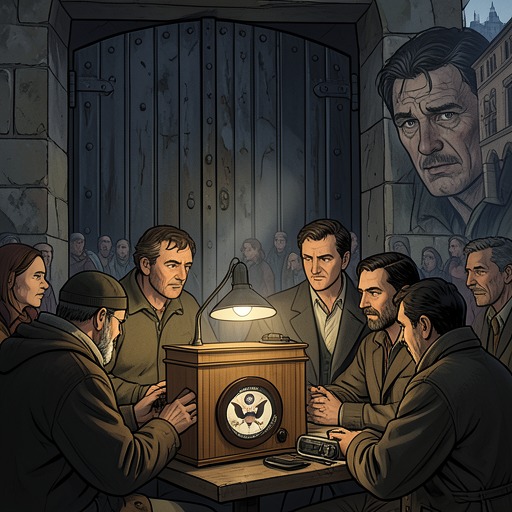
The Annex’s private radio could receive stations from London, New York, Tel Aviv and elsewhere, and was officially available to residents after six in the evening. Its use was governed by a safety-conscious set of rules: residents were forbidden to listen to German news bulletins, regardless of where they were transmitted from, though German stations could be used for classical music. The distinction shows how listening was bound up with concealment as well as information. The radio offered access to the world, but access had to be managed so that the connection itself would not endanger the people relying on it.
The danger was immediate from the first days in hiding. When the family went down to the private office to listen to England, Anne was so afraid that someone might hear them that she begged Otto Frank to take her upstairs; Edith Frank understood and accompanied her. The episode sets the emotional terms of listening: a broadcast could offer contact with the outside, but hearing it meant risking discovery. The radio was not simply household entertainment; it was part of the Annex’s fragile, carefully guarded boundary with the world beyond it.
That boundary grew more precarious when the authorities ordered radios surrendered. The residents expected to hand over their large Philips set, but Victor Kugler had a smaller hidden radio to provide in its place. Anne presents the replacement as a clandestine necessity, not a luxury: people across the country were trying to find old sets they could turn in instead of the radio that served as their morale booster. As outside reports worsened, the hidden set’s voice helped listeners keep their spirits up and tell themselves that matters would improve. The BBC’s significance therefore depended on material arrangements—what could be concealed, what had to be surrendered, and how the residents could continue listening without drawing attention.
News becomes a shared experience
The broadcast is most powerful in the diary when it changes the atmosphere of the Annex. On September 8, the residents heard the seven o’clock news announce Italy’s capitulation. The Dutch broadcast from England followed at eight-fifteen with confirmation that Italy had surrendered unconditionally. Its program played “God Save the King,” the American national anthem and the Russian “Internationale.” Anne describes the Dutch program as uplifting without being too optimistic: the announcement encouraged joy, but the wider picture remained unsettled. British forces had landed in Naples, northern Italy was occupied by Germany, and the truce had been signed on September 3, the day the British landed in Italy.
The importance of this report lies not only in the military news but in the way broadcast time gathers listeners around a common turning point. The residents hear the announcement, then the follow-up program and its music; the changing sequence of reports makes a distant political and military reversal into an event experienced inside the Annex. The broadcaster supplies information, while the listeners must hold its promise alongside the continuing danger and uncertainty. The news can be uplifting without amounting to certainty.
Radio listening eventually becomes an all-day household routine. By 1944, the adults switch on the set at eight in the morning, sometimes earlier, and keep listening every hour until nine, ten or even eleven at night. German “Wehrmacht News,” the BBC, special air-raid announcements, “Music While You Work,” Dutch broadcasts from England, Frank Phillips and Queen Wilhelmina all take turns. Anne jokes about the adults’ appetite for repeated updates, but the detail also reveals the radio’s reach: news, warnings, music and political voices fill the residents’ waking day. Listening creates a shared schedule, even as Anne finds the adults’ constant attention tedious.
Trust, interpretation and the limits of news
The BBC’s credibility is explicitly disputed within the diary. In a conversation about reports from Russia, Jan cautions against accepting claims about the Jews and suggests that the British and Russians may exaggerate for propaganda, just as the Germans do. Anne’s response is categorical: the BBC has always told the truth; even if some reports are exaggerated, the facts are already terrible enough. She insists that millions of peace-loving people in Poland and Russia have been murdered or gassed. The exchange records a conflict over how to judge wartime information, not simply a difference in preferred broadcasts. Trust in the BBC shapes what the characters think they can know about persecution beyond their immediate surroundings.
Anne’s confidence in the broadcaster coexists with the diary’s awareness of uncertainty. Reports arrive through a medium that can inform, encourage and provoke debate, but the listeners do not control the events they hear about or possess complete knowledge of them. Their arguments expose the difficulty of separating reliable news from propaganda while under occupation. For the hidden residents, assessing a broadcast is also an attempt to understand the scale and meaning of the danger surrounding them.
D-Day and the renewed prospect of liberation
On June 6, 1944, the BBC announces at noon, “This is D Day.” The invasion has begun. Earlier reports describe heavy bombing at Calais, Boulogne, Le Havre and Cherbourg, and warn people in occupied territories within twenty miles of the coast to prepare for bombardment. By ten, BBC broadcasts in German, Dutch, French and other languages repeat that the invasion has begun. At eleven, a German-language broadcast carries a speech by Supreme Commander General Dwight Eisenhower; at one, the English broadcast reports 11,000 planes and 4,000 landing craft and small boats in the area between Cherbourg and Le Havre, with English and American troops already in heavy combat.
The rapid succession of announcements gives the day its dramatic shape. The news reaches the Annex in stages: first the unmistakable declaration, then warnings and reports from different languages, then numbers, locations and the scale of the operation. Eisenhower’s message to the French people promises that stiff fighting lies ahead, followed by victory, and calls 1944 the year of complete victory. The broadcasters do not erase the danger; they give it a place in a larger movement toward a possible end to the war.
The response in the Annex is immediate and collective. The residents are in an uproar, asking whether this is the beginning of the long-awaited liberation, yet Anne records that they do not know whether 1944 will bring victory. Hope is powerful precisely because it remains uncertain. The diary closes its account of the broadcast with the insistence that hope gives life, fresh courage and strength for the hardships still to come. The BBC’s role is therefore more than the delivery of battlefield reports: through restricted listening, shared debate and repeated announcements, it becomes the voice by which the residents measure both how much has changed and how much they must still endure.