D-Day invasion of Normandy
Diary of Anne FrankThe D-Day invasion of Normandy is recorded in Anne Frank’s June 6, 1944 diary entry as a rapid succession of broadcasts that turns a long-awaited possibility into a present military operation. From the Secret Annex, Anne and the others try to determine whether the reports describe a preliminary landing or the real invasion. The day brings fresh courage, but not certainty: liberation seems nearer, while the residents know they must still endure fear and hardship.
Background and the first reports
The entry opens with the BBC’s announcement at noon: “This is D Day,” followed by Anne’s emphatic recognition that “The invasion has begun!” Earlier reports had already described heavy bombing of Calais, Boulogne, Le Havre, Cherbourg, and the Pas de Calais. The British also warned people in occupied territories living within twenty miles of the coast to prepare for bombardment, with pamphlets to be dropped an hour beforehand where possible.
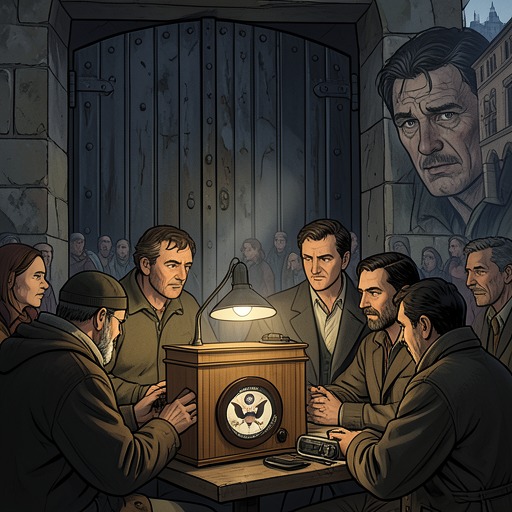
Information reaches the Annex from more than one direction, and the first reports do not immediately settle what is happening. German news says British paratroopers have landed on the French coast; the BBC reports landing craft in combat with German naval units. At breakfast, the residents conclude that the action may be a trial landing like the one at Dieppe two years earlier. The uncertainty gives way only when the BBC announces in German, Dutch, French, and other languages that the invasion has begun: this, Anne writes, is the real one.
Broadcasts and the scale of the operation
The diary preserves the invasion as a sequence of dated and timed news fragments rather than as a view from the battlefield. At eleven, the BBC broadcasts a speech by Supreme Commander General Dwight Eisenhower. In English, he calls it “0 Day” and tells the French people that hard fighting lies ahead, followed by victory, expressing confidence that 1944 will bring complete victory.
At one, the BBC reports that 11,000 planes are shuttling back and forth or waiting to land troops and bomb behind enemy lines. It also reports 4,000 landing craft and small boats arriving in the area between Cherbourg and Le Havre, with English and American troops already engaged in heavy combat. The broadcast carries speeches by the Dutch prime minister in exile, the prime minister of Belgium, King Haakon of Norway, Charles de Gaulle, the King of England, and Winston Churchill. The breadth of the reported forces and speakers makes the invasion sound not like a distant rumor but a vast Allied effort unfolding across occupied Europe.
Anne adds later reports about the operation’s methods and early progress. Straw and rubber dummies are dropped behind German lines and explode on impact; paratroopers land as well, their faces blackened for concealment in the dark. The French coast has been bombarded with 5,500 tons of bombs overnight, and the first landing craft come ashore at six in the morning. Anne reports 20,000 aircraft in action, German coastal batteries destroyed before the landing, and a small bridgehead established. Despite bad weather, the reports say, the operation is going well.
Hope inside the Secret Annex
The news produces a commotion among the Annex residents. Anne frames their reaction as a question of whether this is truly the beginning of the liberation they have discussed so often, a prospect that has seemed almost too good to be real. The diary does not turn that hope into a claim that freedom has arrived. The residents do not yet know whether 1944 will bring victory, and Anne stresses that courage and steadiness will still be needed through further fear, hardship, and suffering.
Her response joins hope to discipline. The residents must remain calm, grit their teeth, and keep going; Anne recognizes that people in France, Russia, Italy, and Germany are already suffering, while those in hiding cannot yet feel entitled to voice their own pain. The invasion changes the emotional horizon of the day, but not the immediate conditions of confinement. Its promise is real enough to renew courage, not certain enough to end anxiety.
Liberation as a widening prospect
For Anne, the invasion matters not only because it may bring safety to the people hiding in the Annex. She writes that its best part is the feeling that friends are on the way: after years of oppression and threat, the thought of rescue means everything. The expected liberation reaches beyond Jewish people alone in her account; she sees it as concerning the Netherlands and all occupied Europe. The change in scale is significant: the invasion offers a prospect of release from a system of occupation, even as the diary continues to record the danger and uncertainty under which the residents live.
The possibility becomes personal when Anne reports Margot’s hope that Anne might return to school in September or October. This imagined ordinary future gives the military news a specific human measure. Yet the entry remains a record of expectation, not fulfillment. The broadcast’s promise and the residents’ hopes are set against the time still required to endure and the consequences of persecution already known to them. In the wider diary, Anne has recorded news that people are being taken from their homes and deported; the invasion therefore arrives not in an abstract theater of war but in the midst of a life shaped by fear for those outside and by the limits of hiding.
Diary form and historical limits
Anne’s account is a contemporaneous record of listening: reports are attributed to the BBC or German news, assembled with the residents’ breakfast-time interpretation, and then followed by Anne’s own response. It does not present her as a witness to the landings themselves. Instead, the changing broadcast reports show how those hidden in Amsterdam encounter a major military event through fragments of news, trying to distinguish a trial from the decisive operation and to read its progress as it unfolds.
The diary’s earlier accounts of deportation give this listening scene its moral weight. Anne had written of people being taken from their homes, families separated, and friends and acquaintances carried away; she also describes the residents’ painful awareness that they are sheltered while people they love remain in danger. Against that background, D-Day is both military news and a possible answer to the question of whether the wider world will intervene. Its decisive consequence within this entry is not immediate liberation, but renewed hope grounded in reports of an Allied landing and in the belief that help may be coming.