Dutch wartime rationing system
Diary of Anne FrankThe Dutch wartime rationing system was the practical machinery through which scarcity entered daily life: ration books and coupons regulated access to essentials, while rising black-market prices and the precarious supply network around the Secret Annex exposed how fragile that access had become. In Anne Frank’s diary, rationing is not simply a background policy. It sets the terms of meals, labor, exchange, and conflict, and makes the difference between a printed entitlement and food actually available painfully visible.
Rules, restrictions, and clandestine supply
After the German occupation of the Netherlands, anti-Jewish decrees narrowed Jewish life through restrictions on movement, transport, shopping hours, schooling, and public activity. Against that larger regime of control, rationing imposed its own daily calculations. The Annex depended on purchased ration books and on people outside who could obtain and deliver supplies; official allocation alone could not meet the residents’ needs. In one early account, ration books acquired on the black market had risen in price from 27 to 33 guilders. Anne’s exasperation at paying that much for printed sheets points to the gap between a coupon’s physical form and the food it was supposed to secure.
The Annex also tried to prepare for scarcity by storing food. Alongside a hundred cans, the residents bought three hundred pounds of beans, partly for their own use and partly for the office staff. The sacks were first hung in the hallway near the secret entrance, but their seams began to split under the weight, so the beans had to be moved to the attic. When the final sack broke during Peter’s lifting, roughly fifty pounds of beans cascaded down the stairs, making enough noise to alarm people below. The incident turned stockpiling into an unintended security risk: provisions meant to protect the group could also betray its presence. The beans were gathered up, and afterward residents searched the corners and crevices as they went upstairs, retrieving what had rolled away.
Rationed goods also generated work. The residents filled packages with powdered gravy, a product of Gies & Co., because Mr. Kugler could find no one else to do the job and it was cheaper to have them do it. Anne compared the repetitive task to work in a prison: it was boring, and left the workers dizzy and giggly. The episode shows how the Annex’s relationship with the outside economy was not limited to receiving aid. Its residents performed paid or cost-saving labor for a business connected to their helpers, even as their confinement made ordinary employment impossible.
Distribution and fairness inside the Annex
Scarcity did not eliminate the need to divide food; it made the terms of division more conspicuous. When butter and margarine were apportioned individually, each person was meant to receive a share on their own plate. Anne judged the distribution unfair because the van Pels, who made breakfast for everyone, gave themselves one and a half times as much as they gave the Franks. Her parents feared an argument and did not challenge the arrangement. For Anne, the dispute was not only about the quantity of fat. It exposed the tension between the labor of preparing food, the authority to distribute it, and the expectation that the portions should be equitable.
A birthday makes the same pressures legible in miniature. On Auguste van Pels’s birthday, she received a jar of jam from the Annex residents, in addition to one ration stamp each for cheese, meat, and bread. Her husband, Fritz Pfeffer, and the office staff gave flowers and food. Anne’s dry observation that this was what the times were like turns an ordinary celebration into a measure of wartime limits: gifts and affection remained, but even a birthday’s abundance was bounded by ration stamps and whatever food could be spared.
The diary also records the erosion of material comfort that made rationing tangible beyond the contents of a plate. By May 1943, the same oilcloth had covered the dining table throughout the period in hiding; the dishcloth was so full of holes that cleaning it was thankless. A flannel sheet had gone unwashed all winter because detergent was rationed and scarce. Clothing was worn, mended, or inadequate, and Anne wondered how a family whose possessions had deteriorated so far could ever regain its former position. These details do not describe ration coupons alone, but they show how scarcity accumulated across household goods, clothing, and hygiene, making deprivation a condition of everyday life rather than a single shortage at mealtime.
Black markets, loss, and improvised exchange
The official system could be undermined by theft as well as by scarcity. During a burglary, intruders took two cashboxes containing 40 guilders, blank checkbooks, and coupons for 330 pounds of sugar—the Annex’s entire sugar allotment. The loss joined physical danger to a direct blow against the residents’ food supply. New coupons would not be easy to obtain, so the stolen allotment could not simply be replaced; a break-in had taken away both money and the recognized means of claiming a large quantity of sugar.
Black-market exchange offered alternatives, but at prices that made necessities costly and insecure. When Anne’s entry of July 1943 describes fruit offered by Bep Voskuijl, the prices are precise: grapes cost 2.50 guilders a pound, gooseberries 70 cents a pound, a peach 50 cents, and melons 75 cents a pound. The newspaper slogan calling for lower prices stands in sharp contrast to the sums demanded for these foods. The list makes the black market’s presence visible in ordinary shopping: fruit could be obtained, but access depended on money and informal connections rather than a simple, stable entitlement.
By the time Anne wrote about conditions outside in 1944, the prices had become more extreme. Half a pound of tea cost 350 guilders, half a pound of coffee 80 guilders, a pound of butter 35 guilders, and one egg 1.45 guilders; Bulgarian tobacco was being traded at 14 guilders an ounce. The suppliers and delivery workers who circulated these goods made the distinction between formal allocation and practical access increasingly porous. A bakery delivery boy could supply darning thread, a milkman could get ration books, and an undertaker could deliver cheese. Anne presents this improvised commerce amid reports of widespread theft, break-ins, and swindling. With salaries frozen and everyone trying to put food in their stomachs, rationing existed alongside a broad informal market rather than containing it.
Arrest, shortage, and substituted meals
The system’s dependence on intermediaries became especially clear when the people supplying the Annex with food coupons were arrested. The residents were left with five black-market ration books but no coupons and no fats or oils. At the same time, Miep Gies and Mr. Kleiman were sick, and Bep Voskuijl could not manage the shopping alone. Several vulnerabilities converged: the Annex had some ration books, but lacked the coupons and specific supplies needed to turn its remaining purchasing power into food.
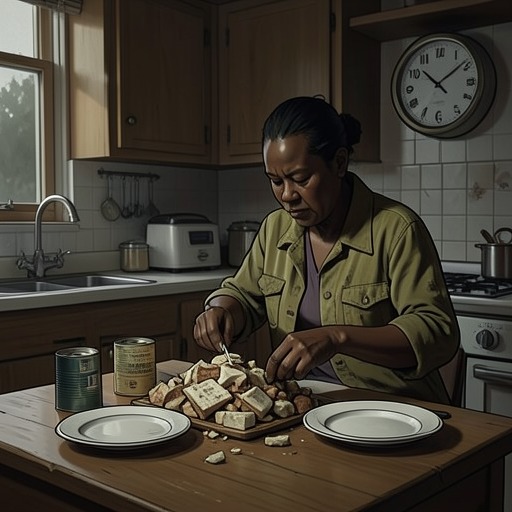
The consequences appeared at once in the menu. The residents could no longer fry potatoes for breakfast, a practice they had used to save bread, and substituted hot cereal. Lunch consisted of mashed potatoes and pickled kale. With no fat, butter, or margarine expected from the next day, even a familiar method of preparing food had to be abandoned. Anne describes the kale as so old and foul-smelling that she pressed a handkerchief scented with prewar perfume over her nose and mouth while sitting at the oilcloth-covered table. The potatoes were also so damaged that one bucket in every two ended up in the garbage. The sequence shows rationing’s limits as a guarantee: possession of a few books could not prevent meals from becoming monotonous, unpleasant, and partly unusable when coupons, fats, and reliable shopping were missing.
That strain had a social cost. Anne writes that the tedious existence was making the residents disagreeable, and connects the worsening food situation to their deteriorating relations. The kitchen became a place where shortage was smelled, tasted, and argued over, not an abstraction imposed from outside. Rationing could not by itself explain every quarrel in the Annex, but the unequal distribution of butter and margarine, the loss of coupons, and the effort required to obtain and prepare food gave existing tensions daily material form.
Rationing, information, and collective survival
Rationing also depended on administrative procedures that people in hiding had to navigate without drawing attention. In Gelderland, according to a story reported by Mr. Kleiman, a soccer match took place between a team made entirely of men in hiding and a team of eleven Military Policemen. In Hilversum, new registration cards were issued so people in hiding could obtain rations: those who needed cards were told to collect them at a specified hour from a separate table. Without the required registration card, a person could not obtain a ration book or would have to pay 60 guilders for one. The arrangement offered a route into the ration system, but its very visibility made discretion essential; Anne notes that such schemes had to be kept from German ears.
News and communication could likewise affect how the residents understood the outside world, though access to the radio was governed by security rules rather than by ration coupons. The Annex’s prospectus allowed residents to use the private radio after 6 P.M., while forbidding German news bulletins and restricting German stations to classical music. On another occasion, fear that neighbors might hear an illicit broadcast led Anne to beg Otto Frank to take her back upstairs; Edith Frank understood her anxiety and accompanied her. These details reveal the shared predicament behind both systems of control: resources and information were available only under rules shaped by the threat of discovery.
As conditions worsened, losing the large radio also became a matter of compliance and morale. When the authorities ordered radios handed in, Mr. Kugler supplied a small replacement set hidden in his home. The residents regretted surrendering the large Philips, but Anne recognized that keeping it could attract the authorities. The smaller clandestine radio became a substitute, like hot cereal for fried potatoes or black-market coupons for official ones: an imperfect means of preserving access under pressure. In June 1944 the BBC announced the Normandy landings, and reports of the invasion filled the Annex with a hope that victory might finally be approaching. The diary’s account of rationing therefore belongs to a wider history of constrained survival: coupons and prices determined what could be put on the table, while fragile networks of helpers, exchange, and news sustained the people waiting behind closed windows.