Fear of discovery
Diary of Anne FrankFear of discovery shapes the residents’ daily life in the Secret Annex, where small sounds and uncertain movements can threaten the concealment on which their survival depends. In Anne Frank’s diary, the fear is not simply suspense: it grows from the Nazi persecution that has restricted Jewish life, driven people from their homes, and made hiding seem the only escape. The diary traces how vigilance becomes routine, how an ambiguous noise can set the whole household on alert, and how the prospect of discovery coexists with the residents’ efforts to imagine a future.
Roots of the Fear
The danger begins outside the hiding place. Before the family’s life in the Annex, Anne records relatives in Germany suffering under Hitler’s anti-Jewish laws; after the pogroms of 1938, her two maternal uncles fled to North America, and her grandmother came to live with the family. Following the German occupation of the Netherlands in 1940, anti-Jewish decrees sharply narrowed where Jews could go, when they could be outside, and what public activities they could pursue. The yellow star and restrictions on transport, shopping, schools, and recreation made persecution part of ordinary life rather than a distant political threat.
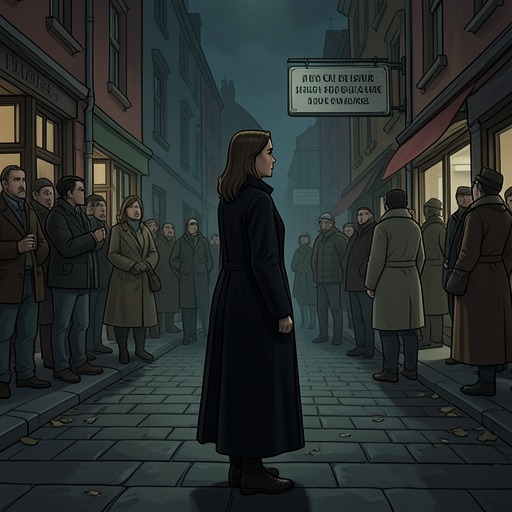
As Anne learns more about what is happening beyond the Annex, the fear acquires a wider human context. After Fritz Pfeffer joins the residents, he tells them that friends and acquaintances have been taken away, and describes military vehicles searching house by house for Jews. Anne writes of families being removed and of people forced along under guard; the knowledge that those outside cannot easily escape makes hiding seem both necessary and precarious. She also describes the painful contrast between the relative safety of the Annex and the suffering of people she cannot help. The threat is therefore not only that the residents may be found, but that safety itself depends on separation from those facing deportation.
Everyday Vigilance
The diary shows fear arriving through ordinary sounds. On one occasion, a doorbell rings at eight o’clock, and Anne immediately thinks that someone has come to get the residents. The others suggest that it may be pranksters or the mailman, and she calms down, but the episode reveals how quickly uncertainty becomes a possible warning. In the Annex, there is little room for a sound to remain merely a sound: it must be considered for what it might mean for everyone in hiding.
Silence is one of the residents’ practical defenses. Anne describes the household staying quiet while a Jewish pharmacist, Mr. Levinsohn, works in the building and might decide to inspect the former laboratory. The diary sets this enforced stillness against Anne’s former liveliness: she calls herself quicksilver, yet notes that she can now sit quietly for hours. Fear thus appears not only in moments of alarm but in a sustained discipline of movement and sound, demanded by the building’s shared spaces and the possibility of an unwelcome visitor.
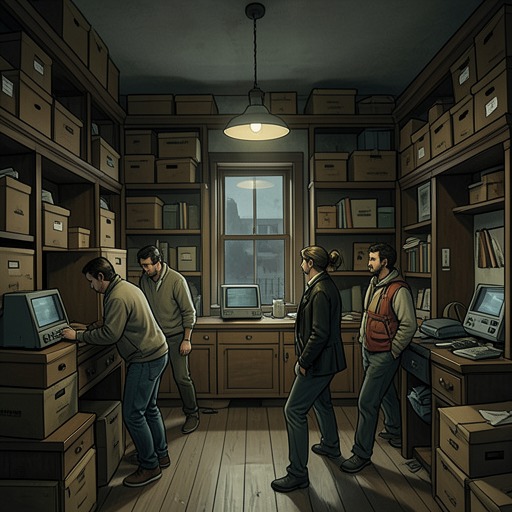
A more acute scare develops when a carpenter comes to work on the building’s fire extinguishers. The office staff have not warned the residents, so they do not know who is hammering near the concealed entrance. Anne alerts Bep, who is eating lunch, that she cannot go back downstairs; Anne and her father listen from the door. When the carpenter knocks and pulls and pushes at the bookcase, the residents fear that he has discovered the entrance. The immediate explanation is mechanical: the hook fastening the bookcase has stuck, preventing the warning from reaching them. Once Mr. Kleiman identifies himself, the door can be opened and the danger passes. Anne’s account makes the concealed bookcase both a safeguard and the focus of the household’s vulnerability: its failure to open at the expected time turns a routine repair into a possible discovery.
Suspicion, Imagination, and Uncertainty
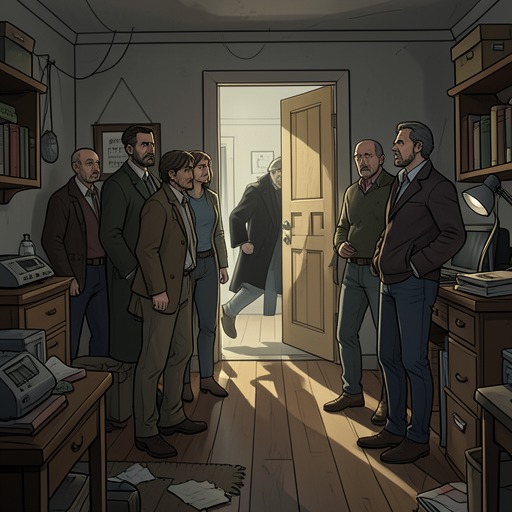
In March 1943, a noise in the warehouse raises the possibility that someone is at the door. Peter tells Anne’s father that he has heard a barrel fall and someone fiddling with the door; Anne turns pale as the household waits. Peter and Anne’s father go downstairs, while the others listen and try to remain quiet. The household gathers again when more noises are heard, and the men eventually check the office. Peter carries a heavy hammer, but they find no sign of activity. The precautions themselves create further risks: everyone avoids running water or flushing the toilet, while coughing and creaking stairs make quiet difficult.
The episode does not end with a confirmed intruder. The residents decide that whoever may have entered probably ran off after hearing footsteps, but they also consider other explanations: the warehouse manager next door may have been at work, and sounds may have been mistaken through the thin walls. Anne recognizes that danger can make imagination distort what is heard. Yet uncertainty does not restore calm. The Westertoren bells have stopped, and the residents are unsure whether the outside door has been locked; even after checking that morning and finding it secure, Anne says she and others had little sleep. The diary preserves the gap between what can be established and what fear makes possible: the building is safe when inspected, but the night has already been lived as a threat.
Rules, Identity, and the Uncertain Future
The danger of discovery produces changes to how the Annex operates. Later, Dussel is assigned to work in the bathroom, Peter is to patrol the house between eight-thirty and nine-thirty, and he is no longer allowed to leave his window open after someone from the neighboring company notices it. The residents are told not to flush the toilet after nine-thirty. A night watchman is hired, and a carpenter from the underground is expected to make a barricade from the white Frankfurt bedsteads. These measures show fear becoming organized as a set of rules, assignments, and physical defenses; the residents must continually assess who can be trusted and what a sound, open window, or unlocked door might expose.
Anne also connects the imposed confinement to Jewish identity. In a later reflection, she describes Jews as chained to one spot, without rights but burdened with obligations, and insists that the time will come when they can be people again and not just Jews. The danger is therefore both immediate and political: discovery could end the concealment, while the restrictions that make hiding necessary already separate Jews from ordinary civic life. Anne’s statement does not resolve that tension; it holds together the hope of survival and the recognition that the residents are being defined and confined by persecution.
That hope is complicated by news of anti-Semitism and the possibility that German Jews who had immigrated to the Netherlands might not be allowed to return after the war. Anne wonders what freedom, truth, and justice can mean if Jews are still treated as lesser beings before the war has ended. Nevertheless, she says she loves Holland and had hoped it would become a fatherland after she lost her own. The fear of discovery thus reaches beyond the concealed rooms: it is linked to the uncertainty of whether safety and belonging will remain possible outside them.
Diary, Witness, and Consequence
The diary’s account of fear is also a record of what its author could know from within hiding. Anne writes of sounds, conversations, precautions, and news brought into the Annex; her descriptions of deportations and danger beyond it include what she has been told, rather than an all-seeing account of events outside. This distinction gives the fear its particular form. The residents must make decisions with incomplete information, interpreting noises in the building and relying on reports from people who can move between the hidden household and the occupied city.
The diary itself had more than one intended form. Anne began writing for herself, then, after hearing a radio appeal from Gerrit Bolkestein for wartime letters and diaries to be preserved, decided to prepare a book for publication and began revising her original entries while continuing to keep the diary. Her account of hiding therefore belongs both to immediate private record and to a deliberate effort to make experience available to later readers. The fear of discovery is recorded in specific incidents, but its recurrence also makes visible the conditions behind them: a life made quiet by danger, sustained by precautions, and repeatedly interrupted by the possibility that the concealment may fail.