Guilt over being safe while others suffer
Diary of Anne FrankGuilt over being safe while others suffer is a recurring moral conflict in Anne Frank’s diary, where the refuge of the Secret Annex stands against the persecution and deprivation she learns are taking place outside. Anne’s safety does not erase her fear for friends or her awareness of those who cannot escape; instead, it makes ordinary comfort feel troubling and happiness difficult to accept without qualification.
Origins in Persecution and Separation
The conflict grows from a history in which Jewish identity increasingly determines the boundaries of everyday life. Anne recalls that relatives in Germany suffered under Hitler’s anti-Jewish laws. After the 1938 pogroms, her two maternal uncles fled to North America, and her elderly grandmother came to live with the family. This earlier displacement makes clear that the danger did not begin with the family’s eventual confinement: persecution had already separated relatives and reshaped the household.
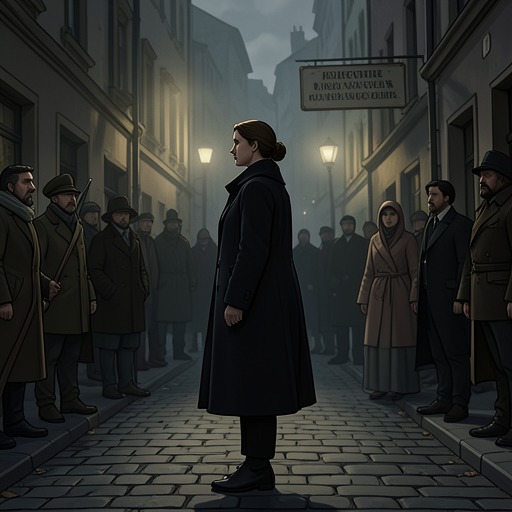
After Germany occupied the Netherlands in 1940, a series of decrees restricted Jewish life. Jews had to wear a yellow star and surrender their bicycles; they faced limits on transport, shopping hours, movement at night, access to entertainment and sports, and visits to Christian homes. Anne’s compressed account of these prohibitions conveys how restriction accumulated across the day. The repeated curtailment of ordinary freedoms forms the background to the later contrast between her relative safety in hiding and the vulnerability of people outside.
That safety is also shaped by loss within the family. Anne’s grandmother became ill and underwent an operation in the summer of 1941; she died in January 1942. The birthday celebration that year was meant to make up for earlier celebrations that had been subdued, and the family lit the grandmother’s candle along with the others. The memory links grief to an ordinary domestic ritual: a small act of remembrance persists inside a life increasingly organized by danger.
Safety Measured Against Others’ Suffering
When Fritz Pfeffer tells the Annex residents what has happened beyond their isolated world, the news changes the meaning of their shelter. Anne records reports of military vehicles searching houses for Jews, families being taken away, and people being marched under guard. These are accounts relayed to those in hiding, not scenes Anne claims to have witnessed herself. Their force lies partly in the distance between the reported events and the enclosed life from which she hears of them.
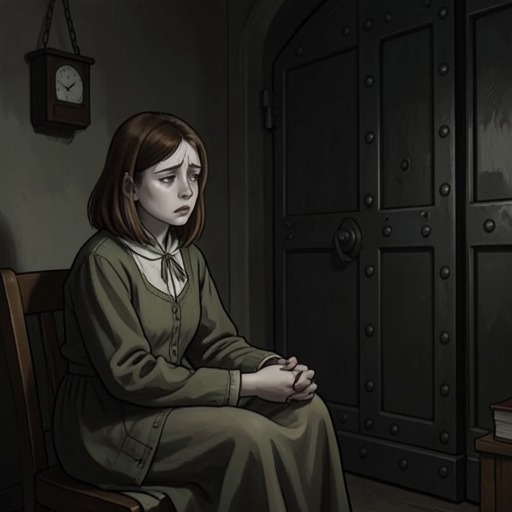
Anne describes the residents as fortunate to be away from the turmoil, but that fortune brings no uncomplicated relief. She is troubled by sleeping in a warm bed while friends may be exhausted or harmed, and frightened by the thought that people close to her are at the mercy of violent persecutors. The contrast is specific and intimate: security is measured not against an abstract idea of danger but against the known vulnerability of friends whom she can no longer help.
The news also complicates the Annex’s emotional life. Anne recalls that before these accounts reached them, the residents tried to remain cheerful; when Miep mentioned the fate of a friend, Anne’s mother or Mrs. van Daan might begin to cry, so Miep stopped sharing such news. After Fritz tells them more, the stories become difficult to put out of mind. Anne recognizes the temptation to return to joking and teasing, both because sustained gloom cannot help those outside and because life inside the Annex must continue. Yet laughter itself becomes morally charged: she catches herself enjoying it and then feels that cheerfulness is a disgrace. Her question is not resolved by choosing either grief or gaiety; she rejects the idea that she can spend every day crying, while acknowledging that the suffering remains present in her thoughts.
Privilege, Scarcity, and the Wider War
Anne’s sense of guilt extends beyond fear for particular friends. She compares the relative quiet and safety of the Annex with the lives of people who are hungry, displaced, or forcibly separated. Reports describe families torn apart, children returning from school to find parents gone, and Dutch Christians living in fear because their sons are being sent to Germany. The war’s consequences therefore reach beyond Jewish families, even as Jewish persecution remains central to Anne’s account.
This contrast is sharpened by the Annex residents’ limited but real capacity to use their money to buy food. Anne calls them selfish for discussing the clothes and shoes they hope to enjoy after the war instead of saving every penny to help others afterward. The self-accusation shows that her concern is not only that others suffer while she is safe; it is also that safety may encourage people to make plans for their own future without adequately considering those who have been left with less.
The surrounding scarcity gives that concern concrete form. Anne describes children in the neighborhood wearing thin shirts and wooden shoes, without coats, caps, or stockings, and walking to cold classrooms while hungry. Some stop passersby to beg for bread. The diary places this visible deprivation beside the Annex’s food and its anticipation of postwar possessions, making the difference between shelter and hardship impossible to treat as a matter of simple luck alone.
Nor does Anne present the conflict as something she can resolve by taking action from within hiding. She says that she could write at length about war’s suffering but would only make herself more miserable; for the time being, those waiting must wait as calmly as possible. The formulation encompasses Jews and Christians, while refusing to confuse their circumstances: all are caught in a conflict whose end is uncertain, and many are waiting for death. The recognition of shared exposure does not cancel the particular persecution that has made Jewish people targets.
Identity, Belonging, and the Limits of Safety
By 1944, the relationship between safety and Jewish identity is expressed with particular force. After an incident heightens the Annex residents’ security concerns, practical restrictions and precautions are added. In the same context, Anne reflects that they are Jews “in chains, chained to one spot, without any rights, but with a thousand obligations.” The phrase connects confinement to a wider condition: hiding protects the residents from immediate discovery, but it does not remove the imposed status and obligations that define their lives under persecution.
Anne’s reflection moves from constraint toward a collective hope that the residents will again be people, not only Jews. Yet she does not imagine that survival means shedding Jewish identity. She insists that they will continue to be Jews, and considers the possibility that the endurance of Jewish people may itself bear witness to goodness and survival. The passage reframes identity: it is forced into prominence by discrimination, but it is also something Anne anticipates affirming willingly. The hope of eventual freedom therefore coexists with recognition that hiding offers neither rights nor a secure future.
Her attachment to the Netherlands reveals a related tension between refuge and belonging. Anne hears that some people in underground circles believe German Jews who immigrated to the Netherlands before the war and were later sent to Poland should not be allowed to return, despite having received asylum. She is disturbed that a country’s stated commitment to freedom, truth, and justice can coexist with proposals to exclude Jews. The possibility of having to leave the Netherlands makes the limits of welcome feel immediate, even before the war has ended.
Still, Anne says she loves the Netherlands and had hoped it would become a fatherland after she had lost her own; despite the threat of rejection, she hopes that it may yet do so. This attachment prevents her account from reducing the country to either a safe haven or a place that has turned against her. Her hope persists alongside awareness that Jewish refugees may be judged collectively and denied return. Safety, in this reckoning, means more than avoiding immediate capture: it also involves whether a persecuted person can belong without being made to answer for an entire group.
The Diary as Witness and Moral Record
The diary’s account of guilt depends on a distinction between what Anne experiences in hiding and what she learns through others. The details of raids, deportations, and hardship outside reach her through reports, including those passed on by Fritz Pfeffer and Miep. Her writing does not make her an eyewitness to every event she describes. Instead, it records how distant news enters the Annex and alters the residents’ sense of comfort, fear, and obligation.
The diary itself also has a layered history. Anne first wrote for herself, but in 1944, after hearing Gerrit Bolkestein discuss collecting wartime eyewitness accounts, she decided to prepare a book based on her diary. She revised and edited one version while continuing her original diary. The published text later drew on different versions, and its early edition omitted some passages for reasons including length, contemporary conventions, and respect for people described. This history matters to the theme: Anne’s moral unease appears in a record that she began to reshape into testimony, an effort to make private experience speak beyond the refuge in which it was written.
The feeling does not end in an easy reconciliation between gratitude and guilt. The Annex remains a place of comparative safety, but that safety is shadowed by the friends Anne cannot help, the children without enough to eat, and the uncertainty of whether Jews will be welcomed even after the war. Her diary holds these realities together rather than allowing comfort to erase suffering or sorrow to erase the need to live. In that unresolved tension, guilt becomes a form of attention: it marks the distance between Anne’s protected circumstances and the people whose danger remains present in her thoughts.