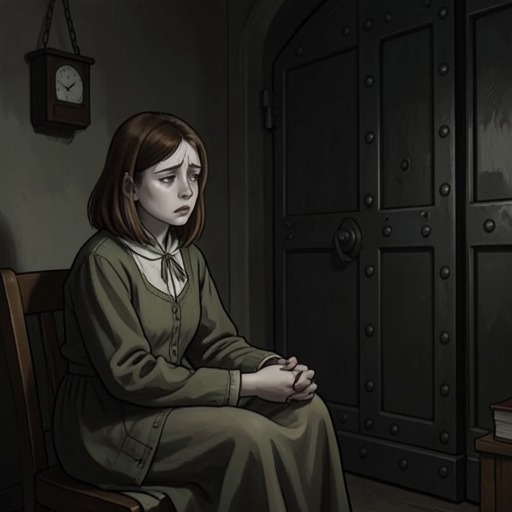
Hanneli Goslar
Diary of Anne FrankHanneli Goslar, known as Lies at school, is one of Anne Frank’s school friends and a recurring presence in the diary’s picture of life before hiding. Anne’s brief descriptions give her a distinct character: shy and reserved in company, outspoken at home, and willing to say what she thinks. As the diary’s world narrows under persecution, Hanneli also becomes part of the contrast between Anne’s own comparative safety in the Secret Annex and the people outside who are exposed to deportation.
Identity and Background
Anne introduces Hanneli among the girls in her school circle. On Anne’s birthday, Hanneli comes to collect her before school; after gym, she returns home with Ilse Wagner and Jacqueline van Maarsen, who are in the same class. Anne recalls that Hanneli and Sanne Ledermann had once been her two best friends, known together as “Anne, Hanne and Sanne.” The account distinguishes this earlier closeness from Anne’s later description of Jacqueline as her best friend.
Anne’s portrait of Hanneli is affectionate but not idealized. She says that Hanneli is usually shy, though outspoken at home, and reserved around other people. She also notes that Hanneli repeats things told to her to her mother, a habit Anne initially presents as a weakness. The diary then marks a change in Anne’s judgment: lately, she has come to appreciate Hanneli a great deal because Hanneli says what she thinks. Candor, rather than social ease, becomes the quality that draws Anne closer to her.
School and Friendship
Hanneli and Anne’s friendship is rooted in their school years and in the everyday company of classmates. On Anne’s birthday, their shared routine includes going to school together, celebrating among classmates, and returning home with other girls from their class. The diary places these ordinary events alongside Anne’s recollection of Hanneli as one of her closest friends, making their bond part of the social world that existed before the family went into hiding.
That world was already being reshaped by the requirement that Jewish children attend Jewish schools. Anne records that she and Hanneli were accepted conditionally at the Jewish Lyceum after the head of the Montessori School, Mr. Elte, was persuaded to accept them. Hanneli passed the year but still had to repeat her geometry examination. The school change therefore joins a personal account of friendship to a restriction imposed on Jewish children under occupation.
Anne also describes the difficulties Hanneli faced in trying to study at home. Her two-year-old sister Gabi played in her room, and when the child did not get her way, she screamed; Anne says Hanneli was also shouted at if she failed to look after her. Their household included Hanneli’s grandparents, who lived next door but ate with the family, a hired girl, an often-absent father, and a nervous mother expecting another baby. In Anne’s account, the crowded and demanding home leaves Hanneli struggling to do homework, while the tutoring she receives cannot readily overcome those conditions.
Separation and the Diary’s Wider Witness
The diary’s later entries place friendship under the pressure of news from outside the hiding place. After Fritz Pfeffer joins the residents of the Secret Annex, Anne records his account of friends and acquaintances being taken away. She describes the searches as information learned from someone newly arrived from the outside, rather than as something she herself witnessed: military vehicles go from house to house, and people identified as Jews are taken away. This news changes the emotional meaning of the friends Anne can no longer reach or help.
Anne returns to the same divide when reflecting on the dangers facing people beyond the Annex. She writes that families are separated and that children can return from school to find their parents gone. The diary sets those reports against the residents’ relative safety and Anne’s guilt at being warm and sheltered while people she cares about are suffering. Hanneli’s earlier place in Anne’s school life gives that concern a personal dimension, though the cited diary passages do not describe a specific later encounter between the two girls.
Textual and Historical Context
The diary itself has a layered history. Anne first kept it for herself, then, after hearing Gerrit Bolkestein of the Dutch government in exile call for wartime eyewitness accounts to be collected after the war, began revising it with publication in mind while continuing her original diary. This distinction between her initial writing and her revised version matters to an account of Hanneli: Anne’s descriptions of friends belong to a work she was both recording and deliberately reshaping.
After Anne’s arrest, her diary manuscripts passed from Miep Gies to Otto Frank, who combined material from Anne’s two versions for the first published edition. He omitted passages for reasons that included the limits of the book’s length and the conventions of its 1947 publication. A later expanded edition restored additional material from Anne’s earlier and revised texts. Hanneli’s brief, sharply observed portrait survives within this broader process of revision and publication, preserving a friendship remembered through Anne’s own changing assessments.
The historical account records that the eight residents of the Secret Annex were arrested, taken first to a prison in Amsterdam, and then transferred to Westerbork. They were deported on September 3, 1944, in the last transport to leave the camp and arrived three days later in Auschwitz. This aftermath establishes the fate of the group Anne had been living with; it does not, in the evidence cited here, establish Hanneli’s later fate or describe what became of her friendship with Anne.