Hope for the war's end
Diary of Anne FrankHope for the war’s end is a recurring, hard-won orientation in Anne Frank’s diary: not assurance that liberation is near, but an effort to recognize signs of change without mistaking them for a conclusion. Allied landings and news from the front lift spirits; reports of persecution and scarcity keep that hope sharply bounded. The radio gives the people in hiding a voice from the outside world, while Anne’s diary records the distance between the possibility of an ending and the suffering that continues in the meantime.
News as a Measure of Possibility
When news arrived that the English had landed in Tunis, Algiers, Casablanca, and Oran, the report became the biggest surprise of Peter’s sixteenth birthday. The response was immediate: everyone was saying that it was the beginning of the end. Yet Anne set that shared excitement beside Churchill’s more cautious formulation, distinguishing the end itself from the end of its beginning. The difference mattered because it allowed hope without presenting victory as already secured. In the same passage, the continuing resistance of Stalingrad—still not in German hands after three months under attack—offered another reason to remain optimistic, but not proof that the war was close to over.
Later, the Allied landing in Sicily again raised expectations inside the Secret Annex. Anne notes that her father was ready for a quick finish, as she considered whether the authorities might approve her going outside for an eye examination. The prospective outing remained subject to delay and risk; military news could change the mood, but could not immediately dissolve the constraints of hiding. Hope enters this episode as expectation made vivid by an ordinary possibility—a walk to an ophthalmologist—while the decision itself remains unresolved.
The War Beyond the Annex
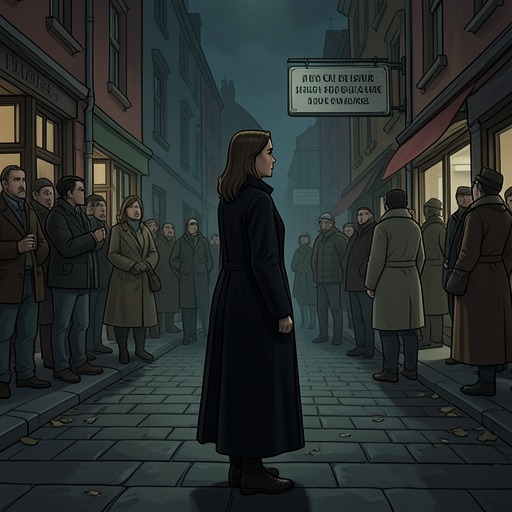
Anne’s sense of possible relief is set against a record of what the war is doing to others. People are taken from their homes at all hours and permitted only a small amount of luggage and money, which may be stolen on the way. Families are separated; children return from school to find their parents gone, and women come back from shopping to find their homes sealed and their families missing. The diary places the persecution of Jews alongside the fear of Dutch Christians whose sons are being sent to Germany, without suggesting that these experiences are identical. Fear has spread across the country even as the forms of danger differ.
The wider conflict makes any simple promise of a near end impossible. Hundreds of planes cross the Netherlands nightly on their way to German cities, while people are killed in Russia and Africa by the hundreds or thousands each hour. Anne observes that the Allies are doing better, but the end is nowhere in sight. The scale of events reaches beyond what the residents can control or fully know; hope depends on fragments of news, while the diary’s attention to forced removals and family loss prevents those fragments from becoming an easy reassurance.
Privilege, Scarcity, and Uneasy Hope
The safety of the hiding place is relative, and Anne recognizes it as such. The residents have quiet, shelter, and money with which to buy food, making them more fortunate than millions of people outside. That good fortune produces unease rather than uncomplicated gratitude: they talk about life after the war and look forward to new clothes and shoes, while Anne judges their attention to future comforts against the need to save money to help others afterward. Hope therefore has an ethical tension. The imagined future is a source of comfort, but it also exposes how sharply the residents’ protected circumstances contrast with widespread deprivation.
That contrast is made concrete in the children nearby. They wear thin shirts and wooden shoes, lack coats, caps, and stockings, and walk from cold homes through cold streets to cold classrooms. Some stop passersby to beg for bread. Anne admits that she could write for hours about wartime suffering, but that doing so would make her more miserable. Her response is not to deny what she has witnessed: she turns instead to the limited task of waiting as calmly as possible. Jews and Christians alike wait, she writes, while many wait for death. Hope sits inside that sentence beside a fact that resists consolation.
The Radio as a Sustaining Link
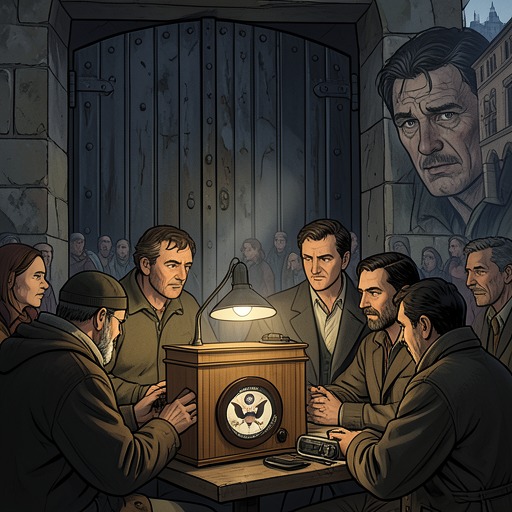
The prospect of surrendering the large radio to the authorities threatens one of the Annex’s means of contact with events outside. The residents are due to hand it over, but Mr. Kleiman has a small set hidden at home and is to provide it as a replacement. Anne regrets losing the large Philips, yet accepts that hiding requires avoiding attention from the authorities. The change in equipment is more than a practical inconvenience: it shows how the residents must adapt their access to news to preserve their concealment.
Outside the Annex, people are also trying to obtain old radios to surrender in place of their morale-boosting sets. Anne describes the radio’s voice as helping listeners withstand worsening reports and keep telling themselves to cheer up and maintain their spirits because conditions are bound to improve. That encouragement does not erase the alarming news; it becomes necessary precisely because the news is so bad. The radio sustains hope as a repeated practice of listening and self-reassurance, not as evidence that danger has passed.
A Hope Without a Guaranteed Ending
Across these entries, hope repeatedly rises with military developments and is checked by the continuing realities of occupation, deportation, hunger, and fear. Churchill’s distinction keeps expectation from collapsing into premature certainty; the fate of Stalingrad and the landing in Sicily offer grounds for optimism, while the suffering around the Annex makes the cost of waiting unmistakable. The clandestine radio gives the residents a way to follow the war and preserve their spirits, but the diary never treats better news as a guarantee of safety.
Anne’s account holds two scales of time together: the urgent present of people being taken from their homes and children going hungry, and the hoped-for future in which the war ends and aid might be given to others. The result is neither despair alone nor easy confidence. Hope remains a fragile, practical response to uncertainty—fed by reports, qualified by what is still happening, and sustained by the effort to wait.