Italian surrender
Diary of Anne FrankThe Italian surrender, announced to the residents of the Secret Annex on September 8, 1943, briefly turns the radio from a source of distant war news into a herald of possible change. Anne’s diary preserves both the public announcement and the intimate force of hearing it together, against the ongoing threat and sorrow that shape life in hiding.
The Announcement
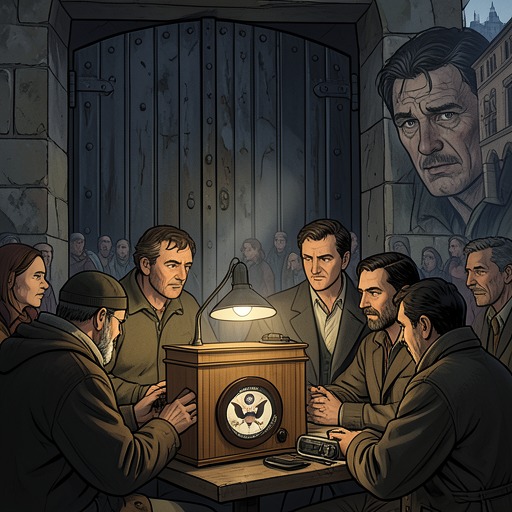
On Wednesday, September 8, the residents were listening to the seven o’clock news when they heard the announcement that Italy had capitulated. Anne calls it some of the best news of the war so far. The news was confirmed in the Dutch broadcast from England, which began at eight-fifteen with a reporter’s delighted account of receiving word of the capitulation an hour and fifteen minutes earlier.
The broadcast’s response made the announcement feel like more than a military update. The reporter said he had never thrown his notes into the wastepaper basket with greater delight. The program then played “God Save the King,” the American national anthem, and the Russian Internationale. Anne describes the Dutch program as uplifting without being too optimistic: celebration was present, but the broadcast did not claim the war was over.
The Military Context
The diary places the surrender within a rapidly shifting Italian campaign. Anne records that the British had landed at Naples, while northern Italy was occupied by the Germans. She also notes that the truce had been signed on Friday, September 3, the day the British landed in Italy. The announcement on September 8 therefore carried news of a formal capitulation alongside reports of continuing military movement and German control in the north.
Anne adds that German newspapers were denouncing the actions of Badoglio and the Italian king as treachery. The contrasting reports expose the political divisions surrounding the surrender: the Dutch broadcast presented it as welcome news, while German newspapers framed it as betrayal. The diary records these accounts as received by listeners in hiding, rather than as a firsthand view of events in Italy.
News in the Annex
The importance of the announcement lies partly in the conditions under which it was heard. The residents depended on broadcasts for news of a war unfolding beyond their concealed rooms; listening together gave a distant military development an immediate place in their shared daily experience. In earlier diary entries, news of the persecution and deportation of Jews had reached the Annex through helpers and visitors, and had left its residents struggling to reconcile their relative safety with the suffering outside. The Italian surrender offered a contrasting report, though it did not erase that knowledge or remove their danger.
The diary’s account is carefully bounded. It records the time of the announcement, the broadcast’s celebratory tone, the reported landings and truce, and the German press reaction. It does not suggest that the capitulation brought freedom to those in hiding or ended the wider war. Its significance in the narrative is a momentary shift from grim reports toward hope, held within the same uncertainty that governs the Annex’s dependence on news from outside.