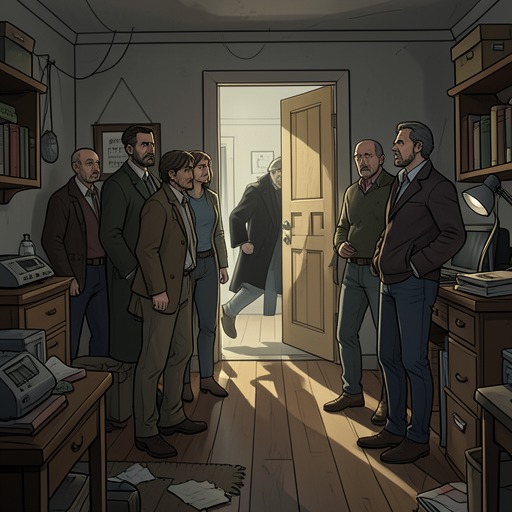
July 1943 burglary of the Secret Annex
Diary of Anne FrankThe July 1943 burglary of the Secret Annex turned an ordinary break-in into a direct test of the hiding place’s security. The thieves forced their way into the office building below the concealed living quarters, and the discovery set off a day of silence, uncertainty, and waiting. Though the burglars did not reach the residents, they took the sugar coupons on which the household and its helpers depended, making the intrusion both a security scare and a material loss.
Causes and Setting
The Annex occupied part of the office building where Otto Frank had worked. Its concealment depended on the distinction between the public-facing warehouse and the hidden rooms above: people who worked in the warehouse had not all been told that the residents were there. That arrangement made the building useful as a hiding place, but also meant that an intruder moving through its lower floors could come close to the secret without necessarily knowing it existed.
The burglary occurred against a background of repeated restrictions and danger. Under the German occupation, anti-Jewish decrees had stripped Jews of ordinary freedoms, while the Annex residents had to keep their presence undiscovered. Their hiding plan had already been brought forward after Margot Frank received a call-up notice; the burglary later showed that concealment required more than a hidden entrance. The ordinary commercial spaces beneath the Annex remained vulnerable to forced entry.
Discovery and Response
Peter van Pels went down to the warehouse at seven in the morning, as usual, and immediately noticed that both the warehouse door and the street door were open. He reported the discovery to Otto Frank, referred to in the diary as Pim. Otto went to the private office, tuned the radio to a German station, and locked the door before the two returned upstairs. The residents did not know at first what had happened or whether the intruders might still be nearby.
The household followed its standing emergency rules: no washing or running water, no unnecessary noise, dressing by eight, and no trips to the bathroom. They complied, relieved that they had slept through the break-in, but the silence imposed a new strain. No one from the office came upstairs during the morning, and the residents remained on tenterhooks until Johannes Kleiman arrived at eleven-thirty with news.
Kleiman explained that the burglars had forced the outside door and the warehouse door with a crowbar. Finding nothing worth taking there, they tried the next floor. Their route through the building brought them beyond the warehouse, nearer to the rooms and offices connected with the hidden household, even though the diary does not report that they entered the Annex itself.
Losses and Security Consequences
The burglars took two cashboxes containing 40 guilders, blank checkbooks, and, most damagingly, coupons for 330 pounds of sugar. The coupons represented the residents’ entire sugar allotment, and replacing them would not be easy. The loss mattered beyond its monetary value: in a rationed and increasingly precarious household, the coupons were a practical guarantee of food supply, and their disappearance sharpened the consequences of a breach downstairs.
The residents were relieved that the cash register and typewriters had been hidden safely in a clothes closet. Yet the burglary made clear that ordinary precautions could protect some valuable objects while leaving the building’s supplies and security exposed. The house was neither an abstract refuge nor a sealed world: its usefulness depended on people working below, goods moving through it, and doors that could be forced.
Otto Kugler suspected the burglar belonged to the same gang that had tried unsuccessfully about six weeks earlier to open all three doors—the warehouse door and the two outside doors. The earlier attempt made the new intrusion feel less like an isolated mishap. It suggested recurring pressure on the building and gave the occupants reason to consider whether a pattern of attempted entry might eventually bring someone closer to discovering them.
Aftermath and Significance
Anne Frank records the episode with a mixture of alarm and dry understatement, observing that the Annex seemed to thrive on excitement. That tone does not erase the danger: the household had to stop ordinary activities, wait without information, and reckon with a serious loss before learning that the burglars had not reached the hidden residents. The shift from routine morning to enforced stillness makes the building’s vulnerability tangible.
The incident also foreshadowed the heightened precautions that would follow other security scares. Later, after another intrusion raised new concerns, Peter was assigned to patrol the house, restrictions were placed on windows and toilet use, and a barricade was planned from white bedsteads. In that broader pattern, the July burglary stands as an early demonstration of how the residents’ safety depended on small, material safeguards—and how a break-in motivated by theft could threaten far more than property.