March 1944 burglary of the Secret Annex
Diary of Anne FrankThe March 1944 burglary of the Secret Annex made the danger of discovery feel immediate again: an intruder had apparently entered the office without forcing a door, taken property, and left the residents unable to tell who had access or whether the person might return. Told through Anne Frank’s diary, the episode moves from a puzzling scene encountered the previous evening to the morning’s confirmation of a theft, and ends not with an identification or arrest but with questions that tighten the residents’ sense of exposure.
Setting and security
The burglary took place in the office building where the Frank family and others were hiding. The hiding place was in Otto Frank’s workplace, a building whose ground floor included a large warehouse and workrooms. The office’s ordinary business and its location among employees and visitors meant that concealment depended on controlling movement and keeping the hidden residents’ presence undiscovered. The diary describes the place as both a working commercial building and a precarious refuge, where a disturbance downstairs could carry consequences far beyond the loss of property.
The residents’ vulnerability had been created by the persecution that drove them into hiding. Under German occupation, anti-Jewish decrees restricted where Jews could go, what transport they could use, and when they could be outside; the yellow star made their identity publicly visible. The Frank family had prepared to hide in the office building, moving belongings out of their apartment over time, but Margot’s call-up notice forced the plan forward by ten days. The burglary therefore occurs within a refuge assembled under pressure, not in a place secured against intrusion.
The building was not inaccessible to outsiders. Employees worked in the warehouse, while trusted office staff knew that the family was coming to hide. An earlier burglary had already shown how a break-in could threaten supplies as well as security: intruders forced doors with a crowbar, and among the items stolen were coupons for 330 pounds of sugar, the residents’ entire allotment. The March incident is described as more complicated precisely because the evidence this time suggested entry without force.
Discovery and reconstruction
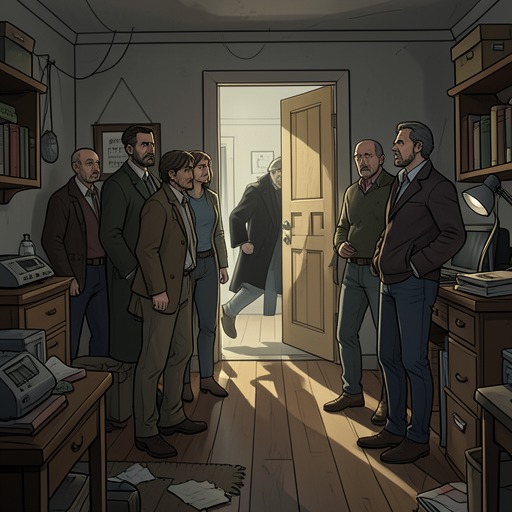
The first sign of trouble came the previous evening, when Hermann van Daan went toward Victor Kugler’s office at about seven-thirty. He found the glass door and office door open; farther in, the alcove doors were open too, and the front office was in disarray. The scene suggested that someone had been inside, but Hermann checked the front-door lock, found it closed, and concluded that Bep Voskuijl and Peter might simply have been careless. He switched off the lamp and went upstairs without raising the alarm.
The next morning, Peter came to tell the others that the front door stood wide open. A projector and Victor Kugler’s new briefcase were missing from a closet. Peter was told to lock the door. Hermann then explained what he had seen the night before, and the residents understood that the apparent disorder had not been an ordinary lapse. What had looked inconclusive in the dark became evidence of a theft once the missing objects and open entrance were discovered.
There were no signs that a door had been forced. Anne’s account presents a duplicate key as the only explanation the residents could find: the burglar must have entered early in the evening, shut the door, hidden when Hermann arrived, and escaped after he went upstairs, leaving the entrance open in haste. This is a reconstruction rather than an established identification. The diary offers a plausible sequence of actions while preserving the uncertainty at its center: no one knows who entered, how the key was obtained, or whether the intruder had noticed the hidden occupants.
Fear, consequences, and narrative form
The residents’ questions extend beyond the stolen projector and briefcase. They wonder who could possess a key, why the burglar did not enter the warehouse, and whether a warehouse employee might have been responsible. Most alarming is the possibility that the intruder heard Hermann or saw him, and might report the people hiding upstairs. The diary does not confirm that the burglar knew of the Secret Annex; it records the residents’ inability to rule that possibility out.
That uncertainty shapes the episode’s ending. Anne fears the burglar may try to enter again, but also considers whether being startled by someone else in the building might keep him away. Her postscript asks Kitty to find a trustworthy detective, with the essential condition that the person not inform on those in hiding. The request is at once practical and revealing: ordinary recourse to investigation would itself be dangerous if an investigator could expose the residents. The episode offers no reassuring resolution, only the need to assess whom it is safe to trust.
The diary’s sequence makes the burglary a study in how little the residents can know from inside concealment. The reader first encounters doors open and an office in disorder, then receives the explanation of the missing property, and finally follows Anne’s tentative reconstruction and unanswered questions. Its first-person diary form preserves the distinction between what was observed and what was feared: entry without forced doors is reported as a fact, while the duplicate key, the intruder’s movements, and possible knowledge of the Annex remain inference.
The incident also belongs to a wider pattern of security measures imposed by the repeated risk of discovery. After a later break-in, the residents’ rules included restrictions on water use and movement, and plans for a barricade made from white Frankfurt bedsteads; Peter was assigned to patrol, while a night watchman was hired. Those later measures should not be mistaken for a direct outcome of the March burglary, but they show how recurrent intrusions translated into changes in daily life. In the March account itself, the immediate consequence is psychological and practical: the residents are left to imagine the reach of an unknown person who may possess a key, while their hiding place remains dependent on secrecy rather than secure control of the building.